
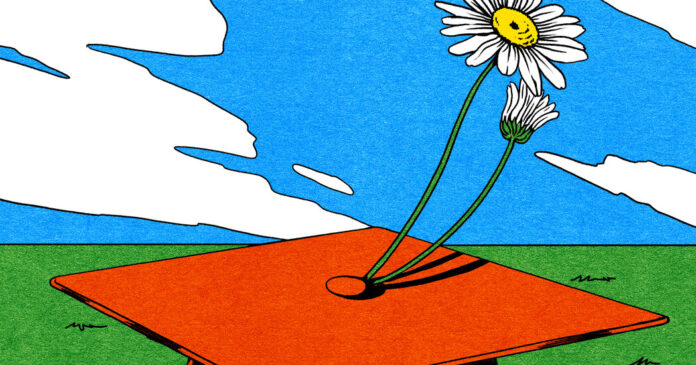

It’s the time of year for what Susan Sontag designated “that necessarily seasonal, minor literary form called the ‘commencement address.’” In the age of memeable wisdom, the commencement address has become a social-media-ready trove of inspiration whence spring bons mots like George Saunders’s “failures of kindness,” (Syracuse, 2013); Steve Jobs’s “Stay hungry, stay foolish” (Stanford, 2005); and David Foster Wallace’s “This Is Water” parable (Kenyon, also 2005).
I appreciate a sincerely delivered secular sermon exhorting me to go in the direction of my dreams, but, like any liberal arts grad, I insist on my own specialness, and the generic nature of graduation speeches often leaves me skeptical. “The world is more malleable than you think,” Bono told the University of Pennsylvania class of 2004, “and it’s waiting for you to hammer it into shape.” I want to believe in this kind of rallying cry, but the lack of specificity in such mass encouragement can make it feel a little toothless. (Is the world waiting as eagerly for the guy who spent all second semester dozing through econ to hammer?)
The best graduation speeches, I think, are the ones grounded in personal experience, the ones that ring not only sincere, but also profoundly felt. You may not be a Taylor Swift fan, but you knew she was speaking from her soul when she told N.Y.U.’s 2022 graduates: “Never be ashamed of trying. Effortlessness is a myth.” Yes! Anyone can see that Taylor Swift tries hard, that her success has come via fist-clenching, teeth-gritting effort. “The people who wanted it the least were the ones I wanted to date and be friends with in high school,” she continued. “The people who want it most are the people I now hire to work for my company.” If a billionaire is going to genuinely connect to an audience of debt-saddled grads, she has to show that she came by her wisdom honestly. She has to truly mean it.
In George Saunders’s speech, he tells a story about a girl in his seventh-grade class who was “mostly ignored, occasionally teased,” and how he could tell this hurt her. He wasn’t mean to her, he says, but, 42 years on, he regretted that when he witnessed her suffering he responded “sensibly, reservedly, mildly.” The oft-quoted line is, “What I regret most in my life are failures of kindness,” but the line that I like even better is more direct: “What’s our problem? Why aren’t we kinder?” He goes on to propose some theories, and some solutions. I love this speech because it emerges from a relatable personal experience, and it dwells in specifics rather than conceptual oratory. Every person present has their own failures of kindness. Everyone present is implicated.