
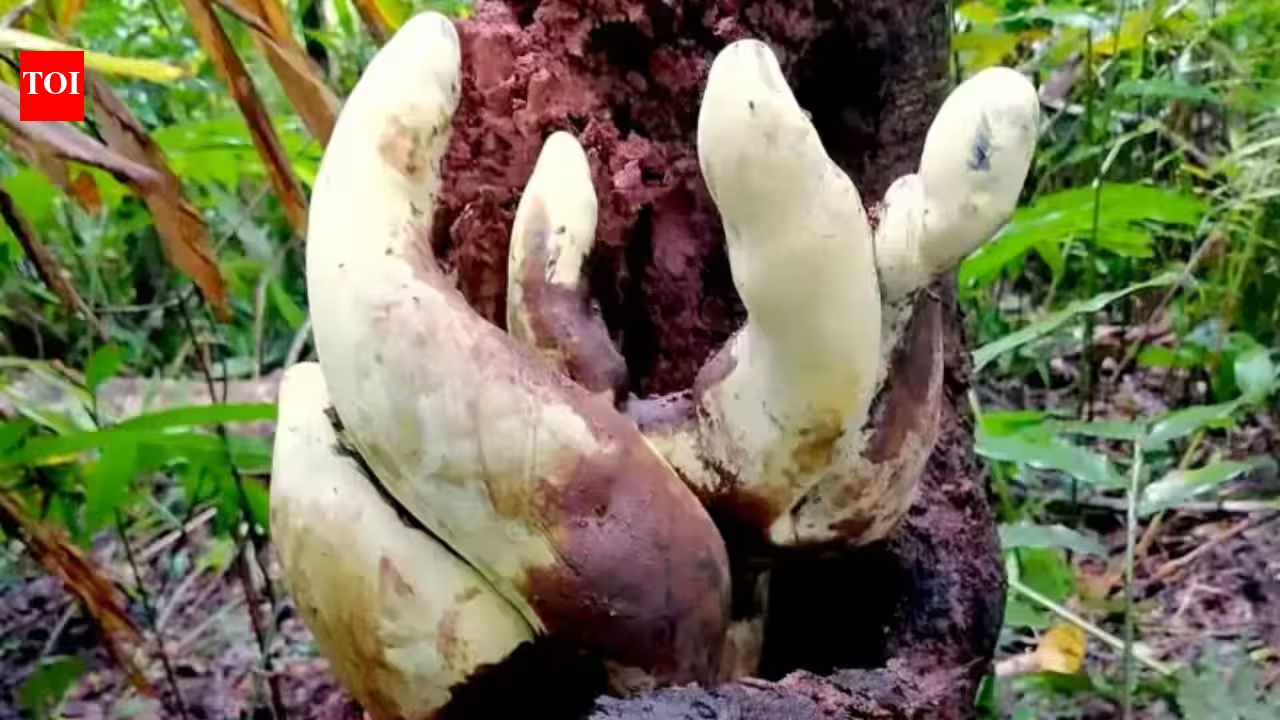

Hidden among the roots of trees in China’s lush forests, an extraordinary organism has emerged as a reminder that nature still has plenty of surprises in store. Rising nearly 20 inches above the forest floor and weighing close to five pounds, the newly identified fungus is challenging scientists’ understanding of how large certain fungal structures can become. Its remarkable dimensions are not its only distinction: genetic evidence suggests its evolutionary lineage dates back approximately 65 million years. Scroll down to read the details.
Meet D-rex, the fungal giant
Named Dianjunus rex and nicknamed D-rex, the species was discovered during surveys of forest environments in Yunnan province, southwestern China. According to ScienceDaily, researchers from the Kunming Institute of Botany encountered unusual whitish structures growing from the woody roots of Chinese cork oak trees.These structures, known as stromata, are reproductive formations that produce spores. Reaching approximately 50 centimetres in height and weighing up to 2.2 kilograms, they are the largest known fruiting bodies among fungi belonging to the phylum Ascomycota.As reported by People, previously known fruiting bodies in this group generally reached considerably smaller heights, making D-rex an exceptional discovery even within a major fungal group comprising tens of thousands of recognised species.
A new branch on the fungal family tree
The scientists initially suspected they had encountered an unfamiliar fungus. However, laboratory investigations revealed something more significant. By examining its physical characteristics, cultivating its spores and analysing its DNA, the team established that the organism was sufficiently distinct to warrant an entirely new genus and family, Dianjunaceae.ScienceDaily reports that D-rex belongs to the order Xylariales, a group known for producing specialised compounds and enzymes that help break down complex plant material. Researchers believe the newly identified fungus may similarly obtain nutrients by decomposing dead wood, although its precise ecological role requires further investigation.
An evolutionary link to the age of dinosaurs
Perhaps the most intriguing aspect of the discovery lies in its ancient origins. Using molecular-clock analysis, researchers compared the fungus’s genetic information with that of hundreds of other fungal species to estimate when its lineage first emerged.The findings suggest that Dianjunaceae originated around 65 million years ago, approximately one million years after the Cretaceous-Paleogene mass extinction that wiped out non-avian dinosaurs.According to People, this timeline has prompted researchers to consider whether the environmental upheaval following the extinction created new opportunities for wood-decomposing fungi. Changes in forest ecosystems and the availability of dead plant material may have helped ancestral fungi diversify.
Why does it grow so large?
According to ScienceDaily, scientists are still investigating what enabled D-rex to develop such towering reproductive structures. One possibility is that its height improves spore dispersal, allowing spores to catch air currents above vegetation and debris on the forest floor.However, producing such a large structure requires considerable energy. Its unusual size may therefore represent an evolutionary advantage in particular forest conditions rather than a strategy that would benefit every fungus.
More discoveries could be waiting
The finding also highlights the remarkable biodiversity of East Asian forests, where varied habitats and complex ecological relationships support unusual organisms. As ScienceDaily notes, difficult terrain, seasonal growth patterns and the often-hidden nature of fungi have made many species challenging to document.Further exploration may reveal more unexpected fungal forms, offering scientists fresh insights into evolution, forest ecosystems and the extraordinary diversity of life that remains undiscovered.Image Courtesy: Kunming Institute of Botany / Chinese Academy of Sciences