

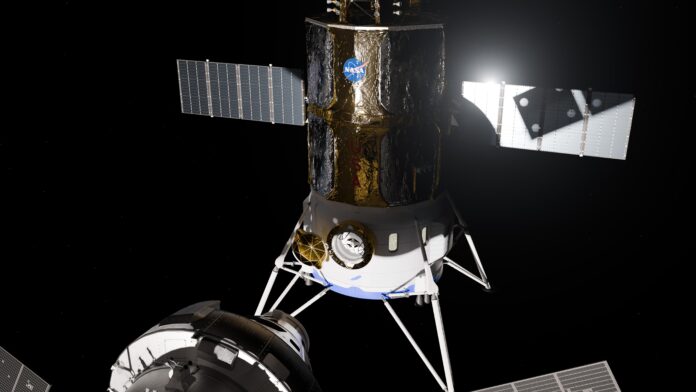
The extreme complexity of Artemis III is owing in part to a pair of decisions NASA made in 2021 and 2023 and in part to the simple limits of known rocket technology. If the engineering physics were perfect—and engineering physics are never perfect—a lunar crew could use just one spacecraft to get to the moon, land, blast back off, and return home. But a spacecraft that could do all of those jobs and remain robust enough to reenter the Earth’s atmosphere would simply be too heavy for a lunar landing and subsequent liftoff. Instead, as in the Apollo days, the job will be divided between two ships—one lightweight one to perform the landing and liftoff and one orbiting mothership to bring the crew home when the lunar exploration is done. During Apollo, the space agency selected Grumman Aircraft Engineering to build its squat, four-legged 23-ft. tall, lunar module (LM). It was a simple ship with a low center of gravity, ensuring a stable foothold on the lunar surface. Grumman inked the contract in 1962 and delivered the goods in time for Apollo 9 and the missions that followed. In 2021, NASA similarly awarded a contract for a crewed lunar spacecraft—this time to SpaceX and its Starship lander. The decision was a headscratcher.
Why NASA’s Artemis III Mission Will Be One of its Most Complex Flights Ever
Published: