

1. Coalition
The parties will immediately begin negotiations to try to reach a 61-seat majority, but the path forward is far from clear. President Isaac Herzog will name a candidate who has the best chance to form a government — not necessarily the party with the most seats.
2. Minority government
If no bloc manages to secure 61 seats, a candidate could attempt to govern without a majority but rather through support on an ad hoc basis from other lawmakers. In this scenario, lawmakers from the Arab Israeli parties — whose community makes up 20 percent of the population and generally identifies as Palestinian — could play a critical role.
3. National unity government
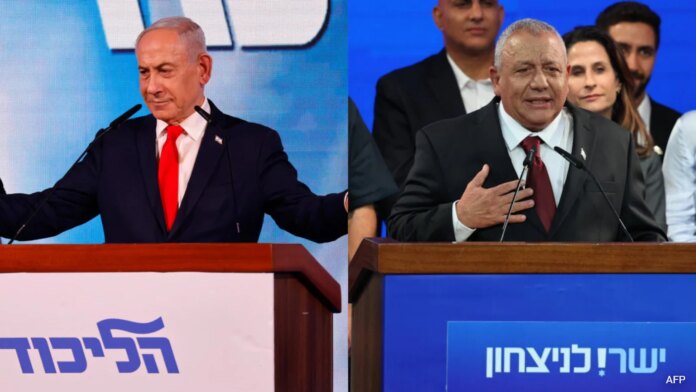
Considering Israel’s extreme polarisation, the prospect of a national unity government would appear fanciful, but it could theoretically create a less extreme government. Israeli commentators have often mused on the possibility of a national unity government in which Netanyahu would jettison his provocative far-right allies as well as ultra-Orthodox parties and team up with Eisenkot, who shares Netanyahu’s views on many security issues. Such a grand coalition would also exclude Arab parties.
4. Deadlock and new elections
If no candidate manages to form a government, Israel will have to return to the polls. The country held four elections between April 2019 and March 2021 due to the inability of politicians to forge a lasting coalition. The candidate designated by the president will, in principle, have 28 days to form a coalition, with a possible 14-day extension.
(AFP)