
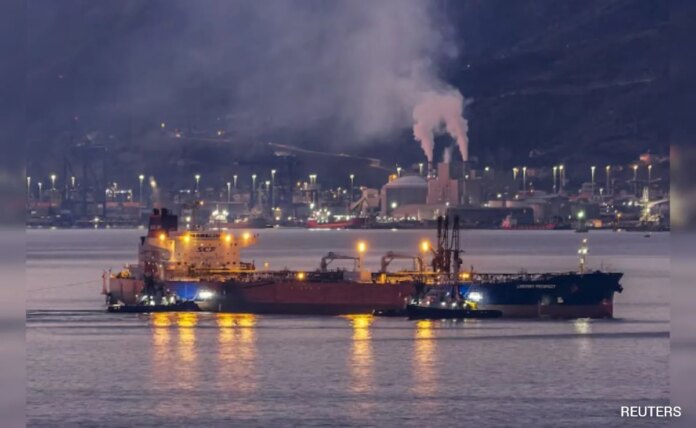

India Fuel Price Hike: For months, India managed to survive one of the worst global oil shocks in recent years through a narrow opening created by Washington.
That window has now shut.
On Sunday (May 17), the Trump administration allowed a sanctions waiver on Russian seaborne crude to expire. The decision may look technical on paper. But for India, it changes the entire energy equation.
The timing could not have been worse.
The Strait of Hormuz — the world’s most critical oil chokepoint — remains under disruption due to the Iran war. Tanker movements have slowed. Insurance costs have jumped. Global crude prices have surged above $105 per barrel from around $72 before the conflict began.
India is now staring at a double squeeze. Middle East oil flows are unstable. Russian oil now carries sanctions risk again.
And this comes barely days after fuel prices in India were raised by around Rs 3. The question now being asked in policy circles, oil markets and boardrooms is simple: what options does India really have left?
India’s Dependence On Russian Crude Oil
For nearly two years, discounted Russian crude became India’s biggest inflation shield. When Western countries cut off Moscow after the Ukraine war, India sharply increased purchases of Russian oil. The economics were too attractive to ignore. Russian crude was cheaper. Freight routes were manageable. Refiners made strong margins.
Over time, Russia became India’s largest crude supplier. Then came the Iran war.
As tensions escalated around the Persian Gulf and the Strait of Hormuz, global oil markets tightened rapidly. Fears grew that supplies from Saudi Arabia, Iraq, Kuwait and the UAE could face disruption.
That is when the US temporarily relaxed enforcement through a sanctions waiver. The waiver allowed countries to continue buying already-loaded Russian crude cargoes without facing immediate penalties. India pushed hard for the extension. Indonesia did too.
Washington agreed for a short period, arguing that global energy stability mattered. But the political pressure inside the US kept growing.
American lawmakers and European allies argued that the waiver was effectively helping Moscow earn more money at a time when the West was trying to financially isolate Russia over the Ukraine war.
On Sunday, the waiver expired. That changes the risk calculation for Indian refiners almost overnight. The biggest problem for India is dependence.
India imports more than 85 per cent of its crude oil needs. Any sustained increase in oil prices directly hits inflation, government finances, household budgets and economic growth.
And India had become deeply dependent on Russian crude during the waiver period. According to Kpler data, India’s imports of Russian oil rose to a record 2.3 million barrels per day in May. In some months, Russian crude accounted for nearly half of India’s total oil imports.
The reason was simple. Russian oil helped India reduce the damage from rising global crude prices. Without that discount, the math becomes painful.
If refiners are forced to cut Russian purchases due to sanctions fears, they may have to turn back to Middle Eastern suppliers at a time when the region itself is unstable and prices are soaring.
That could push India’s oil import bill sharply higher. And once oil prices remain elevated long enough, the pressure eventually reaches consumers. Petrol prices. Diesel prices. LPG cylinders. Airfares. Logistics costs. Food inflation. Everything starts moving up together.
Hormuz Crisis Meets US Sanctions: Centre Walks A Tight Rope
The government now faces a difficult balancing act. It can absorb some pressure through tax cuts or subsidies. But that comes at a fiscal cost. It can ask state-run oil companies to temporarily absorb losses. But that weakens company balance sheets. Besides, they already bleeding losses.
Or it can allow retail fuel prices to rise again. None of the options are politically easy. Especially because inflation had only recently begun stabilising after months of pressure.
There is another concern too. If oil prices continue climbing and supplies worsen, India may once again quietly revive fuel-saving measures seen during earlier crises.
During past energy shocks, governments encouraged work from home, staggered office timings and reduced non-essential travel to cut fuel consumption. Nothing official has been discussed yet.
But energy economists say prolonged disruption around Hormuz combined with tighter Russian sanctions could force countries to think beyond normal market responses.
India’s challenge is not just about buying oil anymore. It is about buying oil safely, cheaply and without triggering geopolitical consequences. Now New Delhi must navigate between two risks at the same time — disruption in the Gulf and pressure from Washington.
Impact Of Fuel Price Hike In India
Speaking on the impact of the recent fuel price hike in India, Rishabh Jain, Director- International Business, Petros Stone LLP, said, “The recent fuel price hike of over Rs 3 per litre is significantly increasing both domestic logistics and international freight costs at a time when exporters are already dealing with high ocean freight rates and volatility in the Middle East corridor. While the weaker rupee offers some temporary relief on export realisations, it only partially offsets the rising cost pressures.”
He added, “What we are seeing across the industry is not strategic agility, but survival-driven adaptation. Many manufacturers are slowing production, liquidating inventory, and fulfilling orders through existing stock to manage working capital. At the same time, less competitive players are struggling to sustain operations, leading to a gradual consolidation within the sector.”