
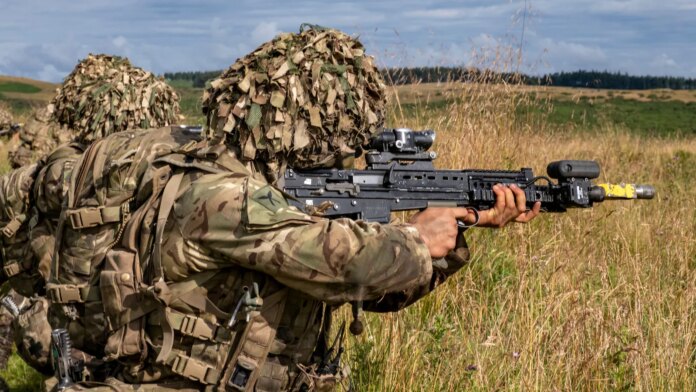

Five British Special Air Service (SAS) soldiers who were sent to Syria in July 2022 to capture an ISIS cell leader ended up being investigated for the murder of two people they shot dead during the operation.
The soldiers said they opened fire because they feared for their lives. However, neither of the two men had a weapon on them, according to The Times.
The soldiers were investigated on two counts of murder and faced life imprisonment if convicted. The case went on for nearly three years before military prosecutors decided not to bring charges in May 2025. The decision did not amount to a formal declaration that the soldiers had acted correctly, and the case could be reopened if new evidence emerged.
An investigation published by The Times details how the shooting and the police investigation that followed affected the soldiers.
What Happened During The Syria Mission?
According to The Times, the incident took place on the night of July 3 2022, in Al-Zer, a village in eastern Syria where ISIS militants were carrying out attacks on Kurdish forces.
The SAS team was part of Operation Shader, Britain’s military campaign against ISIS. Its mission was to capture a suspected ISIS cell leader known by the codename Bravo One. Western intelligence had reportedly tracked his movements for weeks and identified him as a key figure behind attacks on Kurdish forces.
The plan was to capture him alive and transfer him to a Kurdish prison approved by the British Foreign Office. He would then be questioned about ISIS’s activities and possible terror plots in Western countries.
However, the operation did not go as planned.
The Times reported that Bravo One and three associates left a building believed to be an ISIS weapons cache and moved towards another location. The SAS convoy changed its route and approached the group.
At around 11.41 pm, the soldiers were close to their target when they heard gunfire. According to the report, the soldiers could not identify where the shots were coming from. Two members of the group ran into the darkness and disappeared. The other two remained in the field.
A soldier involved in the operation told The Times, “There are lots of things happening at once,” adding that he was “convinced that we faced a threat that was extremely serious”. The report said the soldiers believed the two men were preparing to fire at them. The team leader authorised his men to pursue them, and four soldiers opened fire at around 11.49 pm, killing both men.
The soldiers later checked the bodies but did not find weapons on either person or in the immediate area.
The Kurdish forces initially identified one of the dead as Bravo One. However, Western intelligence later reportedly found footage on Facebook Live, according to The Times, showing Bravo One carrying out an attack on a local checkpoint after the shooting.
Who Were The Two Men Killed?
According to The Times, the two people killed were reportedly teenagers, and few details have been revealed.
One was Muhammad Fateh Khalaf al-Daham, who was reportedly 17 years old. His family is from the village of Al-Zer. According to the report, Muhammad later travelled to Turkey but returned after unidentified gunmen killed his father. Kurdish forces imprisoned him after his return to Syria, but he was released in April 2022, three months before his death.
The second person was identified as Abdullah. A local report described him as a 14-year-old. However, other reports describe him with different names, and there is uncertainty about his identity.
Social media posts and local accounts linked both teenagers to ISIS, The Times reported. Photographs reportedly showed Muhammad carrying an AK-47 and sitting on a motorbike, while Abdullah was seen wearing a black turban. These claims could not be independently verified.
How The Shooting Led To A Murder Investigation
An initial military review cleared the soldiers, concluding that they had acted in self-defence. However, the case took a different turn after reports of civilian deaths began appearing online.
The soldiers maintained that they had acted within the rules of engagement known as “Card Alpha”. The card states that “THE USE OF FIREARMS MUST BE A LAST RESORT.” They argued that their actions should be judged on what they could see and understand at the time, rather than on information discovered later.
“Every time you get a call from an unknown number, you’re thinking about it,” said one soldier.
On July 15, 2022, Gwyn Jenkins, then director of special forces, referred the case to the Royal Military Police (RMP), according to The Times.
The RMP opened a criminal investigation called Operation Tanglement. Five soldiers were placed under suspicion: the team leader who authorised the pursuit and the four soldiers who fired their weapons.
Soldiers Returned To The Battlefield
Even though they faced a murder investigation, the five soldiers were sent back to operational duties.
They returned to Syria within 48 hours of being questioned in August 2022, according to The Times. They then took part in high-risk missions behind enemy lines, including operations that led to the arrest and extraction of ISIS suspects.
One soldier told the newspaper, “I could have taken leave for psychological reasons, but I didn’t want to. The thought of not going anywhere was going to make me spiral into a worse place.”
The investigation continued for more than a year. In September 2023, the soldiers were informed that the RMP was seeking charges against all five and had referred the case to the Service Prosecuting Authority, the military equivalent of the Crown Prosecution Service.
On May 30 2025, they received notices informing them that charges would not be brought, according to The Times. The notice stated that the decision could change if further evidence emerged, another allegation was made, or an appropriate request was submitted to review the decision.