
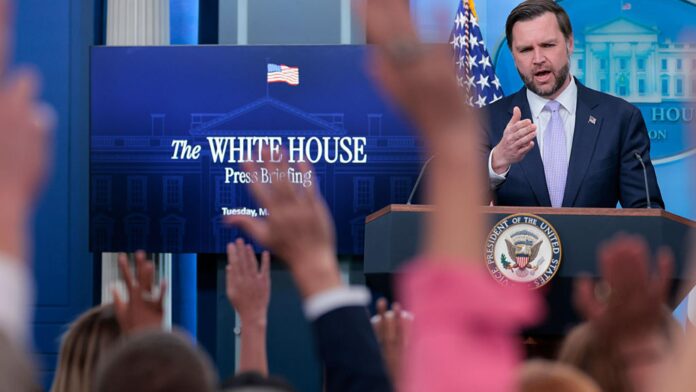

In the wake of the Trump Administration launching a new $1.776 billion fund to compensate people it says were targeted by the “weaponization” of government, top officials on Tuesday declined to rule out payments to some of the Jan. 6 rioters who assaulted police officers during the violent attack on the Capitol.
Vice President J.D. Vance said the Administration would evaluate applications for compensation from defendants tied to the Jan. 6, 2021 siege on the U.S. Capitol on a “case-by-case basis,” even when pressed repeatedly at a White House briefing about people who were previously convicted of attacking law enforcement officers during the riot.
“I don’t rule things out categorically when I know nothing about a person’s individual circumstances,” Vance said. “We do have people who are accused of attacking law enforcement officers. That doesn’t mean that we’re going to completely ignore their claims.”
He added that “we’re not trying to give money to anybody who attacked a police officer” but his willingness to entertain such claims marked another step in the Administration’s effort to rehabilitate the image of the Jan. 6 rioters. “We’re trying to compensate people where the book was thrown at them, they were mistreated by the legal system,” he said.
Earlier in the day, acting Attorney General Todd Blanche offered a similarly open-ended answer during a Senate hearing when asked whether members of groups like the Proud Boys or Oath Keepers could qualify for payments from the new fund. “Anybody in this country can apply,” Blanche said, adding that a commission would determine eligibility rules. “The commission will set the rules. That’s not for me to set.”
The comments underscored how the Trump Administration has sought to reframe the largest criminal investigation in Justice Department history under the Biden Administration as a symbol of political persecution. The rioters themselves, including some convicted of brutal assaults on police officers, have been recast in the President’s rhetoric as patriots, political prisoners, and victims of a corrupt system.
On his first day back in office, Trump granted sweeping clemency to nearly 1,600 people charged in connection with the Jan. 6 attack, pardoning most defendants outright and commuting the sentences of 14 members of the Proud Boys and Oath Keepers convicted of seditious conspiracy. The clemency extended not only to low-level offenders accused of trespassing or disorderly conduct, but also to people who had attacked officers with baseball bats, bear spray, flagpoles, crutches, and other weapons.
More than 600 defendants were accused of assaulting or impeding law enforcement officers during the riot, and nearly 175 were accused of using dangerous or deadly weapons.
The violence on Jan. 6 unfolded after a pro-Trump mob stormed the Capitol in an effort to stop Congress from certifying Trump’s 2020 election defeat. Rioters smashed through windows and police barricades, overwhelmed officers, and forced lawmakers to flee or shelter in place. Investigators spent years combing through thousands of hours of surveillance footage and digital evidence to identify participants in the attack. Trump has repeatedly described Jan. 6 as a “day of love” and argued that those targeted by law enforcement were persecuted rather than properly prosecuted.
Even before Tuesday’s briefing, Vance had sent mixed signals about how he viewed violent Jan. 6 offenders. Before Trump issued his blanket clemency to the rioters in 2025, Vance said that anyone who assaulted a police officer on Jan. 6 “obviously” should not receive a pardon.
“If you committed violence on that day, obviously you shouldn’t be pardoned, and there’s a little bit of a gray area there, but we’re very much committed to seeing the equal administration of law,” he said in a Fox News interview. “And there are a lot of people, we think, in the wake of January the 6th who were prosecuted unfairly. We need to rectify that.”
Now, as vice president, Vance is declining to foreclose the possibility that some of those same defendants could receive taxpayer-funded compensation.
“I’m not committing to giving anybody money or committing to giving no one money,” he said Tuesday.
The new fund—formally called the “Anti-Weaponization Fund”—was announced Monday as part of an agreement resolving Trump’s lawsuit against the Internal Revenue Service over the leak of his tax returns. The Administration says the money is intended to compensate people who suffered from “weaponization and lawfare” by the federal government and to provide financial settlements or formal apologies.
The figure attached to the fund, $1.776 billion, appeared to reference the year of American independence.
Blanche, who previously served as one of Trump’s personal defense lawyers, said the fund was necessary because “the machinery of government should never be weaponized against any American.”
The arrangement has drawn fierce, widespread criticism, including from ethics watchdogs, and former Justice Department officials. Sen. Jack Reed, Democrat of Rhode Island, called the arrangement “an obvious abuse of power” during Tuesday’s hearing, accusing the administration of creating a system in which Trump’s appointees could direct federal money toward people in the President’s orbit.
Critics have also pointed to the unusual structure of the settlement itself. By dropping his lawsuit against the IRS, Trump avoided judicial review of a formal settlement agreement and instead negotiated with officials in an administration he now controls. The fund will be overseen by a five-member commission appointed by Blanche, though the members can be removed by Trump.
The Justice Department has yet to release detailed standards governing who qualifies for compensation or how claims will be evaluated.