
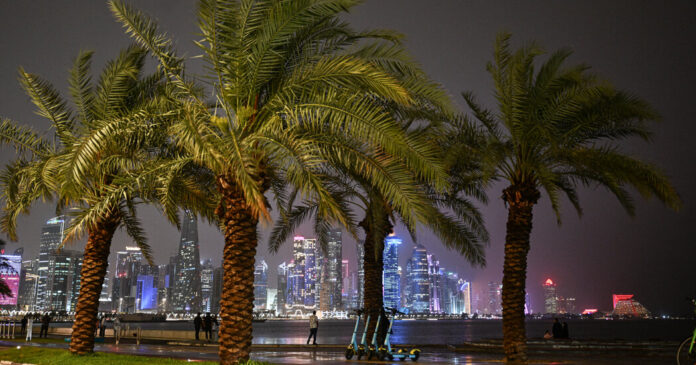

In Qatar, a desert peninsula protruding into the Persian Gulf, natural gas turned the country from a pearl-diving backwater into one of the world’s wealthiest nations.
Qatar spent three decades building supply lines, shipping tens of billions of dollars of liquefied natural gas each year through the Strait of Hormuz to ports across Asia and Europe.
The state, which derives more than 60 percent of its revenue from gas and gas-related exports, used that money to transform the peninsula into a gleaming metropolis. Unpaved desert roads were replaced by monolithic corporate skyscrapers, at the base of which irrigation systems water perennial blankets of grass and fuchsia flowers.
Gas wealth funded a metro system linking the capital, Doha, to Lusail, a northern city that is home to a Parisian-style mall and a theme park with artificial snow. The riches were also funneled into the world’s most expensive World Cup, and a $600 billion sovereign wealth fund with stakes in everything from Heathrow Airport in London to the Empire State Building in New York.
Then, in February, Qatar’s door to the world slammed shut.
The closure of the Strait of Hormuz means virtually no gas has left Qatar’s shore for more than two months. The nation is also cut off from the sea routes through which it imports everything from vehicles to produce. Fears of regional instability have hurt tourism and eroded business sentiment.
Ras Laffan, Qatar’s industrial center for gas production, is shuttered, and roads are blocked. In this vast port south of Doha, loading cranes stand paralyzed. Throughout the capital, hotels and boutiques sit in noticeable silence. Qatar’s growth forecasts have been slashed amid the cessation of L.N.G. trade.
For Qatar, gas shipments “are nothing short of foundational,” Ahmed Helal, a managing director at the Asia Group, a strategic advisory firm, said in an interview in Doha recently. “Nothing you see here would have been possible without the wealth of energy,” he added. “That is why Qatar is quickly falling into a very challenging fiscal situation.”
Qatar’s economic transformation started in the 1990s. It made a large bet on supercooling gas from the North Field — the world’s largest natural gas reservoir, in Qatar’s northeast — to minus 162 degrees Celsius. This turned the fuel into a liquid, allowing Qatar to bypass regional pipelines and ship gas to every corner of the globe.
It was the birth of an energy superpower. Kicked off by its first shipment of 60,000 tons to Japan in 1996, Qatar’s production capacity had jumped to 77 million tons by 2010. For most of the next decade, Qatar was the wealthiest country in the world per capita.
Locals remember this as a period of rapid change. North of Doha and carved out of the desert, the industrial city of Ras Laffan spans more than 100 square miles of gas-processing and liquefaction facilities.
South of the capital, miles of industrial facilities stretch along the coastline, churning out ammonia and fertilizer made from gas piped down from Ras Laffan. Towering gas flares shoot orange flames into the sky, punctuating a landscape otherwise blurred by sand and smog.
From the 1990s to the 2010s, the economy boomed, growing at an average annual rate of roughly 13 percent. To power this build-out, Qatar relied on an influx of foreign workers. Today, about 90 percent of its 3.2 million residents are noncitizens.
Seeking to build on that momentum, Qatar said in 2019 that it would expand the amount of L.N.G. its North Field could produce to 126 million tons a year by 2027. Before the war, its capacity was about 77 million. The expansion is considered one of the largest energy projects ever planned.
Then, in late February, much of that activity ground to a halt. Unlike its neighbors, Saudi Arabia and the United Arab Emirates, which have pipelines that can bypass the Strait of Hormuz, Qatar is geographically trapped behind the waterway.
Within 24 hours of the Iranian blockade, QatarEnergy, the state-owned energy giant, announced it couldn’t fulfill its contracts. Two weeks later, Iranian missiles and drones struck Qatar’s Ras Laffan plant, damaging critical equipment and causing a 17 percent reduction in Qatar’s production capacity.
The damage means that even if the strait were to open tomorrow, it would take years to return to prewar output. Analysts estimate that QatarEnergy has already lost billions of dollars since the war started, and every day that the strait remains closed, the country bleeds hundreds of millions more in lost sales and shipping charter fees.
The International Monetary Fund expects Qatar’s economy to shrink 8.6 percent this year before rebounding in 2027. For countries like Qatar, each day the strait is closed further darkens the outlook, Pierre-Olivier Gourinchas, chief economist at the I.M.F., said at a recent briefing.
The war has also exposed another kind of vulnerability. As part of a long-running effort to diversify beyond fossil fuels, Qatar has tried to transform itself into a tourist destination and a hub for international business and finance.
In 2019, Qatar scrapped a requirement that foreign firms maintain local partners, while the country began subsidizing luxury hotel stopovers for transit passengers. From Formula 1 to fencing tournaments, residents say scarcely a month went by before the war without a major international sporting event.
Since the war began, however, the number of international visitors to Qatar has plummeted amid travel advisories from the United States and other governments. Many multinational companies, fearing regional instability, have sent staff out of the country. In March, the World Travel & Tourism Council estimated that the Middle East was losing $600 million a day in tourism revenue.
In Qatar, the shift in mood is palpable. At Souq Waqif, the city’s traditional market, vendors report far fewer international travelers in the closing weeks of what is usually peak tourist season. In the city of Lusail, a choreographed fountain show at the Place Vendome mall on a recent Wednesday afternoon drew a single spectator, slumped against a stone wall, eating a sandwich.
For Qatar, like many of its neighbors, the diversification strategy hinges on sustained foreign capital, a steady supply of expatriate labor and, above all, the perception of stability, according to a recent report by Frédéric Schneider, a nonresident senior fellow at the Middle East Council on Global Affairs.
Images of Qatar’s airport under air raid warnings and Ras Laffan under missile attack, broadcast worldwide, are “incompatible with that perception in ways that are slow to reverse,” Mr. Schneider wrote. In that sense, he said, “the war has harmed Qatar’s hydrocarbon and post-hydrocarbon economic foundations simultaneously.”
The Qatari government, for its part, is working to project stability while shielding the population from the immediate shocks of the standoff.
Because Qatar imports about 90 percent of its food, the maritime impasse has forced a major reworking of supply chains. Fresh produce from Europe and grain from the Americas, which once arrived by sea, are now being diverted to costly airfreight routes or trucked through Saudi Arabia.
Such a shift would typically set off runaway inflation, but prices for imported goods — like avocados now airlifted from places like Tanzania — have risen about only 5 to 10 percent, according to supermarket workers, a result of aggressive government subsidies aimed at keeping the cost of living stable.
Residents say they generally feel safe, yet the strike on Ras Laffan remains a source of lingering anxiety. Some in Doha described watching an enormous column of fire rise on the horizon on the night of the attack, the flames so intense they could be seen from the capital, accompanied by the smell of acrid smoke.
Economists forecast that even if L.N.G. revenue were to vanish for years, Qatar’s deep pockets would allow it to continue paying salaries and maintaining essential services. S&P Global Ratings, which maintained Qatar’s sovereign rating this month, noted its “sizable accumulated fiscal and external assets.”
At the same time, the authorities have pressured international firms to return to prevent an exodus of foreign capital and talent. The concern is that if companies are allowed to collapse, the country’s overwhelmingly foreign work force could quickly disappear, said Mr. Helal of the Asia Group.
“If there’s a migration out, then that starts to get quite scary,” Mr. Helal said. So far, the Qatari authorities have “done a good job of projecting calm and managing the fallout,” he said. “But is there a big fiscal gap hole that’s forming? Of course,” Mr. Helal added. “It really depends on the duration of the strait remaining closed.”