


In 1994 journalist and music critic Mikal Gilmore, the younger brother of convicted killer Gary Gilmore, wrote a somber, searching memoir, Shot in the Heart, about what it means to come from a family with violence running through its veins. It’s a haunting book, and not an optimistic one. Can the capacity to commit horrific acts be passed through bloodlines? And how, if at all, can the chain be broken?
That’s one of the questions Aleshea Harris asks in her lively, ambitious, darkly funny debut Is God Is, which she adapted from her 2018 play. Racine (Kara Young) and Anaia (Mallori Johnson) are twins who cling to one another: A childhood tragedy that marked them both emotionally and physically has caused them to retreat into a universe of their own making. Anaia’s face is a network of scars, the result of devastating childhood burns. Racine has scars too, but they’re less immediately noticeable, mostly visible on one hand. Anaia is shy and retreating, because she feels she has to be: her face, she believes, is so horrifying to people that she fears being seen as monstrous. Racine, who, as Anaia notes, “still got some pretty to her,” is the firebrand, and she’s fierce about defending her sister from the world’s cruelty.
Racine and Anaia live together and work together, and in a classic case of twins telepathy, they can read each other’s thoughts. (In one early scene, their wordless conversations are splashed across the screen like silent-movie title cards.) Though they rarely fraternize with outsiders, Anaia does have a boyfriend. She explains that they never make love face-to-face, an arrangement that suits them both. But the women’s not-necessarily-healthy solitude is rattled when Racine receives a letter from their mother, whom she and Anaia had believed to be dead—they’d been told she died in the same fire that disfigured them. It turns out she’s still alive, but she’s wasting away. She invites them to visit her, though her motives are largely selfish. She has a task for them: to locate the man, their father, who tried to kill all three of them and do away with him once and for all. She wants him not just dead, but “real dead.” Anaia recoils from this request, but Racine is fully up for the mission.
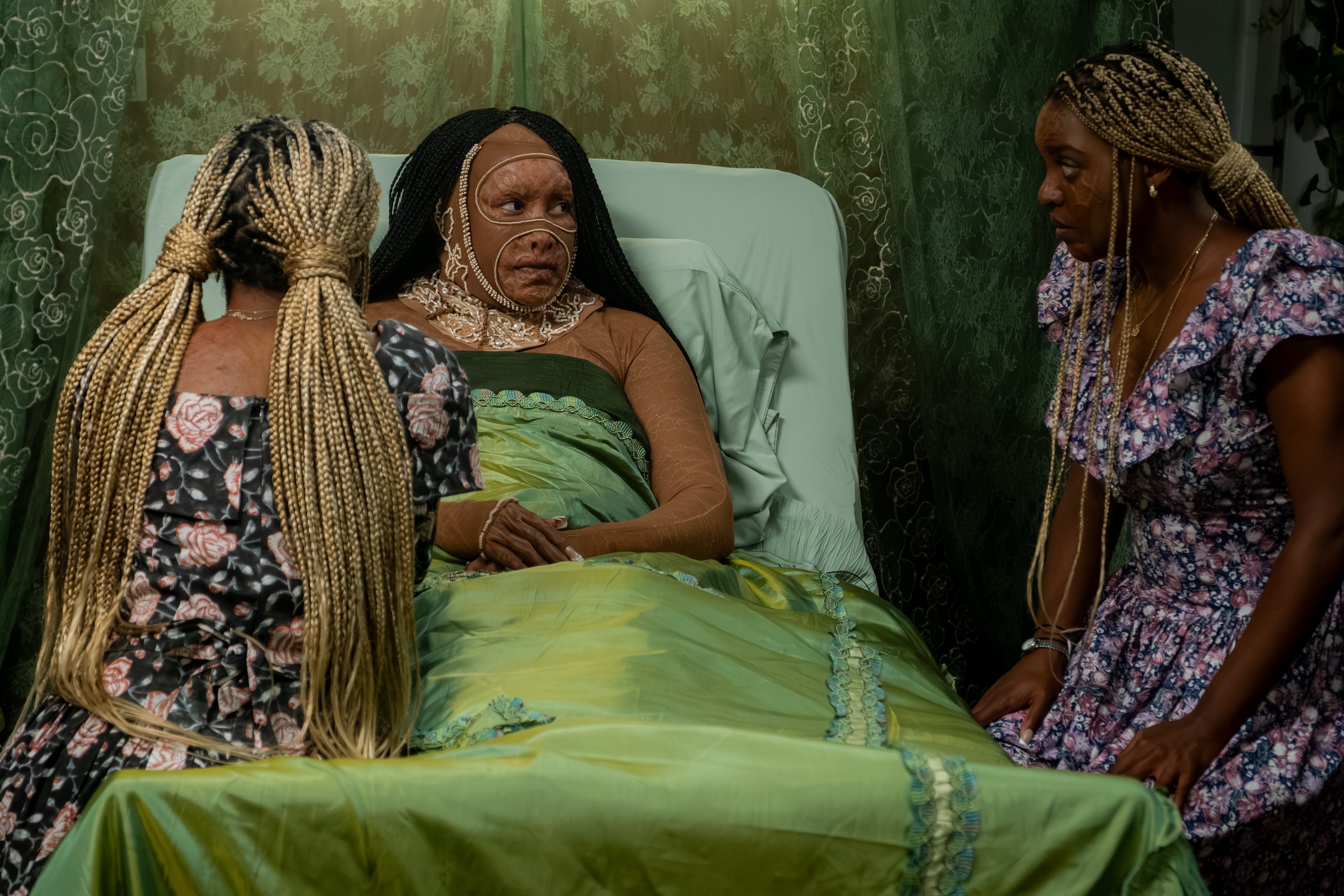
The bloodthirsty escapade that follows is played partly for laughs and partly for shock value, and for the most part, Harris shows a masterful control of the movie’s tone. Racine and Anaia’s mother, Ruby, is played by Vivica A. Fox: Arriving at her deathbed, they find an ailing diva reclining in luxury, her ravaged face trussed in a weirdly elegant beaded sling, her hair being braided by two attentive servants. (The clacking of their talon-like nails rings out like the sound of castanets.) She may be weakened, but she’s still imperious, and she reveals the backstory Racine and Anaia never knew: in an unsettling flashback, we see the terrible event that nearly killed all three of them. Even though it’s discreetly shot, and rendered in dreamlike black-and-white, it’s so disturbing that it threatens to throw the movie out of whack.
But Harris nimbly sets the story back on track. As Racine and Anaia attempt to carry out their mother’s wishes—they think of her as “God” because it was she who made them—they learn more about each other, and themselves. There are moments of great, witty tenderness here. Right before they reunite with their mother, Racine and Anaia freshen their makeup by facing one another, each applying a swipe of gloss to the other’s lips, a wordless invocation of the Velvet Underground’s declaration, “I’ll be your mirror.” The less said about their sociopathic father the better, though the casting is brilliant: he’s played by Sterling K. Brown, an actor of great feeling and depth, and to see him as such a soulless character is unsettling. Unsurprisingly, he’s great at it. Also look for Janelle Monáe, who’s both amusing and charismatic as a spoiled trophy wife.
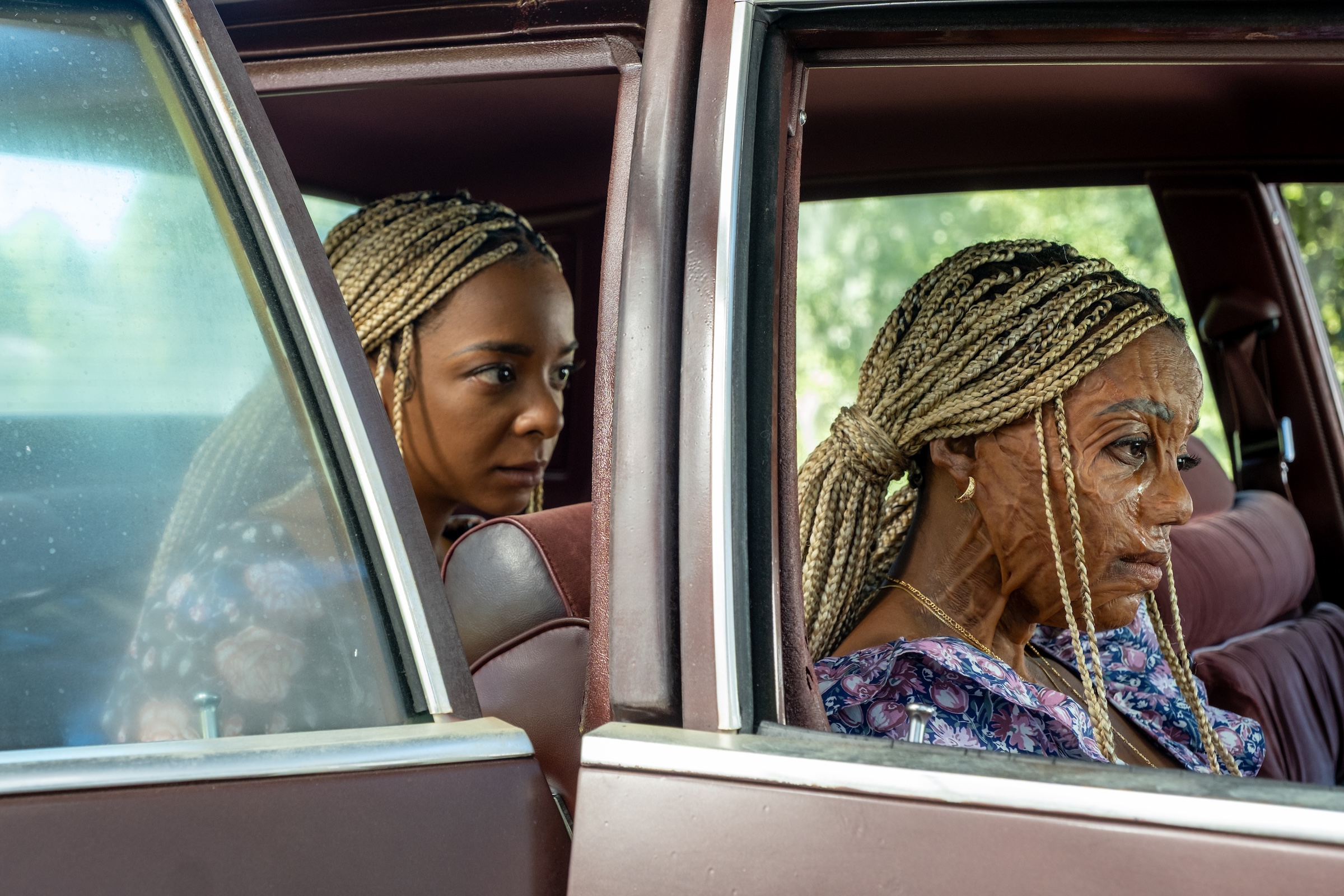
Is God Is is fanciful and brutal, sometimes simultaneously, taking a page or two from Tarantino’s Kill Bill. As the perpetually resentful Racine, Young has a brash, edgy freshness. You understand why she so desperately wants revenge, even though you’re not sure you want to see her get it. Johnson’s Anaia is much sweeter, and though there’s some ferocity inside her too, the movie leaves her in a compassionate, optimistic place. She embodies the hope that even if we can’t change our forebears, we still have control over our destiny. The movie’s final scene feels like the lifting of a curse: It’s a benediction you want to believe in.