
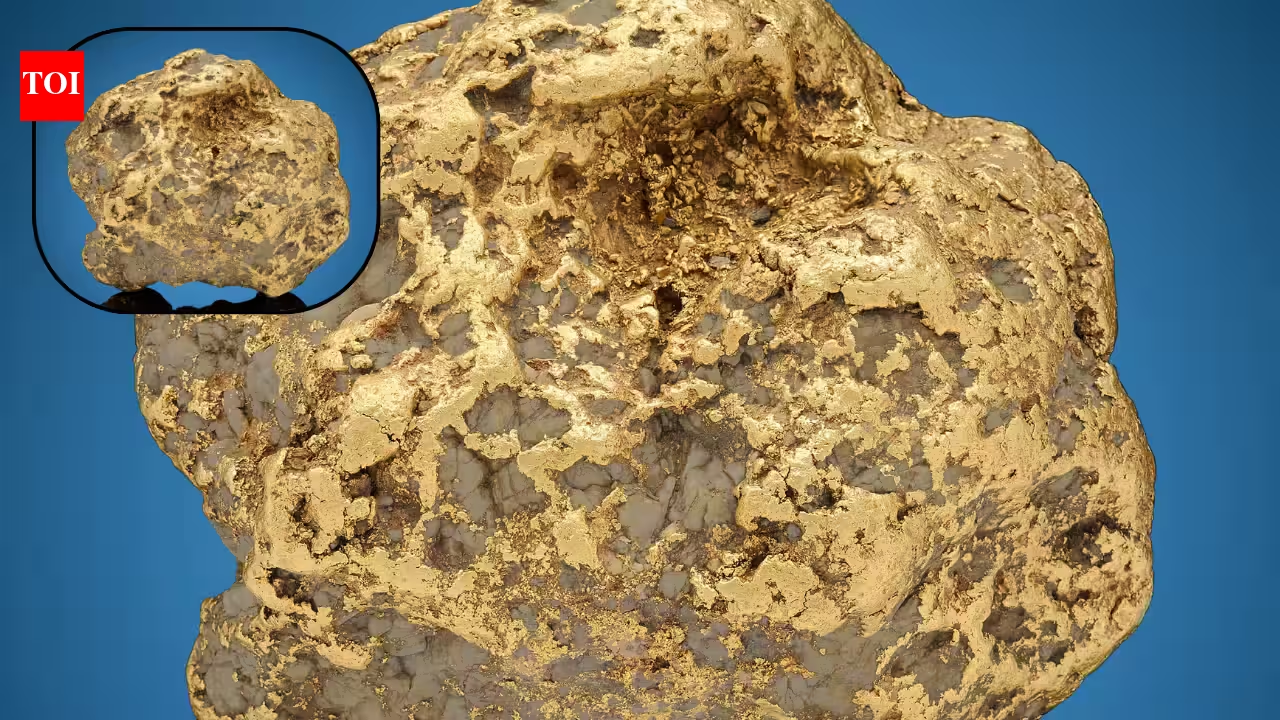

One push of a bulldozer turned an ordinary day of placer mining into a discovery that would enter Alaska’s mining history. In 1998, miner Barry Clay was moving dirt near Ruby when he uncovered a massive natural gold-and-quartz specimen weighing 294.1 troy ounces, or more than 20 pounds. The Alaska Division of Geological & Geophysical Surveys recorded the find as the largest gold nugget mined in Alaska. For more than two decades, the specimen remained a remarkable piece of mining history before Heritage Auctions offered it for sale in 2021. The nugget ultimately sold for $750,000, adding another extraordinary chapter to its story.
A discovery made while moving dirt
Clay was carrying out placer mining near Swift Creek, in the Ruby Mining District of Alaska’s Yukon-Koyukuk Census Area, when the discovery occurred. According to Heritage Auctions’ description of the specimen, Clay was using a bulldozer to push dirt when he noticed something unusual in the material he had excavated. Rather than leaving it behind with the surrounding material, Clay collected the object and took it into town for examination. It was subsequently identified as an exceptionally large gold nugget, making the find significant not only for its size but also for its connection to Alaska’s long history of placer mining.The nugget was later named the Alaska Centennial Nugget because it was found in 1998, a century after the Klondike Gold Rush era that helped make the region synonymous with gold prospecting. The specimen weighs 294.10 troy ounces, equivalent to about 9.14 kilograms, or just over 20 pounds. Its dimensions are approximately 17 by 14.5 by 11 centimetres. Rather than being a clean mass of pure gold, it is a natural gold-and-quartz specimen, with gold covering parts of a contrasting white quartz matrix.
More than just its weight
The size of the nugget is what immediately distinguishes it, but its appearance also contributed to its value as a collectible specimen. The auction house described the surface as having a complex, naturally formed structure, with visible gold running across the quartz-rich rock. Heritage Auctions classified it as a museum-quality specimen and highlighted its rarity as a large, naturally occurring gold specimen that had remained largely in its original condition.An X-ray fluorescence, or XRF, analysis was also carried out on the gold visible on the specimen’s exterior. The auction house reported an average surface purity of 87.59%, corresponding approximately to 21-karat gold. However, the specimen was not subjected to a conventional assay to establish its total gold content. Its owner considered the nugget’s historical and collector significance more important than determining the exact amount of gold contained within it. This distinction matters because the 294.1-troy-ounce figure refers to the weight of the entire specimen, rather than 294.1 ounces of pure gold. The nugget contains quartz and other material alongside the visible gold.
From Alaska mining find to auction highlight
After its discovery, the Alaska Centennial Nugget entered a private collection. It remained there for years before being offered at Heritage Auctions’ Nature & Science Signature Auction in December 2021. The auction took place on December 8, with the nugget becoming the headline lot. The auction record shows that the specimen sold for $750,000, with an internet bidder placing the winning bid. The sale made the nugget the highest-selling item in that auction, which generated more than $2.35 million in total sales.The auction also demonstrated that the specimen’s value extended well beyond the market price of its gold content. Large natural nuggets are unusual, and specimens that combine exceptional size, documented provenance and distinctive appearance can appeal to mineral collectors and museums. Heritage described the Alaska Centennial Nugget as the largest gold nugget ever found in Alaska and among the largest discovered in the Western Hemisphere. The auction house also noted that the Ruby Mining District has a history of producing large gold nuggets.
A record preserved in Alaska’s mining history
The discovery is notable because it connects an individual moment of placer mining with a much broader chapter of Alaska’s gold-mining history. Clay was not searching for a museum specimen when he began moving earth near Ruby; the extraordinary object emerged from ordinary mining activity. The Alaska Centennial Nugget subsequently became a documented record specimen. The DGGS publication identifies the 294.10-troy-ounce discovery as the largest recorded nugget mined in Alaska, while Heritage’s 2021 auction record shows how that historic piece later moved from a private collection into the world of high-value mineral collecting.More than two decades after Clay’s bulldozer uncovered the unusual object, the nugget’s journey reached another milestone. On December 8, 2021, the 20-pound-plus natural gold-and-quartz specimen sold for $750,000, turning a remarkable find from an Alaska mining claim into one of the most valuable mineral specimens offered at that auction.