
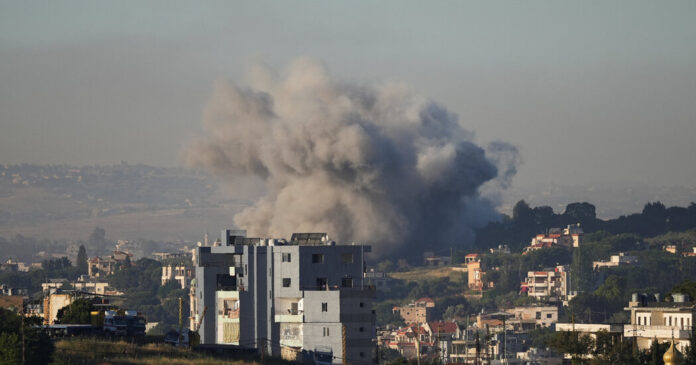

Fighting between Israel and Hezbollah showed little sign of abating on Friday, a day after the Iran-backed militant group rejected a U.S.-brokered cease-fire, as Israeli forces bombarded towns across southern Lebanon and ordered residents to flee.
The continued violence has thrown into question the agreement that Israel and Lebanon announced this week after direct talks in Washington, raising doubts about whether it would ever take effect.
For many civilians in southern Lebanon, the faltering deal brought a now-familiar directive from Israel’s military to leave their homes. More than one million people have already been displaced since the war erupted in March, according to Lebanese authorities. Most have no indication when, or if, they can return.
The cease-fire is contingent on Hezbollah pulling back from Lebanon’s border region with Israel, and on a “complete cessation” of the group’s attacks, but does not require Israel to make any immediate concessions. Hezbollah was not involved in the negotiations and Lebanon’s government has little power to force the group to comply.
Nabih Berri, the speaker of Lebanon’s Parliament, who is a key intermediary between Washington and Hezbollah, criticized the cease-fire agreement on Friday, saying it had been “booby-trapped” with one-sided conditions for the group.
Mr. Berri said he would only support an unconditional cease-fire, in which Hezbollah would only withdraw from southern Lebanon if Israel were to withdraw in parallel. His criticism underscored how far the U.S.-brokered deal was from terms that Hezbollah and its closest political allies were willing to accept.
The latest agreement follows an earlier U.S.-brokered cease-fire that took effect in April but did little to stem the fighting.
Israel’s flurry of evacuation orders on Friday extended deep into Lebanon, including the hillside town of Anqoun, which is about 16 miles from the Israeli border and within commuting distance of the Lebanese capital, Beirut.
Anqoun had previously been spared such orders, and Lebanon’s state-run news agency reported that the town was sheltering roughly 2,500 displaced people, many of whom were forced to flee again on Friday.
Lebanon’s state-run news agency reported heavy strikes across the country’s south, many in towns and villages that were not subject to evacuation orders. Hezbollah also kept up rocket and drone attacks on Friday that targeted Israeli ground forces.
The continued fighting came after Hezbollah’s leader, Naim Qassem, rejected the cease-fire agreement on Thursday, calling it a “humiliating” attempt to force Lebanon’s submission to Israel and tantamount to “surrender.”
Mr. Qassem said any truce deal must be comprehensive and include Israel’s withdrawal from southern Lebanon, where it has occupied broad stretches of territory since the latest invasion began in March.
“As long as the occupation continues, the resistance will continue,” Mr. Qassem said.
Hard-liners in Israeli have also criticized the deal, and the country’s defense minister, Israel Katz, gave little indication on Thursday that Israel was preparing to halt its campaign against Hezbollah. Mr. Katz said that Israeli forces would continue operating in Lebanon “at this stage,” adding that the hundreds of thousands of people displaced from southern Lebanon would not yet be allowed to return.
The ongoing fighting in Lebanon has threatened to complicate President Trump’s efforts to reach a deal with Iran, Hezbollah’s chief backer, which has threatened to pull out of peace talks if Israel does not stop attacking the group.
President Joseph Aoun of Lebanon accused Iran on Friday of using his country as leverage in its talks with Washington. “This is not your country. It’s our country,” Mr. Aoun told CNN, in unusually blunt remarks that reflected a widening rift between Beirut and Tehran.
“They are using Lebanon as a bargaining chip in their negotiation with the United States,” he added. “It’s unacceptable.”
Johnatan Reiss and Hwaida Saad contributed reporting.