
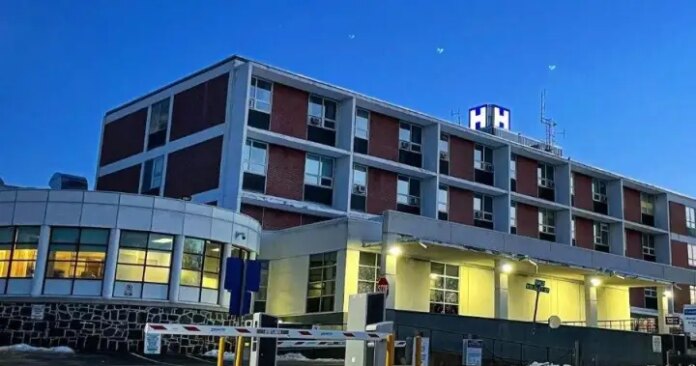

As the Lake of the Woods District Hospital in Kenora, Ont., grapples with a flood that damaged 25 per cent of its physical space, there is concern that seasonal surges could affect the delivery of care.
An “infrastructure failure” on the fourth floor of the hospital led to extensive water damage throughout the facility on May 6, LWDH officials confirmed in a post on Facebook.
In an update Wednesday, staff said all surgeries have been cancelled until the end of May and “efforts are underway to assess additional emergency support options.” The emergency department remains open.
Support options include mobile medical units, something currently being considered in co-ordination with Ontario’s Emergency Medical Assistance Team, and the possibility of the Canadian Armed Forces (CAF) getting involved.
The hospital has not clarified what the role of the CAF would be.
Officials say there is still much unknown, but full restoration efforts are expected to take several months.
“Lake of the Woods District Hospital was already experiencing the pressures of operating within an aging facility that has struggled to meet the demands of a growing community,” an update from May 8 stated. “This current situation has further intensified those capacity challenges.”

Get weekly health news
Receive the latest medical news and health information delivered to you every Sunday.
Summer is also the time when the number of people staying in Kenora swells. As a popular cottage destination for those living in Winnipeg and the surrounding areas, the city’s population expands to nearly 45,000 — three times its original size — according to the city’s 2025 annual report.
The hospital has dealt with overcapacity issues in the past. In mid-March, Cheryl O’Flaherty, the hospital’s president and CEO, said it had been in “code surge” for over a month, meaning high patient volumes were resulting in overcapacity.
During a code surge, the hospital says wait times in the ER can be higher than normal.
LWDH has 81 beds that service the 15,000 people living in Kenora, as well as the surrounding communities and the region’s First Nations.
According to Ontario data on hospital wait times, patients attending the emergency department at LWHD in March had to wait, on average, 2.4 hours for a first assessment from a doctor, well over the Ontario average of 1.8 hours. Sixty-eight percent of low-urgency patients finished their emergency visit within four hours, while 85 per cent of high-urgency patients were discharged within eight hours.
According to CUPE, over 70 per cent of Ontario hospitals are facing budget deficits, which further inhibits their ability to keep up with expanding populations, especially in more remote areas.
A facility condition assessment undertaken at LWDH in 2021 identified $53.8 million in deficiencies across key hospital systems. Hospital officials say this number has been reduced to $37.2 million with support from the government of Ontario.
Last fall, the province also renewed its promise to provide $50 million for a new hospital in Kenora that would also help tackle the issue of aging infrastructure. Select portions of the existing hospital date as far back as 1929.
The province says the new hospital will modernize the ER, expand diagnostic imaging services and provide Indigenous health spaces. The hospital will also be accompanied by 160 beds at the expanded Wiigwas Elder and Senior Care home.
In the meantime, hospital staff and their supports are working around the clock to provide care to those in hospital.
Staff say patients should continue to attend their scheduled appointments unless they have been directly contacted and told otherwise.
© 2026 Global News, a division of Corus Entertainment Inc.