
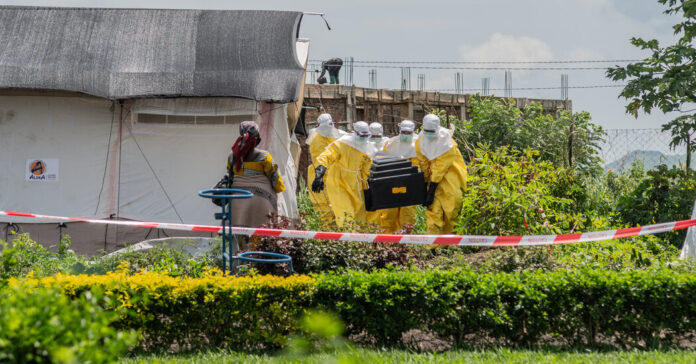

Recriminations were flying on Wednesday as global health officials scrambled to defend their response to the Ebola outbreak in East Africa.
First, the Africa Centers for Disease Control and Prevention faced criticism when the World Health Organization suggested that it acted too slowly in announcing the spread. Then on Wednesday, reports quoted Secretary of State Marco Rubio accusing the W.H.O. of being late in its own efforts.
Responding to those reports, Tedros Adhanom Ghebreyesus, the W.H.O.’s director-general, said, “We don’t replace the country’s work, we only support them,” subtly redirecting the backlash toward African health officials.
To some Africans, the suggestion that African health officials had already bungled their response to the Ebola crisis, scratched an old wound: The perception that only outsiders know what is best when it comes to deadly outbreaks on the continent.
African health officials say they have been battling diseases on the continent for decades, and in some cases with great success. Yet, they say, those successes receive little global attention as African health workers suffer grave consequences and make life-or-death sacrifices, only to come under international criticism.
African health workers have provided the bulk of the frontline care during a series of Ebola outbreaks on the continent. More than 500 of them died in the 2014 epidemic in three West African countries alone.
Dr. Christian Happi, a professor of molecular biology and genetics at Nigeria’s Redeemer University who was born in Cameroon, recalled an incident at the height of the West African Ebola outbreak. A Liberian-American man with symptoms landed in Lagos and was immediately isolated in a clinic, he said.
When the man attempted to discharge himself, the doctor treating him, Ameyo Stella Adadevoh, forcibly detained him, citing the public good. In the scuffle that followed, the man infected her with the virus. He later died, and so did she. But the outbreak in Lagos — the continent’s most populous city — ended in a matter of months, and Dr. Adadevoh is credited with giving her life to help prevent its spread.
Reflecting on that time, Dr. Happi said he feared for his life the night he genetically sequenced the virus. His laboratory in Lagos lacked the appropriate safety equipment, he said, but if necessary, he was willing to sacrifice his own life.
“It’s a wrong stereotype where they believe the health system in Africa is very rudimentary,” he said in an interview, referring to some global health officials. He noted the success of Rwanda in containing an outbreak of Marburg Virus in 2024 as another, more recent example of effective health coordination in Africa.
The W.H.O. announced on Sunday that the Ebola outbreak was a global health emergency, but by then the virus had likely been raging for weeks. Early laboratory results kept coming back negative because local health officials in the Democratic Republic of Congo did not have the equipment to test for Ebola Bundibugyo, the rare species responsible for the current outbreak. There is no vaccine available to treat Ebola Bundibugyo.
The Trump administration dismantled the United States Agency for International Development last year, crippling foreign aid distribution. It also formally withdrew from the W.H.O. in January. Many African nations have relied on U.S. foreign assistance to help manage disease outbreaks, and the U.S. aid cuts have already taken a toll.
On Monday, the Trump administration invoked an emergency public health rule to seal American borders to those who had recently traveled to Congo, Uganda or South Sudan.
The African C.D.C. said it recognized each country’s sovereignty and right to control travel during outbreaks, but warned that generalized travel restrictions and border closures were counterproductive.
“This current Ebola outbreak highlights a deeper structural injustice in global health innovation,” read a statement from the agency on Tuesday. “Many African leaders believe that if this disease had predominantly threatened wealthier regions of the world, medical countermeasures would likely already be available.”
Dr. Tedros said that the number of suspected cases had risen to nearly 600, including 139 deaths, on Wednesday. Testing capacity in the northeastern Congolese province of Ituri, the heart of the current outbreak, is still ramping up.
Health workers in Ituri must overcome years of mistrust caused by the failure of the authorities to prevent violence and massacres carried out by local militias against civilians. In 2021, the government declared a state of siege in the area, which effectively amounted to martial law.
Even so, Africa C.D.C. defended its record. “From the earliest stages of the current Ebola outbreak, Africa C.D.C. acted rapidly, transparently and responsibly,” the agency said in its statement.
It also suggested that Africa was forced to deal with a double standard when it came to health emergencies. The agency pointed out that thousands of Africans had died during the 2014 Ebola outbreak, but an effective global response was only achieved after an American doctor became sick.
The doctor, Kent Brantly, a missionary, contracted Ebola in Liberia and was flown to Emory University Hospital in Atlanta for treatment. On Monday, it was announced that an American doctor named Peter Stafford had tested positive for Ebola in Congo. He was flown to Germany for medical care.
In interviews this week, U.S. public health experts stressed the importance of partnership with health authorities in countries affected by Ebola and acknowledged that foreign officials have at times taken the limelight.
Ebola care is “often seen as an international force flying in and saving Africans. But the majority of people saving lives and risking their lives are Africans,” said Lina Moses, an associate professor at the Tulane University School of Public Health and Tropical Medicine, who worked in Sierra Leone during the 2014 epidemic.
At the same time, democracy activists in Africa have complained for decades about the failure of governments to invest in health infrastructure, which has led in many cases to a reliance on donor aid to fill the gaps.
Corruption has siphoned funds meant for public health into the pockets of government officials, critics say.
Dependence on outside help for fighting outbreaks in Africa also speaks to a broader concern about the troubled relationship between the continent, stretching back to the colonial era, said Yvonne Adhiambo Owuor, a novelist from Kenya.
“It’s a cultural pathology,” she said. “It’s always Africa that needs saving.”