
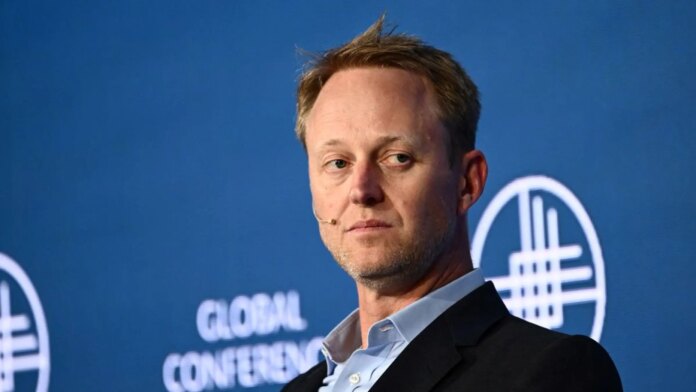

Chase Koch is one of those billionaires who blends into a crowd without much effort—whether he’s mingling with his family’s super-rich friends or the paper-pushing nerds in think tank circles, whether he’s talking about the success rates of addiction recovery programs or an epic eight-hour Phish show he attended while in college. It’s not until he casually notes that his family’s reach helped him set up a conversation about the war on drugs between Snoop Dogg and his father, the 90-year-old billionaire industrialist Charles Koch, that you realize this 48-year-old from Wichita, Kansas, truly represents the next generation of raw power—one as comfortable talking Pink Floyd as principles-based management.
As Chase Koch is discretely taking over the philanthropic machine established by his father and uncle—which, yes, he concedes still invests hundreds of millions of dollars in influencing elections—he is focused on making sure it continues beyond any one figurehead. Rather than remaking the network in his image, he’s almost adopting a stewardship model wherein he continues to leverage his family’s wealth to keep convening other like-minded, outcome-obsessed donors who want to ensure their money is making a difference. It’s a highly unusual approach to this orbit, focusing more on structures than chasing in-the-moment remedies. It’s why attendees at many of the big music festivals might notice and appreciate the designated sober-supportive spaces, but are less likely to recognize the fingerprints of the Koch orbit, which has worked with organizers like Live Nation, iHeartMedia, and AEG to set many of them up.
“My father had me, as a young man, studying Milton Friedman. He was a big fan of his. And Milton Friedman said the greatest mistake is to judge programs and projects based on intent, not results,” Koch tells me. “And so our approach to social change has always been about real results that help people and move the needle.”
But the unavoidable topic of politics is always enmeshed with the Koch family. Their network of free-market, free-expression groups continues to be a major player in the Republican Party, even as it keeps Donald Trump and his MAGA movement at arm’s length. Their candidates have massive advantages through institutional endorsements, on-the-ground politicking, advertising dollars, and digital know-how.
Chase Koch does not linger on that largesse. Instead he brushes it off as almost a rounding error. “If you look at our overall efforts in politics, it’s less than 10% of what we do across all the community efforts. Over 90% is community-based solutions,” he says. (Still, that 10% is more than almost every other player in electoral politics. The Koch network spent a gobsmacking $550 million on the 2024 election cycle alone.)
The big things that get Chase Koch going are schools, addiction recovery, and a range of programs the Kochs believe build stronger communities.
“School reform is an example of where we’ve focused a lot of efforts,” Koch says. “Just in the last five or six years, we’ve helped, I think it’s now 28 states, really get some form of school choice.”
Charles Koch’s personal giving has now passed the $2 billion lifetime marker, and he quietly helped transfer almost $6 billion in nonvoting shares of his suite of companies to a libertarian web of nonprofits and social-change organizations that Chase is helming. It’s a reminder that the Koch Family is, by some estimates, among the five richest on the planet with about $150 billion in worth. For context, that’s just ahead of the Saudi Royal Family.
Their marquee effort, Stand Together, has cobbled together an unlikely coalition of business titans, celebrities, and community activists to tackle everything from criminal justice reform and education inequality to lowercase-L liberalism and uppercase-C capitalism. Meanwhile, Chase Koch’s Key Change initiative and his Believe in People organization are scaling up and have already churned out more than $400 million in projects.
Chase Koch and I spoke on May 5 by phone for our TIME 100 Philanthropy list out today. This interview has been edited for length and clarity.
TIME: You’re building a long-term approach to solving or addressing the underlying causes of major societal problems here. Can you walk me through how you came to that approach?
My father’s been involved in social change for almost 60 years of his life. So it’s based on a lot of learnings over a very long period of time. One thing that’s very different about our approach and why we think so long-term is that we don’t really think about it as philanthropy. We think about it more through the lens of social change. So that’s kind of a paradigm shift in and of itself. We feel like the long-term nature of that is critical.
So I think a big, big thing that’s different about our approach is we’ve learned a lot in business about what works. How do you get a return on your investment? How do you eliminate waste? How do you continually pivot? And so those business principles we’ve brought into our social change efforts. We bet on people that are closest to the problem and that have been through the problem because we believe that they are the solution to the problem, not problems to be solved. That’s a big differentiator.
The other big differentiator is that we have a comprehensive approach. So we look across all the institutions of society and say, for a specific problem, how do we transform education? How do we get the business community involved and get a kind of a groundswell community behind a specific problem as opposed to working in silos? Then it enables you to work in communities at a much deeper level when you have this when you have an entire community that are passionate about an issue come together to get results and overcome a problem.
The leverage that you get from a community-based approach, that’s why we call it Stand Together. It’s multiple leaders on a specific issue in a specific community to ultimately drive movements. And I would say that’s the last differentiator, is that mindset of, yes, of course we want to help and optimize on the margin, but we’re looking for movement like nationwide movement results to change, to, to really help people, you know, movements of millions, if you will. So that’s, that’s what I would say long term. And then our model of our partnership model on our principle based model is really what sets us apart.
What are you so jazzed about that you’ve been able to accomplish so far?
During COVID, obviously we had addiction rates skyrocketing. Prior to COVID, we found a gentleman named Scott Strode who was founder of a group called The Phoenix in Colorado. He battled addiction his whole life but he had a mentor who showed him that exercise, getting on a bike and getting in a boxing ring, was what was going to help him overcome his issue. And it worked for him. And so he said, If it worked for me, why will this not work at scale for others as well? And he built his first gym in Colorado that basically leveraged the power of community and bringing people together, plus the power of exercise.
His relapse rates were below 10%, which is order of magnitude better than the next-best addiction program alternative. And so what Stand Together does is we find a guy like Scott and we bet on him, and then we bring scale. We have something like 700 business leaders in all 50 states that see what’s working and they want to inject capital, but also network and capability to enable him to scale and create a movement. And that’s what we did. We created a movement. When we met Scott, he was helping a few thousand people in Colorado. I think he had three gyms at the time when we met him. With our community, we’ve helped grow that to what we called it 1 Million Strong. We think over the next three years we can get that to 10 million because the scale just is exponential.
We’re also very creative in how we tap different communities to really put gas on the fire when something’s really working. I’m very, very passionate about music and the power of music to unite people. And so we brought 1 Million Strong to the music industry. Obviously one of the biggest problems in that community is addiction. Not just artists that are on the road all the time, but the crews, folks in the music industry. We built partnerships with folks like Mike Rapino from Live Nation, iHeart Media, AEG at Coachella and Stage Coach. We’ve leveraged the power of music to build a movement.
What stands out with what your family has done is you’ve built a machine that passes from generation to generation. How does that conversation go? I mean, no one likes to address that elephant in the room.
Right? You’re talking about succession? It’s never a pleasant thought, but it’s not something that we shy away from. I think this principle-based approach enables us to hopefully be successful for multiple generations.
If you were talking to my father, he would say, this isn’t about him being the one guy who can do it and had the vision. Yes, he’s had an incredible influence on building this platform, but he would credit the amazing team, hiring folks and putting them in the right places to build this platform that we feel like has long-term staying power.
To hit the elephant in the room, my father’s 90. Hopefully we have another 30 years with him ’cause he’s in great shape and very healthy. But he would say, Look, if I’m gone tomorrow, I feel great about this.
I’m good at things that my father didn’t have strengths in. And I’m not good at things that my father did have strengths in. So I’m just going to lean into my strengths and my passion and then have a team that compliments the things that I can’t bring that my father did bring over time. And as long as you have that mindset, and it’s not about, if you look at it from a business perspective, whose name’s on the building. We don’t think that way. We think about the team that’s going to make this successful long term and continue to get people in roles based on where they can deliver the most value.
It would be really easy to just be a dilettante in this situation and only care about Number One. Why not just do that? Why keep the movement going?
The reason my father started in social change is that he cares. He cares about other people. And he’s seen what these principles that I described—like bottom up, as an example—he’s seen the power of those to drive human progress. You know, he studied philosophy, studied what worked and what hasn’t.
In this country we have a crisis of purpose, a crisis of meaning. And what we believe is these principles, when applied, people see that it can transform their lives and give them more meaning. So we’re playing the long game here, there’s no doubt about it. But we feel like we’ve got the capability to do it.
We have over 300 community organizations that we support, so there’s a serious scale there. Over 700 business leaders that are part of Stand Together, that all have great ideas and built fabulous businesses that want to bring what they’ve learned in business to social change. And 90,000 educators are part of this. And then 4 million grassroots activists as well. So when you put all those things together it’s really exciting and you see this community growing exponentially. We believe we can really drive change, and not just on a problem like addiction, but big things that need to be transformed, like our education system. And we’re making progress.
Your family’s associated with the libertarian wing of this country’s politics and there’s no avoiding that. Do you see this going forward? There was a break during Trump 1.0, but there’s been a noticeable pivot here. Can you walk me through what’s behind that and where we should be watching going forward about the political involvement of this network?
It’s a fair question. I do have to say that this is a significant misperception, especially in the media and the way it gets portrayed. If you look at our overall efforts in politics, it’s less than 10% of what we do across all the community efforts. Over 90% is community-based solutions.
But I will say that policy, great policy, is critical to remove barriers for the most people. School reform is an example of where we’ve focused a lot of efforts and just in the last five or six years, we’ve helped, I think it’s now 28 states, really get some form of school choice, which is absolutely critical to have a lot of alternatives that meet kids’ needs.
As you can tell, my focus is really more around the communities and really tackling it from a culture bottom-up level. But I also recognize that great policy is critical to the future. So that’s going to be part of our efforts going forward. That won’t go away, but we’ll make decisions based on where we can make a difference to remove bad regulation that holds people back. There’ll be a very clear and high bar where we get involved and where we don’t.
Do you worry that the political overtones of your family overshadow the 90% of the work that you’re doing outside of the political realm?
Not at all. Like I said, it’s a misperception and it’s way overblown. But I think that’s old news, honestly. When you look at the partnerships that we’re building and the movements we’re creating, that should be the focus, not about legacy. Is Koch involved in politics or not? I just think that’s an old kind of tired story.
Make sense of what matters in Washington. Sign up for the D.C. Brief newsletter.