

New Delhi:
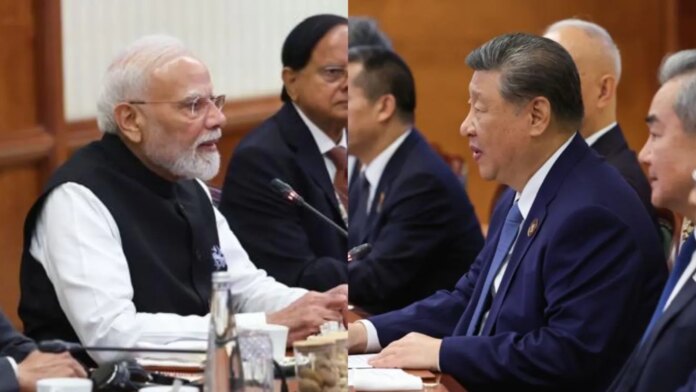
Speaking with Prime Minister Narendra Modi on the sidelines of the BRICS Summit, Chinese President Xi Jinping said today that both countries can “fully learn” from each other’s strengths and support one another. Xi Jinping arrived today in New Delhi for his first visit to India in seven years and held talks with PM Modi, focusing on border issues, trade and investment.
The Chinese President’s two-day visit comes as India hosts the BRICS summit. PM Modi and Xi Jinping held bilateral talks on the sidelines of the summit.
“It gives me great pleasure to extend a warm welcome to you. Thank you very much for your positive remarks at the BRICS Summit. I express my gratitude for the support and cooperation received from China during India’s BRICS chairmanship. We now have the opportunity to discuss bilateral cooperation. Once again, a warm welcome to India,” PM Modi said.
The Chinese President stated that he received the invitation to visit India on his birthday — June 15 — and added that in their 21 meetings over the years, he and PM Modi have “guided India-China relations onto a path of steady development.”
“On my birthday, I received the invitation to visit your hometown. We have met 21 times and reached a series of important consensuses, which have guided China-India relations onto a path of steady development,” Xi Jinping said. “China has always viewed and developed its relations with India from a strategic and long-term perspective. Although our two countries have different national conditions, we can fully learn from each other’s strengths, support one another, achieve success together, and pursue common development.”
“In the face of the profound changes unseen in a century and the unprecedented pandemic situation, China and India, as the world’s two most populous countries and important members of the Global South, shoulder significant responsibilities. Both sides should keep the future of humanity in mind and care for the well-being of our peoples, working together to play the role of major countries,” he added. “We should advocate an equal and orderly multipolar world, not privatise our own interests, and contribute more positive energy to world peace, stability, development, and prosperity.”
The two leaders are expected to undertake a comprehensive review of bilateral relations and consider new measures to expand engagement. At the heart of the discussions is likely to be the Line of Actual Control (LAC), the disputed and often contested frontier.
“Both leaders had a productive meeting on the sidelines, where they reviewed the steady progress in India-China relations since their last meeting in Tianjin. They underscored the importance of maintaining peace and tranquility in border areas, and reaffirmed their commitment to pursue cooperation based on mutual respect, mutual interest and mutual sensitivity,” Ministry of External Affairs spokersperson Randhir Jaiswal said in a statement.
According to a statement by the MEA, the two leaders “welcomed the steady progress in India-China bilateral relations since their last meeting in Tianjin in August 2025.”
“Differences should not become disputes. Prime Minister highlighted that both sides must be guided by three mutuals- mutual respect, mutual sensitivity and mutual interest,” the ministry said.
In the bilateral talks, the Prime Minister stressed that “peace and tranquility” in border areas are essential for both nations’ relations.
“Prime Minister emphasised that peace and tranquillity in the border areas remain an essential basis for the continued development of bilateral relations. He underlined the need for both sides to observe existing agreements and understandings on border-related issues. The two leaders expressed commitment to a fair, reasonable, and mutually acceptable resolution of the boundary question proceeding from the political perspective of their overall bilateral relations and the long-term interests of the two peoples,” the satetment read.
China, by contrast, has traditionally maintained that the boundary dispute should be dealt with separately from other aspects of bilateral ties.
The PM Modi-Xi Jinping meeting follows a number of high-level exchanges between the two governments. National Security Adviser (NSA) Ajit Doval held Special Representative talks with Chinese Foreign Minister Wang Yi in Beijing late last month. The discussions covered the delimitation of the frontier, trans-boundary cooperation and the need to maintain peace along the LAC.
Doval and Wang are the designated Special Representatives for the India-China boundary negotiations. The roles were established in 2003 to seek a solution to the 3,488-km border dispute.