
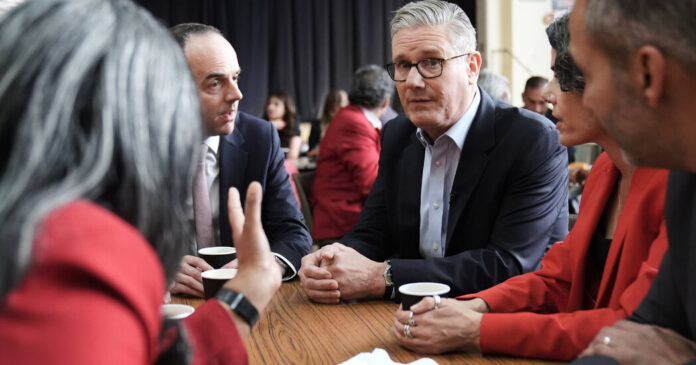

Prime Minister Keir Starmer of Britain staved off calls for his resignation on Tuesday, but he remains in deep political peril as he waits to see whether his Labour Party rivals will formally launch a challenge to his leadership.
His two most likely opponents — Wes Streeting, the health secretary, and Andy Burnham, the mayor of Manchester — both remained silent about their plans after Mr. Starmer effectively dared them in a Tuesday morning cabinet meeting to mount a bid to oust him.
The prime minister has remained defiant in the face of an increasing number of Labour lawmakers who are calling for him to step aside. That number grew to beyond 80 by Tuesday evening, even as 100 supporters of the prime minister issued a letter saying they opposed a messy leadership fight.
On Wednesday, Mr. Starmer and lawmakers will pack the House of Lords in Parliament for an elaborate ceremony, rife with symbolism and steeped in history, that marks the beginning of a new legislative session. After arriving in a horse-drawn carriage escorted by the Household Cavalry, King Charles III will read out a speech prepared by the government that lays out Mr. Starmer’s agenda for the year.
But the increasingly vicious civil war inside the Labour Party will be just beneath the surface. Among the lawmakers who could be seated near Mr. Starmer in the chamber, one on Tuesday accused him of failing to seize “opportunity with the gusto that’s needed” and another wrote that “you, prime minister, have lost the trust and confidence of the public.”
The other grim backdrop for the king’s speech will be the pressure in the British bond market, where some investors are concerned that the ousting of Mr. Starmer might hinder his government’s efforts to bring down debt levels. At one point on Tuesday, the government’s borrowing costs, which have risen since the start of the war in Iran, surged to levels not seen since the 2008 financial crisis.
Mr. Starmer has been facing a fast-moving rebellion within his party after it suffered major losses in last week’s local elections in England, and in parliamentary elections in Scotland and Wales. Dozens of Labour Party lawmakers have publicly urged him to set out a timetable for his resignation to allow a contest to find his successor.
At the Tuesday cabinet meeting, Mr. Starmer told ministers, “The country expects us to get on with governing,” according to a statement from his office. After the hourlong meeting ended, several of his backers in the cabinet expressed support for him staying in office.
Steve Reed, the housing secretary, said the prime minister had his full support. Jennifer Chapman, the secretary for international development, said she had “detected no mood among anybody in that room” for a leadership challenge. John Healey, the defense secretary, said on social media after the meeting that “more instability is not in Britain’s interest.”
But after the meeting, four junior ministers publicly submitted their resignations, saying they had lost confidence in his ability to lead the country.
One of the junior ministers, Jess Phillips, is a well-known politician who has campaigned to combat violence against women and girls. She wrote that Mr. Starmer was “a good man fundamentally” but that he had been too unwilling to fight for change.
It remains unclear what will happen in the hours to come.
Attention now shifts to Mr. Streeting, the health secretary, who has made no secret of his desire to challenge Mr. Starmer. But he would need the backing of at least 81 Labour lawmakers to formally start a leadership contest. It was unclear on Tuesday whether he had enough support to make that happen.
Some of Mr. Starmer’s fiercest critics do not want him to leave office immediately, but rather to announce that he will step down in the fall. That would give the party time to organize a contest to succeed him that might include Mr. Burnham, the mayor of Greater Manchester, who appears to have political momentum behind him. But Mr. Burnham would need to win a seat in Parliament first in a special election, something that would take weeks if not months.
In addition to Mr. Burnham and Mr. Streeting, others who might challenge Mr. Starmer include Angela Rayner, who served as deputy prime minister before stepping aside amid questions about her personal taxes, although she has suggested she would back Mr. Burnham if he was successful in returning to Parliament.
Concerns about the economic impact of the political turmoil are likely to continue until the issue is resolved.
In British politics, the bond market has come to hold significant sway. The premiership of Liz Truss, a Conservative, was cut short in 2022 amid convulsions in the bond market after investors balked at her unfunded spending plans. This time, investors have repeatedly signaled their support for Mr. Starmer and his chancellor of the Exchequer, Rachel Reeves, who have kept to ironclad fiscal rules in an effort to bring down debt levels.
Now the uncertainty over Mr. Starmer’s position is adding strain to the bond market. The rising yields signal concern that a new leader from the left of the party might be tempted to borrow more to pay for more spending and investments.
“Because it is unclear who is most likely to succeed Starmer and the policies that they would pursue, investors are likely to attach a risk premium to U.K. assets until the uncertainty is resolved,” Andrew Wishart, an economist at the bank Berenberg, wrote in a note.
As a direct result of the U.S.-Israeli led war against Iran, Britain, like many other economies, is now facing significantly higher inflation and slower economic growth than it was forecast to at the start of the year, in a blow to Ms. Reeves’s efforts to turn round the economy.
Investors are now betting that the Bank of England will raise interest rates instead of cutting them, in turn raising borrowing costs for mortgage holders, businesses and the government. All of these lead to a more constrained financial outlook and make it harder for any leader to pursue quick economic growth.
Analysts at Capital Economics concluded in a recent report that a new prime minister would face the same challenges.
“We doubt a new leadership would be any more successful at boosting medium-term economic growth,” they wrote, adding: “Not least because the current fiscal constraints would remain.”
Stephen Castle and Megan Specia contributed reporting from London, and Eshe Nelson from Paris.