
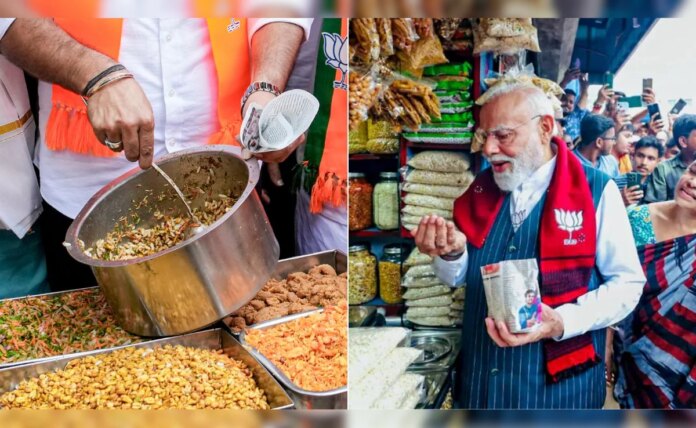

In the charged atmosphere of West Bengal’s political landscape, even the simplest gestures often carry deeper meaning. Prime Minister Narendra Modi’s decision to stop and enjoy jhalmuri during his visit to the state may have appeared casual at first glance, but in electoral politics, such moments rarely remain just symbolic. Instead, they evolve into powerful narratives that reflect intent, connection, and messaging.
Interestingly, jhalmuri is now set to be a part of the celebrations during the swearing-in ceremony of the newly elected cabinet of the BJP government in West Bengal. These preparations will be made on the sidelines of the massive show of strength planned at the brigade parade ground in Kolkata on Saturday (May 9) morning.
Read: “I Ate Jhalmuri, But Trinamool Felt The Sting”: PM Modi In Bengal
Jhalmuri is not just a snack in Bengal. It is woven into the fabric of everyday public life. From railway stations and college campuses to bustling markets and political rallies, it is omnipresent. In a state where politics thrives on street-level engagement and mass participation, the prime minister associating himself with something so intrinsically local sends a deliberate signal: leadership that is visible, accessible, and rooted among the people.
More importantly, jhalmuri represents affordability and inclusivity. It is consumed across class lines, making it a shared cultural experience for both the affluent and the economically weaker sections. By choosing to engage with this everyday element, PM Modi projected a leadership that resonates with the lived realities of ordinary citizens, bridging the gap between governance and grassroots life.
What seemed like a fleeting visual quickly transformed into a layered political message. In the context of elections, such gestures symbolise simplicity, humility, and relatability — qualities that are often strategically highlighted to build trust among voters. It reinforces a style of politics where leaders are not distant figures but participants in the daily rhythms of society.
The moment also subtly underscores the importance of India’s informal economy. Street vendors selling jhalmuri are part of a vast network of small entrepreneurs who sustain urban and semi-urban livelihoods. Initiatives like PM SVANidhi, aimed at supporting street vendors with financial assistance, find indirect reflection in such public interactions–linking policy intent with visible ground-level engagement.
At another level, the gesture aligns with broader national campaigns like “Vocal for Local” and “Atmanirbhar Bharat.”
Jhalmuri, as a traditional and locally sourced food item, becomes a cultural symbol, reinforcing the importance of indigenous products and self-reliance. It reflects an understanding of regional identity and the significance of cultural markers in shaping political narratives.
Opinion: PM Modi’s ‘Jhalmuri’ Moment: When The Snack Becomes The Story
West Bengal’s politics has always been deeply influenced by cultural symbolism and emotional connection. In this context, the jhalmuri moment goes beyond optics. It demonstrates an awareness of the state’s socio-cultural pulse. It shows how political communication in Bengal is not just about speeches or rallies, but about subtle integration into everyday life.
Such imagery also plays a crucial role in modern political storytelling. In an era dominated by visual media and social platforms, moments like these travel fast and leave a lasting impression. They help build an emotional bridge between leadership and the electorate, reinforcing perceptions of authenticity and approachability.
Ultimately, jhalmuri in this narrative is far more than a snack. It becomes a metaphor. A metaphor for simplicity, inclusivity, and the everyday struggles and aspirations of millions. Through a single, seemingly ordinary act, a larger message is conveyed: governance that is grounded, inclusive, and connected to the pulse of the people.