
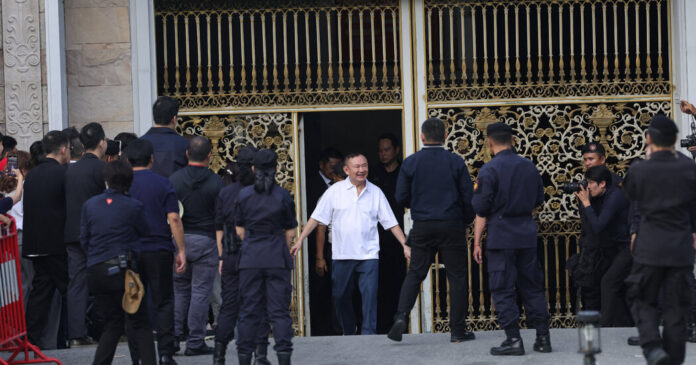

Thaksin Shinawatra, a former prime minister who has been a potent political force in Thailand for decades, was released from prison on Monday after a parole board reduced his sentence, partly for good behavior.
Only a year ago he seemed to be at the summit of Thai politics — Paetongtarn Shinawatra, his daughter, was prime minister, and Mr. Thaksin was seen as an influential power broker behind the scenes.
But in August, Ms. Paetongtarn was dismissed as premier, and the following month, Mr. Thaksin, 76, was ordered to serve a year in prison for past convictions for corruption and abuse of power.
At about 7.40 a.m., Mr. Thaksin emerged from the Klong Prem Central Prison in northern Bangkok, smiling and greeting his family and members of his Pheu Thai political party. He left without taking questions from reporters.
Here’s a quick recap of how Mr. Thaksin’s journey.
A Populist Rising
In 2001, Mr. Thaksin, a telecommunications billionaire, was elected prime minister as he promised populist policies such as a universal health care program and low-interest-rate loans for rural communities.
He quickly became a foil to the royalist-military establishment in Thailand, which is a constitutional monarchy. Mr. Thaksin’s policies ultimately posed a threat to the elites because he sought to “rearrange the political or social order,” said Siripan Nogsuan Sawasdee, a professor of political science at Chulalongkorn University in Bangkok.
Mr. Thaksin was re-elected, but in 2006, he was ousted in a coup. His removal reverberated in Thailand for years as pro-Thaksin and anti-Thaksin groups battled it out in the streets. He went voluntarily into exile, living mostly in Dubai.
A Resurgence From Exile
Mr. Thaksin’s influence continued while he was outside Thailand, with parties linked to him winning elections. His sister Yingluck Shinawatra was elected prime minister in 2011 but three years later she, too, was removed in a coup.
By 2020, a new progressive movement became the leading force in Thai politics, agitating for change. That appeared tantalizingly close in 2023, when the Move Forward Party won the general election but was blocked by the conservative establishment from forming a government.
Around that time, Mr. Thaksin made a dramatic return to Thailand. To many, it appeared he had finally cut a deal with his former antagonists — and his Pheu Thai Party formed the government.
As for Mr. Thaksin, he was promptly sentenced to eight years in prison for a previous conviction in absentia on charges of corruption and abuse of power. But on his first day in prison, Mr. Thaksin was transferred to a V.I.P. suite at a hospital for chest tightness, hypertension and low blood oxygen levels.
Later, he received a royal pardon and was released six months later, effectively not spending a day in prison.
A few months later, Ms. Paetongtarn, a political novice, ascended to the prime ministership. It appeared that Mr. Thaksin’s resurgence was complete.
Another Downfall
Only a few months into her tenure, Ms. Paetongtarn caused an uproar when she appeared overly deferential in an interaction with Hun Sen, the strongman in neighboring Cambodia. That led to her swift downfall.
Mr. Thaksin, too, found himself in legal jeopardy. He beat charges in a case related to Thailand’s infamous royal defamation law, but in September was sentenced to a year in prison over charges related to a prior conviction. At the time, he said he wanted to “bring closure to everything in the past — whether legal battles or conflicts related to me.”
Now Mr. Thaksin’s Pheu Thai Party is part of the governing coalition, and some critics worry that the former prime minister will have undue influence.
“When he’s out, I’m not sure if Thailand will have two prime ministers or not,” said Pichit Chaimongkol, the leader of the People and Student Network for the Reform of Thailand, a group that petitioned the Justice Ministry to block Mr. Thaksin’s parole.
Mr. Thaksin was granted parole because he’s older than 70 and had shown an improvement in his attitude and behavior, according to the Department of Corrections. It added that there is a low risk of him offending again.
Mr. Thaksin will have to wear an electronic monitoring device for four months, in line with parole conditions, and many analysts expect him to try to stay out of the limelight this time.
But in a country where the entrenched royalist-military establishment has long thought of him as a foil, the question remains as to whether his laying low will be enough.
The attorney general is appealing Mr. Thaksin’s previous acquittal relating to the royal defamation case.
Ms. Siripan of Chulalongkorn University said that she believes Mr. Thaksin will always be regarded as a threat to the old guard, adding, “I don’t think they will ever trust him.”