
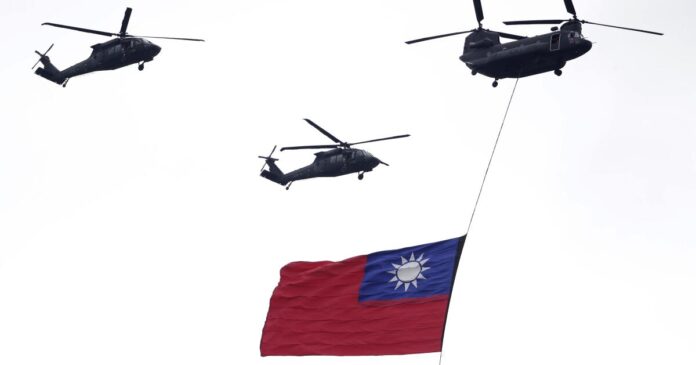

TAIPEI, Taiwan — A resolute Secretary of State Marco Rubio took to the White House lectern Tuesday and declared the United States, under President Trump’s leadership, had launched a bold new operation to reopen the Strait of Hormuz, based on the principle that international waterways must remain free.
An hour later, Trump walked it all back, ending the complex military endeavor after less than a day.
It was just the latest evidence to America’s allies that the word of the U.S. government is subject entirely to the president’s whims. And such is the worry fueling concerns in Taipei ahead of Trump’s state visit to China this week.
Privately, senior administration officials have assured Taiwanese leadership ahead of the trip that Trump has no intention of changing long-standing U.S. policy on the island, two sources familiar with the discussions said — a stance of “strategic ambiguity” that has avoided any declarative statements on Taiwanese independence since it was coined by Henry Kissinger 55 years ago.
A White House official was definitive that U.S. policy toward Taiwan “remains the same as the first Trump administration.”
“The U.S. One China policy, as our cross-strait policies are collectively known, is based on the Taiwan Relations Act, the three U.S.-PRC Joint Communiques and the Six Assurances to Taiwan,” the official said. “There is no change to our policy with respect to Taiwan.”
But Chinese officials told The Times that their president, Xi Jinping, intends to raise the matter as a top priority, knowing that only one person — Trump himself — speaks for the administration today.
Whether Xi can leverage the intimacy of a private audience to shift Trump’s stance, potentially linking it to other U.S. objectives, is the source of significant concern here.
Taiwanese officials fear even the most subtle rhetorical change in policy from Trump could imperil a delicate status quo that has held, to its benefit, for decades. They have similarly sought assurances that the administration will follow through on a pending U.S. arms sale worth over $10 billion, which received approval from Taiwan’s legislature on Friday.
“The most serious scenario would be if President Trump were to make an impromptu statement, such as, ‘I oppose Taiwanese independence,’ particularly if he were to link this to trade, the Iran issue, or a summit agreement,” said Chienyu Shih, of the Institute for National Defense and Security Research in Taiwan. “This would constitute a rhetorical concession of substantial significance to Beijing.”
Rubio told reporters at his news conference Tuesday — with a similar confidence he expressed on the Iran file — that China understands Washington’s long-standing position on the island.
“I’m sure Taiwan will be a topic of conversation. It always is. The Chinese understand our position on that topic — we understand theirs,” Rubio said.
“I think both countries understand that it is in neither one of our interests to see anything destabilizing happen in that part of the world,” he added. “We don’t need any destabilizing events to occur with regards to Taiwan, or anywhere in the Indo-Pacific. And that’s to the mutual benefit of both the United States and the Chinese.”
Trump has suggested a willingness to shift U.S. policy on Taiwan before.
During his initial campaign for the presidency in 2016, Trump openly questioned the One China policy, drawing ire from Beijing for suggesting he might endorse Taiwanese independence. He accepted a call from Taiwan’s president after his victory and would later support significant arms sales to Taipei.
And yet, at a 2017 meeting with Xi, Trump vacillated, telling the Chinese leader he could “deal with” the Taiwan issue in “a matter of months,” according to the Wall Street Journal. The Chinese were reportedly so flabbergasted by the comment that they dismissed it as rhetorical flourish.
“There is concern that the conversation between the two leaders could veer into sensitive territory on the topic of Taiwan,” said Brian Hart, deputy director of the China Power Project at the Center for Strategic and International Studies, “but there are many in the administration who would still appreciate the importance of general continuity in U.S. policy.”
U.S. support for Taiwan’s democratic movement used to be a matter of principle. Today, Washington sees it as a matter of national security. Over 60% of semiconductors are produced in Taiwan, including 90% of the world’s most advanced chips. And it is viewed as the clasp of the first island chain guarding against Chinese maritime expansion.
A robust debate between Taiwan’s Cabinet and the opposition in parliament ended Friday not over whether to accept U.S. defense equipment, but over how much to spend. The Legislative Yuan approved $24 billion in purchases — including a defense package passed by Congress in December and the pending arms sale — falling short of Taipei’s $40-billion proposal.
Anticipation for the president’s state visit is high here in the capital city, where local news is filled with questions over the influence Trump’s war in Iran might have on his appetite for supporting Taiwan.
Chinese defense analysts have seen the war as a sign of U.S. weakness. But Taiwanese defense experts have taken away a different lesson: cheap equipment from a lesser military, such as dumb mines thrown in a strait, may just be enough to paralyze a superpower.
The latest U.S. National Security Strategy, released by the Trump administration in December, emphasized the importance of support for Taiwan and the status quo.
But the Taiwanese took note that the strategy also called for an end to forever wars in the Middle East, offering little preview of the president’s sudden strategic pivot on Iran in February, launching a war few saw coming.
What Trump chooses to say in China “might be difficult to predict,” said Jyh-Shyang Sheu, a scholar of Chinese politics and military capabilities based in Taiwan.
But “in Taipei, we are still focusing on the U.S. policy,” he added, “more focusing on what he does instead of what he says.”