
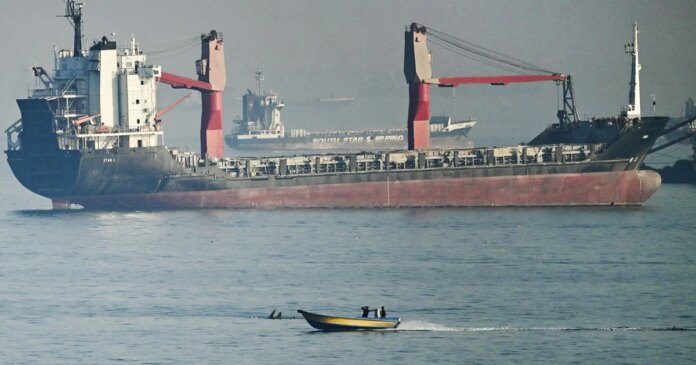
Saudi officials were angered by President Donald Trump’s surprise announcement that the U.S. would start guiding ships through the Strait of Hormuz, fearing the move could spur more Iranian attacks on Gulf allies and reignite the conflict, two U.S. officials said.
Subscribe to read this story ad-free
Get unlimited access to ad-free articles and exclusive content.


NBC News reported this week that Washington launched the operation without notifying key Gulf allies first.
In response, the Kingdom informed the U.S. it would not allow the U.S. military to fly aircraft from Prince Sultan Airbase southeast of Riyadh or fly through Saudi airspace to support the effort, the officials said. Trump paused the operation 36 hours after it was started, and the airspace was reopened.
Project Freedom was the Trump administration’s effort to get traffic moving through the strait that has been blocked by Iran since the U.S. and Israel-led war began. The operation came after a ceasefire was declared April 8 to broker a peace deal. The U.S. and Iran are negotiating.
Unlike some other countries in the region, Saudi Arabia can still move oil without ships transiting the Strait of Hormuz. Their East-West pipeline, which runs 750 miles from the Persian Gulf to the Red Sea, bypasses the strait and can export millions of gallons of oil every day. The pipeline better positions the Saudis if the strait remains closed or too dangerous to transit because they can still move their oil out of the region.
“The Kingdom of Saudi Arabia continues to stand in support of de-escalation and avoiding escalation, as well as negotiations and the efforts undertaken regarding them,” Ambassador Dr. Rayed Krimly, the Saudi deputy minister for public diplomacy, posted on X.
A Middle East official said the Kingdom preferred diplomacy, but reserves the right to self-defense and supports Gulf allies’ right to self-defense.
“The way Project Freedom was to be executed was risky and could have triggered escalation,” the official said. Gulf allies could have suffered “catastrophic” strikes, the official said. “All was resolved though within hours and was less dramatic than it sounds,” the official said.
The official said these issues would have been handled previously with a few phone calls, “but given the world we live in today the rush to put things out on social media puts things on high focus,” the official said.
The White House will not say whether or when Project Freedom will resume, and the president reserves all options available to him, according to a senior White House official. The White House continues to dispute that there were ever restrictions placed on the U.S. related to the operation.
“The focus is on getting a deal done,” according to the senior Trump administration official.
One of the officials said the operation would not resume anytime soon because the Gulf allies’ concerns remained.
When the Saudis and other Gulf allies spoke with both Trump administration and U.S. military officials to express their concerns that the operation might be too risky, and to ask how the U.S. would respond to Iranian aggression over the operation, the U.S. made clear that a peace deal was the primary focus and the U.S. would likely not respond to Iranian strikes on infrastructure in the region, the U.S. officials said.
The president announced the operation Sunday in a social media post, and his top national security advisers spent the next 36 hours talking up the effort to help commercial vessels through the strait, only for Trump to abruptly call it off.
The U.S. military had been lining up a number of additional ships in the Gulf for transit through the strait when the operation was stopped, a third U.S. official said. U.S. Central Command had earlier announced that two U.S.-flagged ships had made it through the strait as part of the operation.

Kuwait also said it would revoke U.S. military use of its bases and airspace to support Project Freedom until Trump reversed course, according to the two officials. The Kuwaiti embassy didn’t immediately return a message seeking comment.
The U.S. military refers to permission to use another country’s territory as ABO, which stands for access, basing and overflight. Fighter jets, refueling tankers and support aircraft all need permission to fly from key regional allies. Saudi Arabia and Jordan are critical for allowing aircraft to base there, Kuwait is critical for overflight, and Oman for both overflight and naval logistics.
The White House has previously said that “regional allies were notified in advance.”