

Bhopal:
In a state where one statement on reservation once triggered upper-caste rebellion, birthed SAPAKS, and helped bring down a BJP government, former chief minister Uma Bharti has once again thrust Madhya Pradesh into the heart of India’s most politically combustible debate.
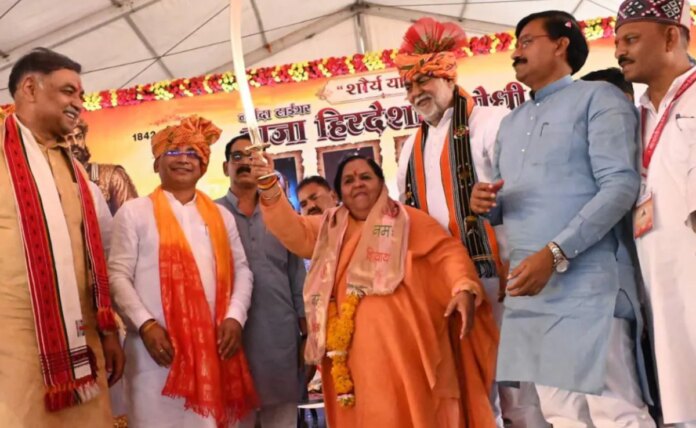
In Bhopal’s Jamboree Maidan on Tuesday, while addressing the Raja Hirde Shah Lodhi Shaurya Yatra, Uma Bharti delivered an unapologetically hardline defence of reservation, declaring that the system cannot and should not end until India’s deepest social inequalities are dismantled.
“As long as the family members of the president, prime minister, and chief justice do not study together in government schools, absolutely no one can abolish reservation,” Uma Bharti said before a massive gathering.
The remark reopened one of the BJP’s most sensitive pressure points in Madhya Pradesh, caste, social justice, and the volatile balance between OBC consolidation and upper-caste backlash.
In 2016, then chief minister Shivraj Singh Chouhan made a similar assurance protecting reservation. The fallout was politically devastating. Furious upper-caste mobilization led to the rise of SAPAKS Sangh, massive statewide protests, Karni Sena backing, and a wave of anti-BJP sentiment that many believe contributed heavily to the party’s 2018 Assembly defeat.
By reviving an aggressive pro-reservation narrative, Uma has not merely spoken on social justice she has reignited a political minefield. Her speech was delivered from the platform of Lodhi assertion, and that context matters.
The Lodhi community, spread across nearly 25 crucial Assembly constituencies in Madhya Pradesh particularly in Bundelkhand and Gwalior-Chambal holds enormous electoral influence. Combined with Uttar Pradesh and Rajasthan, the Lodhi vote can shape dozens of Lok Sabha seats.
Uma Bharti knows this arithmetic intimately. Her speech effectively fused reservation politics with backward caste identity, social equality, and community power projection. She argued that caste divisions and structural inequalities remain deeply entrenched, and reservation remains one of the few mechanisms capable of correcting historical imbalance.
The shared stage of Uma Bharti and Prahlad Patel signaled more than ceremonial community outreach. It showcased the continuing political weight of Lodhi leadership inside the BJP and hinted at the possible emergence of a stronger Lodhi-centered influence bloc.
Uma Bharti said that the Lodhi community has a significant population and plays a decisive role in the formation of governments. She asserted that this community possesses the political strength to make governments.
Uma Bharti has previously underscored this political strength, openly stating that parties seek Lodhi votes by using her image during elections. She had remarked that the community wields enough electoral power to influence around 50 Assembly seats, including 27 key constituencies in Madhya Pradesh, while in Uttar Pradesh, Lodhi’s impact nearly 70 seats. Expanding this across Rajasthan, Uttar Pradesh, and Madhya Pradesh, she asserted that the Lodhi community holds sway over 30 to 40 Lok Sabha constituencies making it one of North India’s most politically significant caste blocs.
Meanwhile, controversial BJP MLA Pritam Lodhi amplified the symbolism by demanding Bharat Ratna for Uma Bharti and Kalyan Singh, aggressively reinforcing backward caste pride and political recognition.
MLA Pritam Lodhi stirred controversy by declaring, “If Hema Malini’s Dharmendra can receive the Bharat Ratna, then why can’t our Kalyan Singh Babu Ji?” However, while veteran actor Dharmendra has been honored by the Government of India with the Padma Bhushan and Padma Vibhushan, he has not been awarded the Bharat Ratna.
Chief Minister Mohan Yadav’s invocation of Raja Hirde Shah Lodhi’s anti-British legacy further elevated the event from social commemoration to political consolidation. He said that Raja Hirde Shah forged a distinct identity by uniting the Bundela and Gond communities and posed a formidable challenge to British rule.
He announced that research would be conducted on Raja Hirde Shah’s life and legacy, and efforts would also be made through the Education Department to incorporate his struggle-filled journey into the academic curriculum. Known as the “Narmada Tiger,” Raja Hirde Shah resolved in 1842 to fight against British rule and continued his resistance alongside his brothers until 1858.