

Bright orange flashes and a roiling funnel of black smoke filled the air as Israeli fighter jets struck Iran’s naval command center at the port of Bandar Anzali. Israel said it also destroyed several Iranian navy vessels and called the strike “one of the most significant” it had conducted during combat operations against Iran.
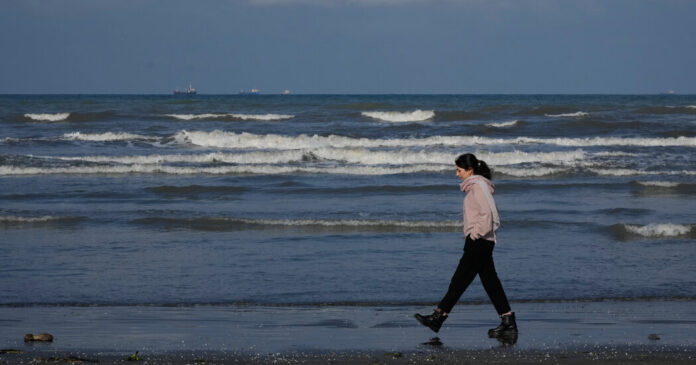
Yet the attack in March, captured in footage released by Israel’s military, happened not on the strategically critical Persian Gulf, but on the Caspian Sea, a huge body of water hundreds of miles north. Routinely overlooked, the Caspian has taken on new significance as a trade route linking Russia and Iran.
For two allies that have been embroiled in wars and facing more Western sanctions than any other country, the waterway provides a passageway for both overt and covert trade — shipments that have helped Iran persist as an adversary to the United States despite overwhelming American military superiority.
Russia is shipping drone components to Iran via the Caspian Sea, U.S. officials say, helping Iran rebuild its offensive abilities after losing roughly 60 percent of its drone arsenal during recent fighting. The officials spoke anonymously to divulge private military assessments.
Russia also provides goods that would typically pass through the Strait of Hormuz, now blockaded by the U.S. Navy, as part of global trade.
Iranian officials have said that efforts to open alternative trade routes are progressing rapidly, with four Iranian ports along the Caspian working around the clock to bring in wheat, corn, animal feed, sunflower oil and other supplies. Mohammad Reza Mortazavi, the head of the Association of Iran’s Food Industries, told the state broadcaster IRIB that Iran is actively rerouting essential food imports through the Caspian.
Russian trade officials and port statistics also indicate a swift increase in Caspian shipping in recent months. Two million tons of Russian wheat that used to be shipped to Iran annually through the Black Sea — now under threat of Ukrainian attacks — is going via the Caspian, said Vitaly Chernov, the head of analytics for the PortNews Media Group, which tracks Russia’s maritime industry. “Against the backdrop of instability in the Middle East, Caspian routes to Iran look much more attractive,” he said.
Alexander Sharov, the head of RusIranExpo, which helps Russian exporters find Iranian buyers, estimated in an interview that cargo tonnage across the Caspian could double this year. Although Western sanctions made some major companies hesitant to ship through the Caspian, the Hormuz crisis might help overcome that, he added.
Bigger than Japan, the Caspian is considered the largest lake in the world. Much of the trade passing through it is opaque. It has proved difficult to monitor from afar, not least because ships plying the route between Russian and Iranian ports habitually turn off the transponders that allow for satellite tracking, according to maritime tracking groups. Unlike the Persian Gulf, the United States cannot interdict ships on the Caspian because only the five bordering nations have access.
“If you’re thinking about the ideal place for sanction evasion and military transfers, it’s the Caspian,” said Nicole Grajewski, a professor specializing in Iran and Russia at Sciences Po in Paris.
While both Russia and Iran are public about trade in commodities like wheat, trade in weapons systems is a different issue.
Drone shipments show the close defense partnership between Moscow and Tehran. While it is unlikely the Russian parts play a decisive role in Iran’s war with the United States and Israel, they help bolster Tehran’s drone arsenal. If the shipments continue, they will help Iran to quickly rebuild that arsenal, the U.S. officials said.
The trade flowed in both directions in years past, the officials said, with Iran shipping drones to Russia for use in Ukraine even as Russia sent parts to Iran. The need for supplies from Iran diminished after July 2023 however, when Russia, under license from Iran, began producing its own model of the Shahed drone at a factory in Tatarstan.
In August, for instance, the Ukrainian military announced that it had sunk a Russian vessel at the Russian port of Olya that it said was transporting components for Shahed drones from Iran. It called the port, in the northwest corner of the Caspian, a hub for importing military supplies that aided Moscow’s war effort. (Russia conceded only that the vessel was “damaged.”)
The U.S. Treasury Department had already sanctioned the vessel and its Russian owner, MG-Flot, in September 2024, accusing it of transporting short-range ballistic missiles from Iran to Russia.
For Russia and Iran, the Caspian’s strategic significance has long been obvious. They have been developing plans for two decades to build a trade corridor from the Baltic Sea to the Indian Ocean, running 7,200 kilometers (4,500 miles) through western Russia and then the Caspian basin, in order to avoid Western trade routes. The ambitions exist mostly on paper, but they include replacing the dilapidated shipping fleet and constructing new port facilities and a new rail line.
Experts question whether the conflicts entangling both nations have sapped the considerable resources needed to build the infrastructure for these projects. Among other issues, shallow portions of the Caspian can limit navigation.
Caspian trade presents a delicate balancing act for President Vladimir V. Putin of Russia. With a dwindling number of allies in the Middle East, Mr. Putin wants to support Iran, but overt military aid risks antagonizing President Trump as well as Arab allies important for Russia’s energy trade.
The Caspian remains a significant challenge for the United States as well, in part because it is a diplomatic blind spot. “For American policymakers, the Caspian is a geopolitical black hole; it’s almost like it doesn’t exist,” said Luke Coffey, a senior fellow at the Hudson Institute.
Mr. Coffey pointed out that the nations bordering the Caspian literally fall along fault lines for U.S. military planners: European Command is responsible for Azerbaijan and Russia, while Central Command has responsibility for Iran, as well as Turkmenistan and Kazakhstan. At the State Department, three separate bureaus cover those five countries.
The potential importance of the Caspian came into clearer focus for planners in the United States and Western Europe after Russia’s full-scale invasion of Ukraine in 2022. Russia again used ships in the Caspian to fire missiles at targets in Ukraine, as it had in Syria.
Analysts observed an increase in dark ship traffic, in which container ships turned off their mandatory tracking signals. Iran used the Caspian during the early stages of the war in Ukraine to resupply Russia with ammunition. Then Iran began providing its domestically produced Shahed drones to Russia across the Caspian.
In January 2025, Russia and Iran signed a wide-ranging cooperation treaty. European officials have said that Iran and Russia have continued sharing technology and tactics.
Over the course of the war, Russia improved the design and performance of the drones and began producing them domestically, advances they have shared with Iran, experts believe.
Exactly what war materiel Russia has shipped to Iran since the start of the war remains unclear. The volume of trade cannot come close to matching what Iran used to send and receive through the Strait of Hormuz, especially in terms of the oil exports that generate such a large share of the country’s revenue.
“Russia and Iran have found ways around the sanctions regime,” said Anna Borshchevskaya, an expert on Russia’s Middle East policy at the Washington Institute. “And that’s exactly why the Israelis bombed the port. Because they understood that through this small, very important trade route, Russia can provide a lot of help to Iran.”
Reporting was contributed by Ronen Bergman, Alina Lobzina, Shirin Hakim, Arijeta Lajka and Aric Toler.