

Hyderabad:
India is closing in on a new space milestone, with the Vikram-1 rocket now on its way to Sriharikota ahead of its first launch attempt.
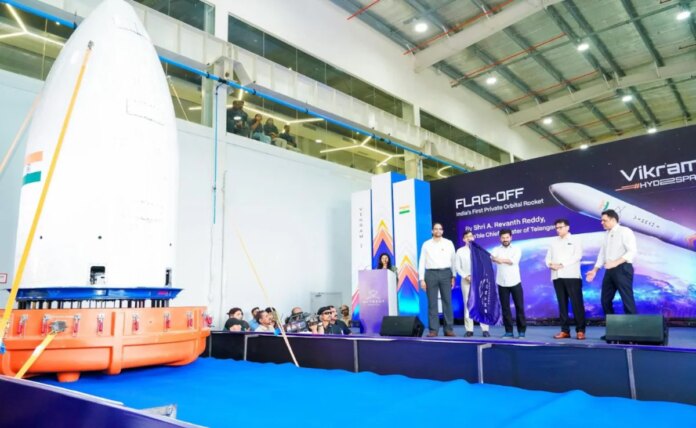
Telangana Chief Minister A Revanth Reddy flagged off the rocket from Hyderabad. It is being transported to the Satish Dhawan Space Centre, where the final phase – integration, system checks and launch preparations – will begin.
The rollout included the payload fairing, the structure that shields satellites during flight. The mission could expand how India accesses space.
Officials said pre-flight testing has been completed, with key propulsion stages already positioned at the spaceport.
Why This Launch Matters
If Vikram-1 succeeds, it could create history as India’s first privately developed rocket to place satellites into orbit, pushing open a space sector long led by the Indian Space Research Organisation (ISRO).
The mission is being cleared by the Indian National Space Promotion and Authorisation Centre (IN-SPACe), with ISRO providing technical oversight. It is part of a broader shift to bring private players into space launches.
An orbital mission, which means placing satellites into sustained orbit, is significantly more complex than earlier suborbital flights.
What Happens Next
At Sriharikota, the rocket moves into final assembly and a round of system checks before a launch window is locked in the coming months.
This is the last stretch before liftoff. Countdown operations, testing and integration now shift fully to the launch site.
One of the company’s founders said the most critical testing has been completed, with launch campaign activities set to begin at the spaceport.
What Is Vikram-1?
Vikram-1 is a multi-stage launch vehicle designed to carry small satellites, up to 350 kg, into low Earth orbit.
It is around seven storeys tall and has been built using carbon composite structures. The vehicle is powered by solid and liquid propulsion systems, including 3D-printed engines.
Developed by Skyroot Aerospace, it is aimed at the fast-growing small satellite launch market.
India’s Private Space Push
India has opened up its space sector to private players, moving beyond a model dominated by ISRO.
In 2022, Skyroot Aerospace carried out a suborbital launch with Vikram-S, marking the entry of private players into India’s spaceflight ecosystem. Vikram-1 is its first attempt at an orbital mission and part of a series of planned launches.