
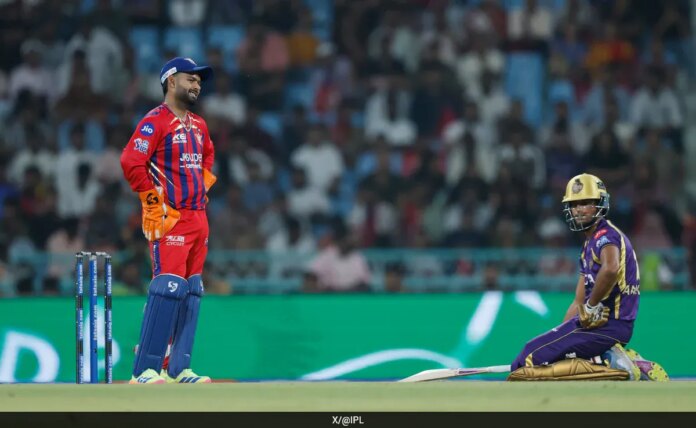

The Indian Premier League (IPL) is divided over the dismissal of Kolkata Knight Riders (KKR) batter Angkrish Raghuvanshi in the match against Lucknow Super Giants (LSG). In the IPL 2026 match on Sunday, Angkrish became only the fourth batter in the T20 league’s history to be given out for obstructing the field. The cricketing world is split on whether the third umpire, Rohan Pandit, was right to signal him out. Former India cricketers Virender Sehwag and Rohan Gavaskar, however, were not in agreement with the third umpire’s call.
For match officials, the criteria for “obstructing the field” calls are simple. They first try to determine if the batter significantly changed the direction of their run and if they did so without probable cause. In Angkrish’s case, the answer to both questions was deemed to be “yes.”
During a discussion on Cricbuzz, however, Rohan argued that Angkrish’s eyes were not on the ball, and therefore, he should not have been given out.
“I think it’s not out because of the way he turned, dived, and jumped. His eyes were not on the ball,” Rohan, the son of the legendary Sunil Gavaskar, said. “He thought, ‘I have dived, turned now, I want to dive.’ It wasn’t his intention to stop the ball. If he wanted to stop the ball, he would have stayed in one place because he was already in the line of the throw. The ball would have hit his body. But when he dives and jumps, it shows that this was unintentional. So, I believe it’s not out.”
Sehwag held a similar opinion, saying the fact that Angkrish looked at the fielder once was natural, as every batter does that while running. For the former India opener, even the dive was justified.
“Every batsman looks at the fielder when the ball goes to them. You take one run, you take two runs, and you see which end is safer. If the throw was coming to the bowling end, there was no need to dive. But when you know the throw is coming to your end, then you will dive. Your eyes will naturally go towards the fielder. It’s not that his eyes were on the fielder because he thought, ‘I am stopping something.’ He dived after that. So, I believe it’s not out,” Sehwag said.
“When he turned, he was looking at the fielder to see where the ball was coming from. But after turning, he ran and jumped. He wasn’t looking at the fielder anymore, nor was his attention in front. In my opinion, a slightly harsh decision has been made here,” the former India opener added.
ANGKRISH RAGHUVANSHI ANGRY ON POOR UMPIRING pic.twitter.com/DBJdg9HRP6
— Rohshh45 (@rohitfc58737) April 26, 2026
What Does the Rule Say on “Obstructing the Field” Dismissals?
The relevant part of the MCC rulebook is cited in the IPL 2026 playing conditions. Clause 37.1.4 states:
“For the avoidance of doubt, if an umpire feels that a batter, in running between the wickets, has significantly changed his direction without probable cause and thereby obstructed a fielder’s attempt to effect a run out, the batter should, on appeal, be given out, obstructing the field. It shall not be relevant whether a run out would have occurred or not.”
Other former cricketers, such as Sanjay Bangar and Carlos Brathwaite, also argued that Angkrish cannot be expected to make a 180-degree turn and that there is bound to be a natural turning radius.
Featured Video Of The Day
IPL 2026 News | Shami’s Sensation Leads Lucknow to First Win of Season
Topics mentioned in this article