
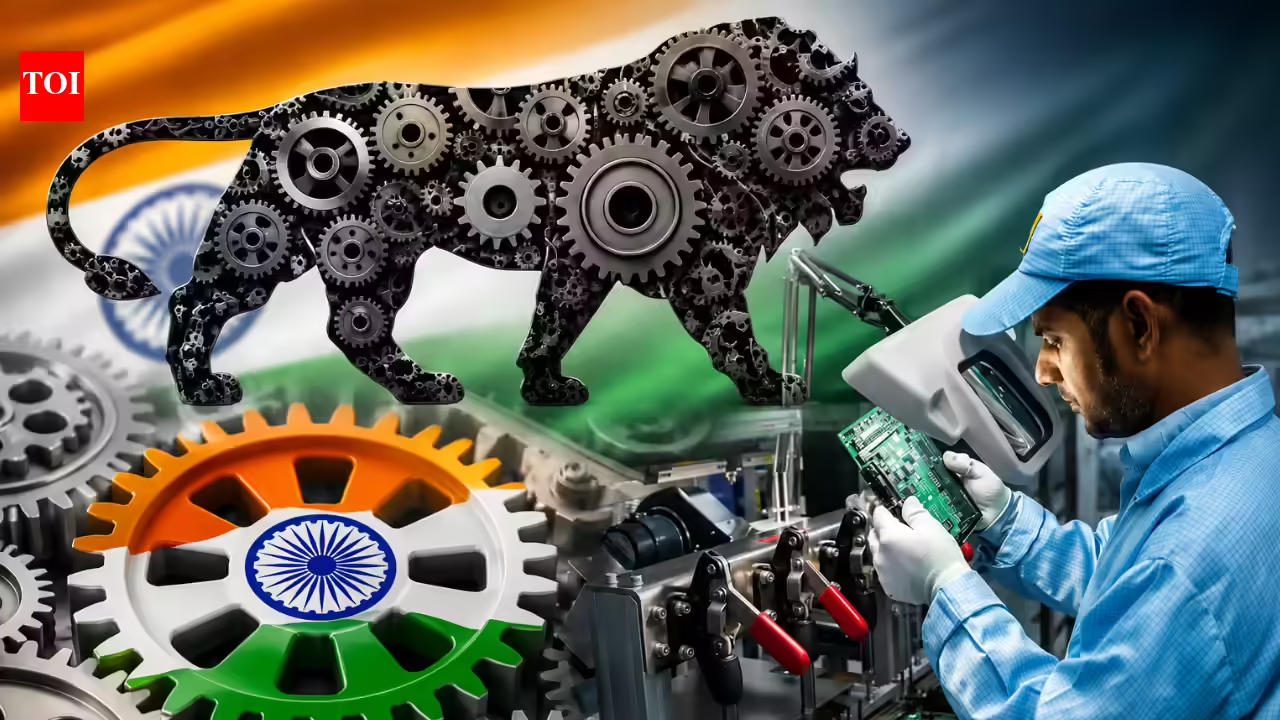

India is preparing a fresh manufacturing push centred on identifying nearly 100 products that are either not produced domestically or are inadequately manufactured despite existing capability, signalling a sharper industrial policy focus amid shifting global supply chains, geopolitical tensions and the country’s ambition to emerge as a global manufacturing hub.The initiative, outlined by Department for Promotion of Industry and Internal Trade (DPIIT) Secretary Amardeep Singh Bhatia, comes alongside a broader policy push that includes faster foreign investment approvals, easing of FDI norms, expanded free trade agreements (FTAs) and a proposed “Made in India” branding framework aimed at improving the global positioning of Indian products.The government’s approach reflects a broader shift in industrial strategy — from focusing primarily on attracting investment to identifying gaps in domestic manufacturing ecosystems and attempting to address them sector-by-sector.
What is the government planning?
Speaking at a Confederation of Indian Industry (CII) event, DPIIT Secretary Amardeep Singh Bhatia said the government is working with industry stakeholders to identify around 100 products that are either not manufactured in India or are being produced in insufficient quantities, as quoted by PTI.The list includes components from the automobile sector such as axles and motorcycle parts, though officials indicated the exercise spans multiple industrial segments.“Another area where we have been working is to bring in another 100 products which are either not getting manufactured in India as of now or which are not sufficiently being manufactured at the moment,” Bhatia said.The objective is to expand domestic manufacturing capacity for both local consumption and exports.“We are working closely with the industry (on that),” DPIIT secretary said, adding that many products are not manufactured in India despite existing capability, with gaps often linked to technology or scale.The initiative also reflects a structural challenge within Indian manufacturing. Several industrial products and intermediate components continue to be imported despite India possessing engineering capabilities, labour scale and market demand to support local production.
Why this push matters now
Over the past few years, India has increasingly attempted to position itself as an alternative manufacturing destination amid global supply-chain diversification efforts and geopolitical tensions.Disruptions caused first by the Covid-19 pandemic and later by the Russia-Ukraine conflict and the ongoing Middle East crisis exposed vulnerabilities in concentrated global production networks.India now increasingly views manufacturing resilience as both an economic and strategic priority.The government’s Production Linked Incentive (PLI) schemes, semiconductor initiatives, electronics manufacturing incentives and logistics reforms have already aimed to deepen domestic industrial capacity. The latest 100-product identification exercise appears intended to extend that effort into component ecosystems and industrial sub-sectors.The focus on auto components is particularly significant because India already has a strong automobile manufacturing base but still depends on imports for several high-value precision components and specialised industrial inputs.
Where FDI comes from and the manufacturing gap in which sectors
India’s total foreign direct investment (FDI), including equity inflows, reinvested earnings and other capital, has crossed $1.14 trillion since April 2000, according to government data. Fresh equity inflows alone stood at $776.75 billion during April 2000-December 2025.During April-February 2025-26, total FDI inflows crossed $88 billion. The services sector remains the largest FDI recipient, followed by software and hardware, telecom, trading, automobiles, construction and pharmaceuticals. Yet India continues to import large quantities of industrial machinery, electronic components, precision engineering goods and intermediate manufacturing products.
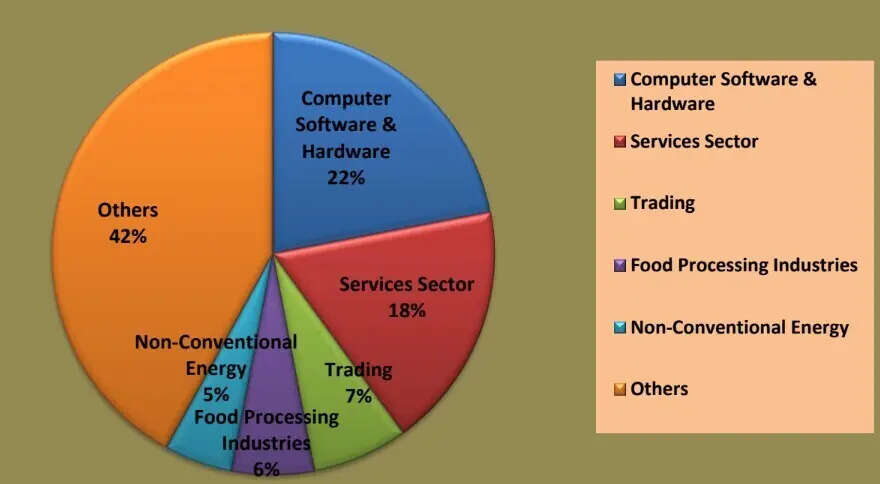
Sector-wise distribution of FDI equity inflows (April to December 2025)
Singapore accounted for 37 per cent of FDI equity inflows during April-December 2025, followed by the US at 16 per cent and Mauritius at 10 per cent.
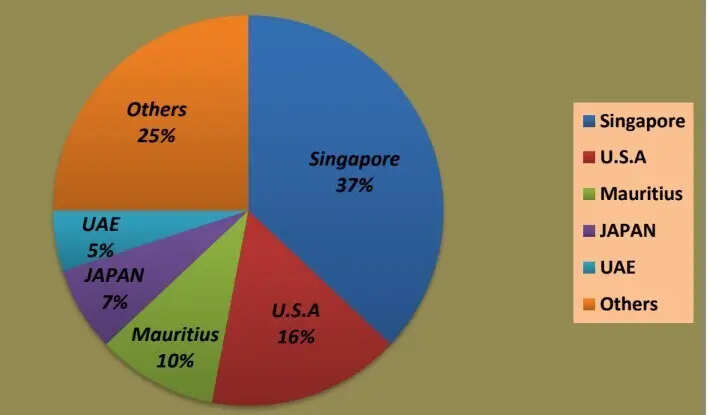
FDI equity inflow in top 5 countries, (April to December 2025)
At the same time, technology-intensive manufacturing economies such as Germany, South Korea and Taiwan continue to account for a relatively modest share of overall inflows.Policy analysts have argued that attracting a greater share of manufacturing-linked FDI from technology-exporting economies will be important if India wants to move beyond assembly-led growth towards deeper value addition and industrial capability building.Government officials increasingly acknowledge that without stronger domestic supplier ecosystems, India’s manufacturing expansion risks remaining dependent on imported intermediate goods and high-value components.
Faster approvals and easing FDI norms
Alongside the manufacturing push, the government has updated its Standard Operating Procedure (SOP) for processing FDI proposals.Under the revised framework, all FDI applications requiring government approval are to be cleared within 12 weeks, compared with the earlier 10-week timeline prescribed in 2017.The process is also being made fully paperless through the National Single Window System portal.
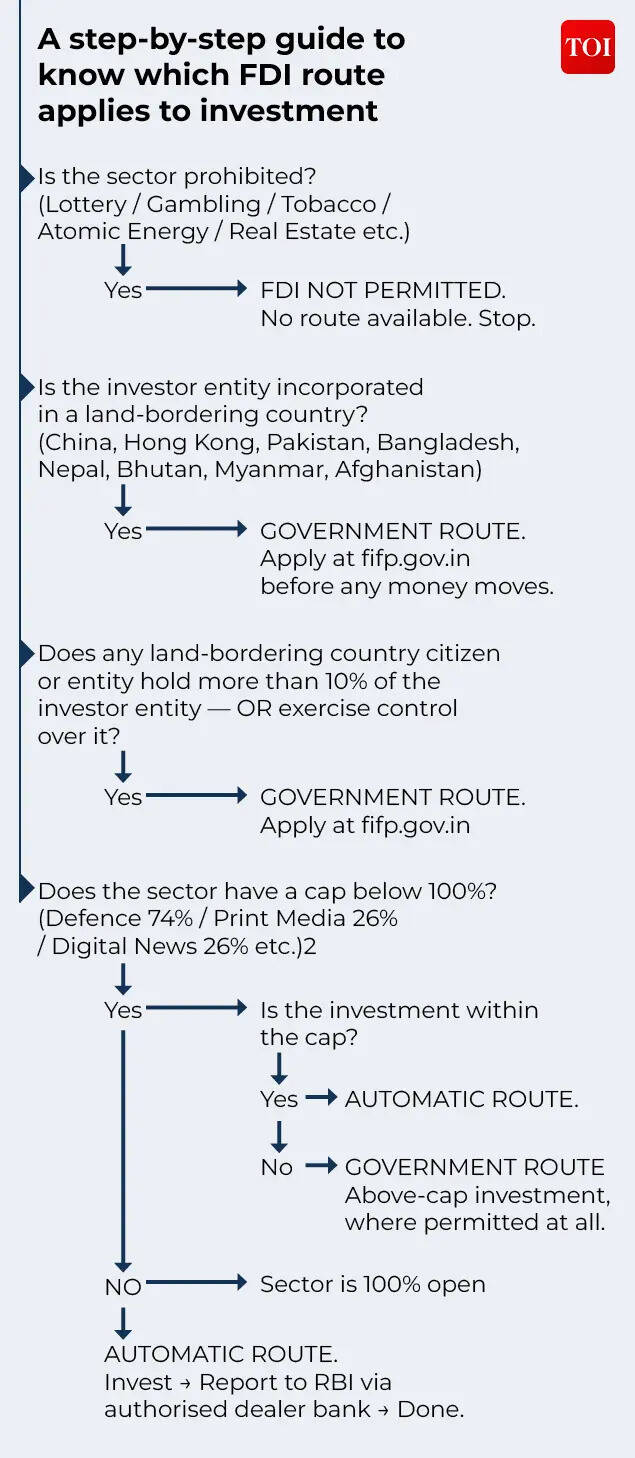
The updated SOP further introduces stricter timelines for consultations with ministries and regulators such as the RBI, Ministry of Home Affairs and Ministry of External Affairs. In cases where comments are not received within the stipulated period, it will be presumed that the concerned department has no objections.The changes come after the government eased certain provisions linked to Press Note 3 (PN3) — the 2020 framework introduced after the Galwan clashes to scrutinise investments from countries sharing land borders with India.Under the latest relaxation, foreign companies with up to 10 per cent Chinese or Hong Kong shareholding can now invest through the automatic route in sectors already open to automatic FDI approval, provided the stake remains non-controlling.The government has also announced expedited 60-day clearances for investments in sectors such as capital goods, electronic components, advanced battery components, polysilicon wafers and rare earth processing.
Why FTAs are central to the strategy
The manufacturing push is also closely linked to India’s expanding trade agreement network.Commerce Minister Piyush Goyal recently said India aims to take exports to $1 trillion in the current financial year after achieving record goods and services exports of $863.11 billion in 2025-26.India has concluded multiple FTAs in recent years, including agreements with the UAE, UK, Australia, New Zealand, Mauritius and the European Free Trade Association (EFTA) bloc, while negotiations continue with several other economies.
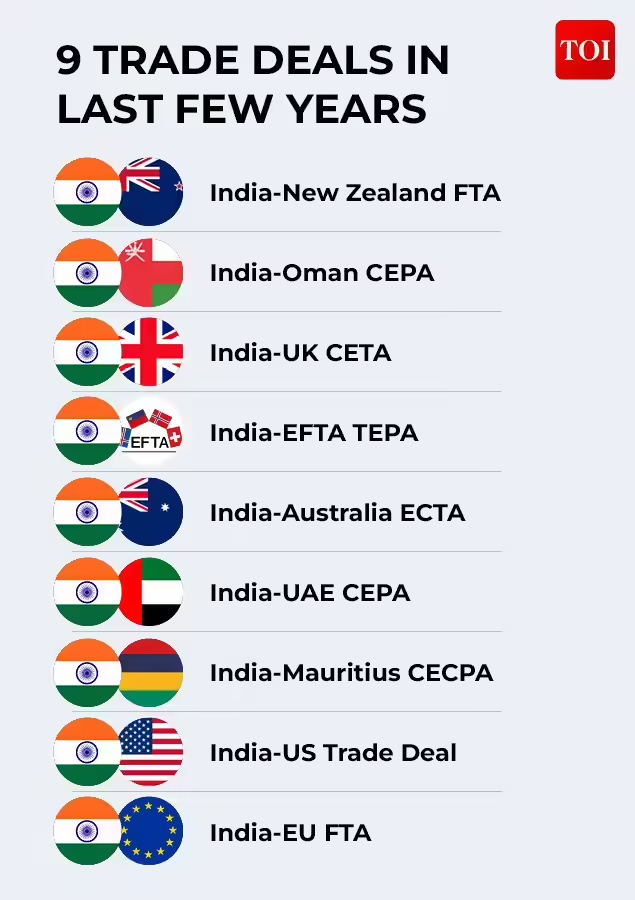
For policymakers, the strategy increasingly involves integrating investment, manufacturing and trade policy — attracting investment, strengthening supplier ecosystems, integrating Indian firms into global value chains and using FTAs to secure overseas market access.
The proposed ‘Made in India’ branding push
Alongside industrial reforms, DPIIT is also preparing to launch a “Made in India Brand Scheme”.The programme, currently being piloted in the steel sector, aims to create a quality-assurance and value-addition certification system supported by a common logo.Officials say the objective is not merely to label products as Indian-made but also to build greater global confidence around manufacturing quality and standards.The approach mirrors strategies previously adopted by countries such as Germany, Japan and South Korea, where manufacturing identity became closely associated with quality and reliability over time.
The bigger challenge
Despite the renewed policy push, India’s manufacturing sector continues to face structural constraints that have persisted for decades. Manufacturing’s contribution to GDP has largely remained stuck in the 15-17 per cent range over the past two decades, well below the ambitions outlined in the National Manufacturing Policy, 2011, which had targeted raising the sector’s share to 25 per cent of GDP and generating 100 million jobs.While India has improved its ease of doing business, expanded infrastructure spending and rolled out production-linked incentives, industry continues to flag deeper bottlenecks ranging from high logistics costs and fragmented supply chains to regulatory complexity, uneven infrastructure quality, skill shortages, research & development, innovation and technology adoption like AI.DPIIT secretary Bhatia said that artificial intelligence is advancing fast and is affecting manufacturing through higher productivity and innovation.”We should be ready for that…world over, this change has been felt,” Bhatia said.A parliamentary standing committee on commerce, in a March 2026 report, urged stronger efforts to reduce import dependence in sectors such as electronics, crude petroleum and gold, while emphasising domestic value addition.“Department should undertake a strategic diversification of India’s merchandise export basket with a clear shift towards high-value sectors and emphasise the need to revitalising labour-intensive industries through targeted policy support and effective utilization of existing schemes.” ” The parliamentary standing committee on commerce noted.
The Committee further recommends strengthening of domestic manufacturing capabilities to reduce dependence on imports particularly in crude petroleum, gold and electronic components and also focus on capacity building measures and strengthening supply chain. Value addition initiative should be at priority to enhance competitiveness and improve overall trade balance with focus on real ‘Make in India’ and ‘Aatmanirbhar Bharat’
The parliamentary standing committee on commerce, March 2026 report.
The Economic Survey 2025-26 similarly argued that manufacturing capability should increasingly be treated as a strategic national asset, with the state playing a larger coordinating and capability-building role.The challenge for India, therefore, is no longer limited to attracting factories. It increasingly involves building complete industrial ecosystems capable of competing with established global manufacturing networks.As India advances towards its long-term economic ambitions, policymakers appear to be recognising that the next phase of manufacturing growth may depend less on headline investment announcements and more on whether the country can successfully localise the products, components and technologies it still imports at scale.