
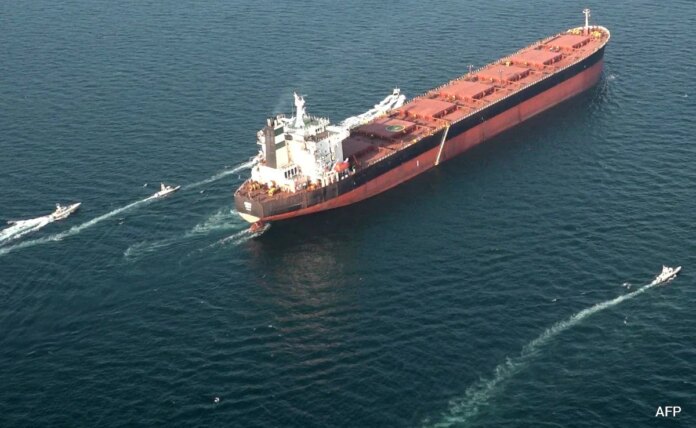

A suspected drone or missile attack resulted in the sinking of an Indian cargo ship within Omani territorial waters on Wednesday morning. Although it remains unclear who carried out the attack, the usual suspect, at least in the public eye, is Iran, which has targeted commercial shipping transiting the Strait of Hormuz without its approval since it imposed a blockade in March.
The Ministry of External Affairs (MEA) has strongly condemned the attack as “unacceptable”. “We deplore the fact that commercial shipping and civilian mariners continue to be targeted,” it stated on Thursday.
MV Haji Ali, a 57-metre-long and 14-metre-wide vessel, was reportedly transporting cattle from the Somali port of Berbera to the Emirati port of Sharjah. According to reports, it was attacked near Limah, off Oman’s northern coast, at approximately 3:30 am on 13 May.
The location of the attack suggests that the cargo ship was following a new shipping corridor that emerged after Iran blocked the main shipping lanes in the Strait of Hormuz in March. After launching “Project Freedom”, the US Navy instructed mariners to use the same route for safe passage. NDTV reported on the emergence of this new route in the waterway in early April.
According to the UK Maritime Trade Operations Centre (UKMTO), four vessels following this route came under attack on 4 May and 6 May. Another vessel had a close encounter.
For more than a month, numerous ships, including small Indian vessels, have taken this route to cross the waterway, often travelling without transmitting critical information intended to maintain the safety of the waters under normal conditions. Despite media coverage, there were no major reported attacks on ships, whether small or large, using this shipping route until 4 May, according to UKMTO data.
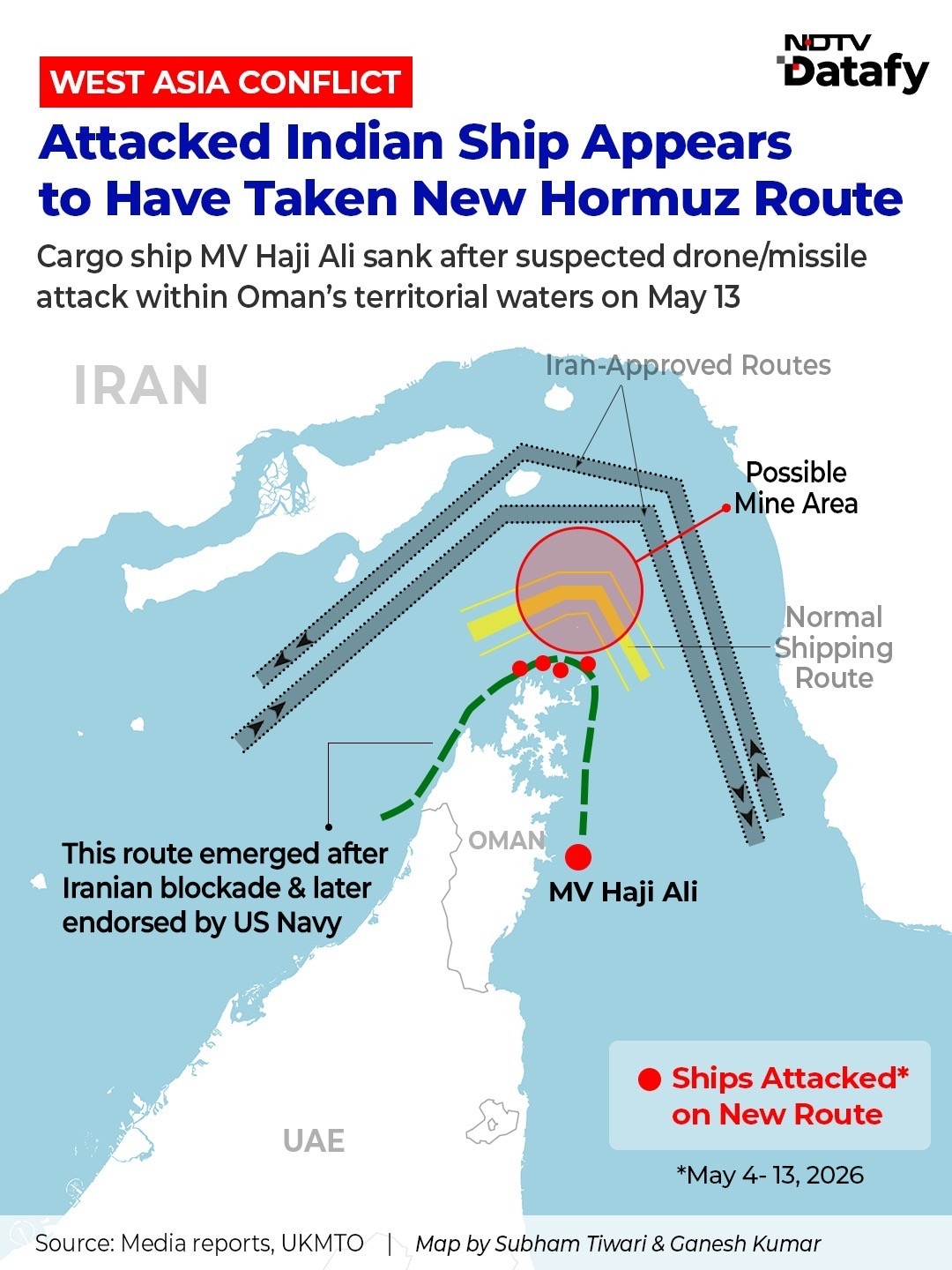
Vessels in the region are increasingly travelling without transmitting critical safety information.
However, five attacks in just ten days suggest that Iran now intends to maintain a firmer grip on the Strait of Hormuz. It also signals that Iranian forces are imposing their own definition of the strait more aggressively.
A day before the attack and sinking of MV Haji Ali, Iran asserted that “the scope of the Strait of Hormuz has been significantly expanded”. It has “transformed into a vast operational region”, according to Mohammad Akbarzadeh, the political deputy of the Navy of the Islamic Revolutionary Guards Corps, as reported by the New York Times.
Before the war commenced, the narrowest point of the channel between Oman’s northern tip and Qeshm Island was considered to be the Strait of Hormuz. Iran now defines the area as “extending from the coasts of Jask and Sirik to beyond Greater Tunb Island”.
Satellite imagery of the Strait of Hormuz and the Gulf of Oman shows hundreds of fast boats, potentially belonging to the Iranian Revolutionary Guards Corps, patrolling the waters.
Since the US-Israeli military operations against the country began in late February, Iran has carried out more than three dozen retaliatory attacks on commercial vessels. To minimise the risk of attacks, some vessels have sought to negotiate safe passage with Iran, opting for routes that run through Iranian territorial waters and along its coastline.