
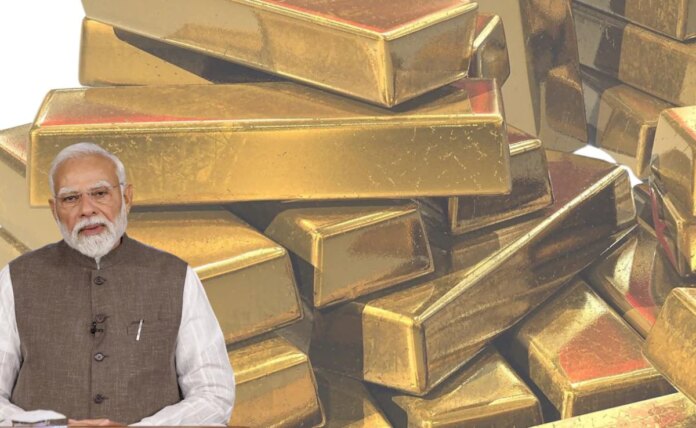

Stock Market Today: Jewellery company stocks saw heavy selling pressure after Prime Minister Narendra Modi urged Indians to avoid buying gold jewellery for a year.
The appeal was not symbolic. It was linked to a serious macro concern. India’s rising import bill and pressure on foreign-exchange reserves. And a weakening rupee amid elevated crude oil prices and geopolitical tensions.
Gold is India’s second-largest import after crude oil. When Indians buy gold, the country imports more. When imports rise, dollars go out. The rupee weakens. Forex reserves feel the strain. Follow Markets Live Updates
Markets reacted immediately to PM’s message.
Investors dumped jewellery stocks on fears that demand could slow, especially during weddings and festive purchases — the backbone of the industry’s sales cycle.
How Jewellery Stocks Reacted
| Company | Intraday Fall | What spooked investors |
| Titan Company Ltd. | −6.6% | Market leader, most exposed to retail jewellery demand |
| Senco Gold Ltd. | −10.8% | High wedding-season dependence, mid-cap volatility |
| Kalyan Jewellers India Ltd. | −9.5% | Store expansion cycle, demand-sensitive valuations |
“Recent reactions across sectors including gold also indicate how consumer sentiment and investment behaviour may gradually shift towards more cautious spending patterns,” said Bhavin Patel, Co-Founder & CEO, LenDenClub.
Vikram Subburaj, CEO, Giottus.com, explained the larger picture: “PM Modi’s remarks reflect a macro concern that India cannot ignore when Brent crude is above $105 per barrel and the rupee has weakened beyond 95. India’s crude import dependence remains close to 85-89 per cent. The country’s gold import bill touched a record $72 billion in FY26. However, the data does not suggest Indian households are abandoning gold. Gold demand rose to about 711 tonnes in 2025 despite record prices.”
He adds that what is changing is secondary allocation behaviour. Younger investors are adding digital assets alongside gold during periods of currency weakness and geopolitical stress. This means gold demand remains strong — but markets fear the sentiment shock of the Prime Minister’s appeal.
What’s Happening With Gold
Deveya Gaglani, Senior Research Analyst – Commodities, Axis Direct, said gold itself is not in a breakout phase. “Gold prices are under pressure due to persistent inflation and high crude prices. Strong US jobs data gives the Federal Reserve room to stay hawkish. We expect gold to remain in a consolidation phase.”
Gaglani added that PM Modi’s statement is aimed at conserving forex reserves, not influencing global gold prices. “India is a price taker, not a price maker in gold. The statement is unlikely to move international prices.”
Gaglani added that domestically, MCX gold has strong support near Rs 1,48,000. Corrections toward Rs 1,50,000 may still be seen as buying opportunities for long-term investors. He advises a 10 per cent portfolio allocation to gold as a hedge.
This means: gold as an asset is stable. Jewellery stocks are not.
Why Investors Reacted So Fast
For jewellery companies, revenue is directly linked to:
- Wedding purchases
- Festive demand (Akshaya Tritiya, Dhanteras, Diwali)
- Store footfalls
- Consumer sentiment around gold as savings
Significantly, the Prime Minister’s speech directly touches all four. Even if actual demand does not fall sharply, the fear of a slowdown was enough for traders to exit positions. That is what played out on Dalal Street.
“For consumers, this could mean being more mindful about discretionary expenses, fuel usage, borrowing patterns, and investment decisions over the coming months. In times like these, financial planning, maintaining liquidity, and borrowing responsibly become critical. As a digital lending platform, we believe consumers should focus on building financial discipline, avoiding impulsive credit-led purchases, and prioritising long-term financial stability over short-term consumption,” Patel added.
However, history suggests that gold demand in India is emotionally and culturally resilient. But markets trade on perception first. Data later. On Monday, perception won. Jewellery stocks lost their shine.