
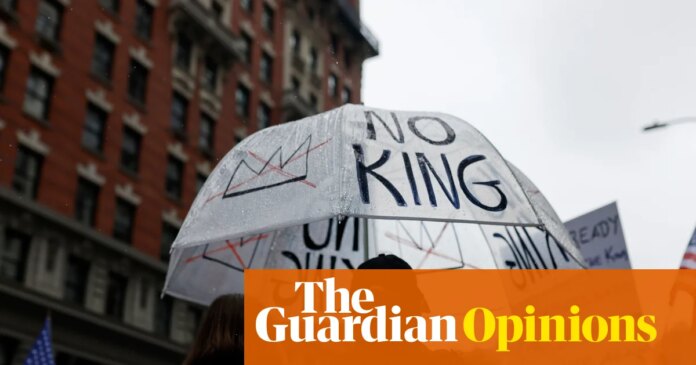

In Donald Trump’s first term, my Brooklyn-based activist group had the peculiar dynamic of being started by two men while being composed of about 65% women. Since November 2024, our group has doubled in size, and the gender imbalance has tipped even further: we are now about 80% women.
Almost 18 months into Trump’s second term, it is abundantly clear that the appetite for anti-Trump, pro-democracy activism has not dimmed at all. And yet, there is a substantial portion of the populace that, in my experience as an activist, seems to have lost its fervor for the fight.
If I see two other men’s faces at one of my group’s events, it feels like we’ve had a pretty good masculine turnout. Bigger events like the No Kings rallies feature more men, but nearly everywhere we go under Trump 2.0, there is a notable paucity of men. “When we look at the demographics of Resistance 2.0 there is overwhelming consistency,” writes Dana R Fisher, who studies civic engagement at American University. “Participants are predominantly white, highly-educated, female, and middle-aged.” During Trump’s first term, things were similar: Laura Putnam and Theda Skocpol reported that women comprised “70% of the participants and most members of the leadership teams”. There is also a well-documented gender gap in Trump support.
So where did all the men go, and how can we get them on board?
Some men have veered right. Some have burned out, their engines flooded by a terror that the work of protecting democracy goes on and on, world without end. Some have retreated to tend their own gardens: work, children, art, vinyl collections. (I will refrain from offering any gender-related thoughts about who might be better acclimated to the prospect of thankless, all-important work.)
Underscoring all of these is a quiet belief held by some men – especially white men – that however bad things may get – and have already gotten – in the United States, however much everything from the Dobbs decision overturning abortion to ICE violence may make for a crueler, uglier country, they will personally remain OK. Too many have a metaphorical sign up in their cubicles that reads “Your Emergency Is Not My Crisis.”
And it is a vicious cycle: the more women and non-binary people do the overwhelming majority of resistance work, the more men take in the wrong-headed message that this work is not for them. The truth is, the arrival of any new man in these spaces is cause for celebration. My co-leaders and I have a special emoji that we reserve for a new man joining our group.
Here we have arrived once more at that place organizers like myself regularly find ourselves: the junction of what should be and what is. Should men need personalized invitations to participate in the work of building a better world? Absolutely not. But do men need to be invited? Seems like the answer might be yes.
The women leading this work everywhere I go are heroic in their courage, their vigor and their determination. But I am a resolute believer in the big-tent approach to political change, and making sure that 50% of the population plays a role in this fight is crucial to assembling a pro-democracy majority in a moment of unprecedented peril. We need everyone right now, and men are conspicuous in their absence. (Next up: people in their 20s.)
My unscientific conclusion is that the men who have already drifted away, whatever their reasons, are unlikely to come back. Instead, now is an ideal time to extend an invitation to the men in our circles who hover on the edges, shouting fruitlessly at their TV screen or social-media feed, not knowing yet how much good they can do – or how much better they will feel – if they take action.
My co-leaders – six women – and I have recently gotten to thinking about what we might do to break men out of their morass of hopelessness and torpor. Working on the principle that you should always ask a busy person if you want to get something done, we have been targeting fathers of school-age children for deeper immersion in our work. I became an activist because I could not stomach abandoning my children to the collapse of American democracy. And while not every father is a viable candidate for us – I don’t think we are going to win JD Vance over – we at least share a common language. The future is the place where our children will live.
Perhaps it is time for men like me to organize spaces where men can take a tentative first step toward participating in the communal and organizing work that is the lifeblood of a country under terrible strain.
This past Sunday, I hosted about half a dozen men at my apartment to eat pizza, drink beer, and talk about our experiences. Some of the men had already been doing this work for years; for others, the pizza and the beer were their first step forward. We ended our get-together with a concrete request: reach out tonight to three men you know are frustrated by the state of the country, and ask them to join you for the next activist work you plan to participate in. If we want to triumph over the forces of authoritarianism, we will have to do it, painstakingly, one person at a time. Draft those invitations.
What’s giving me hope now
Last Friday, our group hosted a May Day picnic in Brooklyn’s Prospect Park that eventually transformed into an evening Shabbat dinner. More than 100 people came by over the course of the day, including 25 new members who joined our email list after the event. Sharing challah and frittatas and chocolate chip cookies on a balmy evening with old friends and new ones, grizzled organizing veterans and fresh-faced newcomers, was just the uplift I needed. As strangers, we are doomed. Building community is how we will keep democracy alive.