
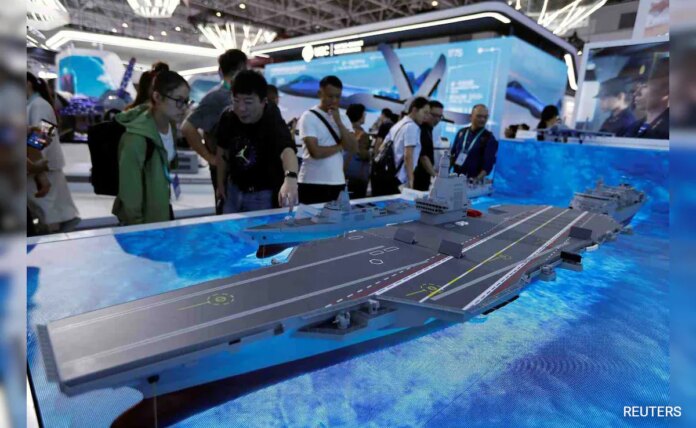

The British Empire once ruled the world because its industrial might was well complemented by its unmatched naval prowess. When the United States unseated the Empire as the world’s largest economy and the strongest military power after World War 2, it followed the same strategic playbook — it built a strong economy, developed cutting-edge weapons and dominated the world’s naval pathways with its myriad military bases and superior ships. China — which has made clear its intention that it not only wants to rebuild the global order but govern it — is following the same trajectory, sending itself on a direct collision course with the mighty US. And to take on Washington in the global waters, Beijing is building its fourth aircraft carrier, which it apparently teased recently.
China has been bolstering its naval power by adding new ships to its fleet. The latest in its series of naval enhancements is its first nuclear-powered aircraft carrier. Ahead of the 77th anniversary of China’s Navy, the country released an AI-generated video showing imaginary officers atop three ships. The names of these ships in the videos resembled those of their three aircraft carriers — Liaoning (Type 001), Shandong (Type 002), and Fujian (Type 003). All these ships run on traditional fuels.
However, in the same video, titled Into the Deep, a fourth character was introduced. The name of the character was He Jian. “He” sounds like the Mandarin word for “nuclear”, and “Jian” is the word for a “ship”, indicating that the new ship could be nuclear-powered.
China has not officially confirmed or denied that a new carrier is being built, but satellite images taken over the past couple of years indicate that a large vessel is under construction at a shipyard in Dalian, a city in the northeast of the country.
China is also developing a “Blue Water” Navy, which can operate far away from the country’s oceanic boundaries.
The video shows the Chinese sailors engaged in real-life drills in the western Pacific, far from home, using advanced weapons.
The country’s latest aircraft carrier is believed to be of a similar size to America’s nuclear-powered Gerald R. Ford-class carriers.
Beijing’s fourth aircraft carrier could weigh over one lakh tonnes. It will likely have the capacity to carry between 80 and 100 fighter jets, rivalling US carriers. If it’s nuclear-powered, it will have an unlimited range. It would be able to travel at a pace of 50 km per hour, substantially brisk for a ship of its size.
The Chinese navy now has the world’s largest operating fleet of 234 warships compared to the US Navy’s 219. However, it is miles behind when it comes to the US Navy’s carrier fleet size — the US has 11 aircraft carriers, all nuclear-powered.
Experts, however, believe that given the current geopolitical realities, China can proceed to commission several aircraft carriers.
China has a strong presence in India’s backyard with active bases in Djibouti in the Horn of Africa and Pakistan’s Gwadar. Its navy is also active in the commercial port of Hambantota, in Sri Lanka. With more ships, it can intensify its naval activities in the Indian Ocean and the Arabian Sea.