

Guwahati:
Nearly 250 members of the B’nei Menashe community from Manipur and Mizoram arrived in Tel Aviv last week, marking the latest phase of a renewed, state-backed migration effort by Israel.
The group landed at Ben Gurion Airport under a special government initiative aimed at facilitating their return to what they regard as their ancestral homeland.
The relocation is part of a broader programme approved by the Israeli cabinet in late 2025, with plans to resettle thousands more by 2030. Known as Operation Wings of Dawn, the initiative seeks to bring back a community that traces its origins to one of the “Lost Tribes of Israel”.
The B’nei Menashe, or “Children of Manasseh”, are drawn largely from the Mizo, Kuki and Chin ethnic groups of northeast India. They believe they are descendants of the biblical tribe of Manasseh, which is said to have been exiled following the Assyrian conquest.
Their identification with Judaism, however, is relatively recent. In the 1970s, visiting Israeli researchers noted similarities between local customs and ancient Jewish practices, including ritual traditions and oral narratives resembling the Exodus story.
The movement gained further momentum after a tribal leader in the 1950s reportedly described a vision identifying Israel as the community’s ancestral homeland. Over time, many members shifted from Christianity to Judaism.
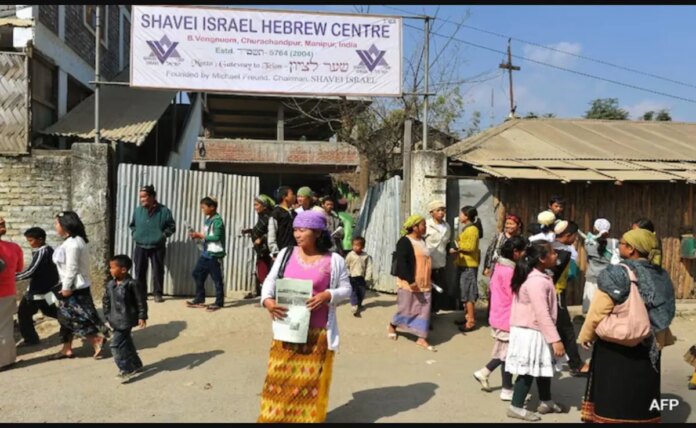
The community is estimated to number between 7,000 and 10,000 across Manipur and Mizoram. Thousands have migrated to Israel over the past two decades, with organisations such as Shavei Israel facilitating the relocation of around 4,000 people.
Despite these claims, the B’nei Menashe are not automatically recognised as Jewish under Israeli law, and each group requires special approval to immigrate, involving both legal and religious processes.
According to officials and community representatives, the latest arrivals are expected to be settled in northern Israeli towns such as Nof HaGalil and Kiryat Yam, where integration programmes are in place.
The relocation comes amid continuing ethnic tensions in Manipur and broader instability in parts of West Asia, factors that have contributed to the urgency among some families to move.
For many in the community, the journey is not only geographical but deeply personal, shaped by questions of faith, identity and belonging.