

New Delhi:
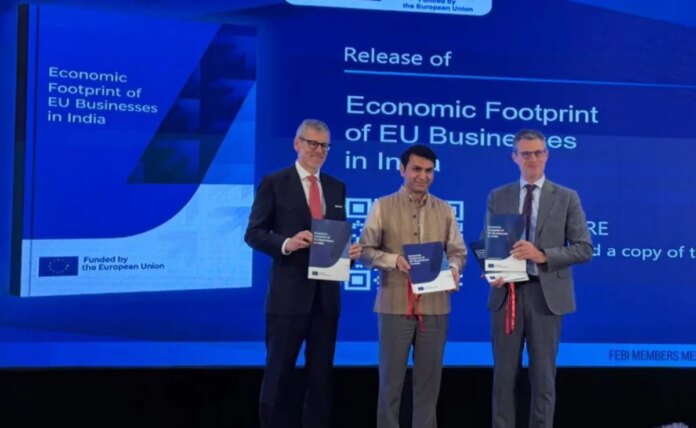
European companies have dramatically expanded their footprint in India over the past decade, with close to 6,000 EU firms generating 186 billion euros in turnover in 2024 alone, equivalent to roughly 5 per cent of India’s gross domestic product (GDP), according to a landmark report released on Wednesday by the European Union’s delegation in India.
The report, titled The Economic Footprint of EU Businesses in India, offers the most comprehensive account to date of Europe’s commercial presence on the subcontinent, tracking growth from 2014 to 2024. Its findings underscore a fundamental shift in the EU-India relationship: European companies are no longer merely trading partners but have become structural pillars of India’s economy.
EU companies collectively support close to 6 million jobs in India, 3.7 million through direct employment and roughly 2 million more across supply chains and related services. In a single year, 2024, these firms contributed approximately 7 billion euros in taxes to Indian public revenues and spent 271 million euros on corporate social responsibility initiatives.
Over the full 10-year period covered by the report, EU companies poured 218 billion euros in cumulative investments into India, cementing Europe as the country’s leading foreign investor. On the trade side, EU firms generated 23.5 billion euros in exports from India in 2024, accounting for around 6 per cent of the country’s total export earnings.
While manufacturing remains the dominant sector, accounting for 40 per cent of EU business activity in India, the report points to a broadening sectoral base. Professional services account for 16.6 per cent, information and communication technology for 12 per cent, administrative support for 9.4 per cent, and trade for 6.2 per cent, a spread that reflects the maturation and diversification of European investment in the country.
Geographically, Maharashtra, Karnataka, Delhi, Tamil Nadu and Haryana together host approximately 85 per cent of all EU firms. Karnataka has emerged as the go-to destination for ICT and services, while Tamil Nadu and Gujarat are rapidly developing as manufacturing powerhouses. Delhi, meanwhile, has consolidated its position as the nerve centre for professional and administrative functions. The report singles out Gujarat and Telangana as the fastest-growing destinations for fresh European investment.
The report’s release comes at a moment of heightened diplomatic and economic engagement between Brussels and New Delhi. Bilateral trade is approaching 200 billion euros, with an investment stock of 140 billion euros, figures that have helped cement the EU’s status as India’s top trading partner. The two sides adopted a Joint Comprehensive Strategic Agenda at the 16th EU-India Summit in January 2026, signalling a shared intent to deepen ties across trade, technology, and sustainable development.
EU Ambassador to India Herve Delphin said the relationship goes well beyond commerce. “EU businesses’ presence in India goes far beyond the balance sheet; it’s about creating jobs at scale and driving real innovation and collaboration,” he said, adding that both sides are actively co-developing the next generation of startups, trusted supply chains, and innovation hubs.
Negotiations on investment protection and geographical indications agreements are ongoing, and both sides are working to build so-called Blue Valleys – joint investment and co-development zones – as part of a broader effort to institutionalise the partnership.
The report concludes by identifying manufacturing, digital technologies and services as the sectors with the greatest potential for expanded cooperation. With a recently concluded free trade agreement in place and a dense web of over 50 bilateral sectoral dialogues active, the EU-India economic relationship appears set for yet another decade of growth.