

For years, India’s missile programme was shaped by one reality that its main security challenges came from adversaries closer to its own borders, namely Pakistan and China. Most Indian ballistic missiles were therefore designed with the region in mind. Even the existing Agni-V, which can strike targets around 5,000 km away, already gives India the ability to hit key parts of China while launching from deep inside Indian territory.If India’s threats are geographically close, why would New Delhi need a missile reportedly capable of travelling over 10,000 km? Why develop an intercontinental ballistic missile (ICBM) with MIRV capability when India continues to officially adhere to a doctrine of “credible minimum deterrence”?
The answer is not just about range but ensuring India can still retaliate even after a first strike and keep pace with rapidly changing missile technology, which is why the prospect of Agni-VI has sharpened focus on how the country views long-range deterrence in an evolving security environment. The discussion around the proposed Agni-VI has triggered a larger strategic debate inside India’s defence ecosystem. The debate gained traction after Defence Research and Development Organisation Chairman (DRDO) Samir V Kamat publicly stated that the organisation was fully prepared to move ahead with the Agni-VI programme pending government approval.
What exactly is an ICBM?
An Intercontinental Ballistic Missile, or ICBM, is a long-range missile designed to travel more than 5,000 km. Unlike cruise missiles, which fly through the atmosphere using engines throughout their journey, ballistic missiles spend much of their flight outside the atmosphere, which means the missile actually leaves Earth’s air atmosphere and travels through space for part of its journey. An ICBM typically follows three stages:
- Boost phase: Rocket motors propel the missile upward at extremely high speed.
- Midcourse phase: The missile exits the atmosphere and travels through space along a ballistic trajectory.
- Terminal phase: The warhead or warheads re-enter the atmosphere at hypersonic speeds and descend toward the target.
The defining characteristic of an ICBM is not merely range but strategic reach. Such missiles travel across continents and ensure retaliation capability in a nuclear conflict.During different stages of flight, especially while re-entering the atmosphere, the ICBM can travel at hypersonic speeds (five times the speed of sound) measured in Mach numbers. India already possesses systems that many analysts classify as nearing the range of ICBMs through the Agni-V. However, Agni-VI, if tested, would place India firmly within the category of states operating true long-range intercontinental capability.
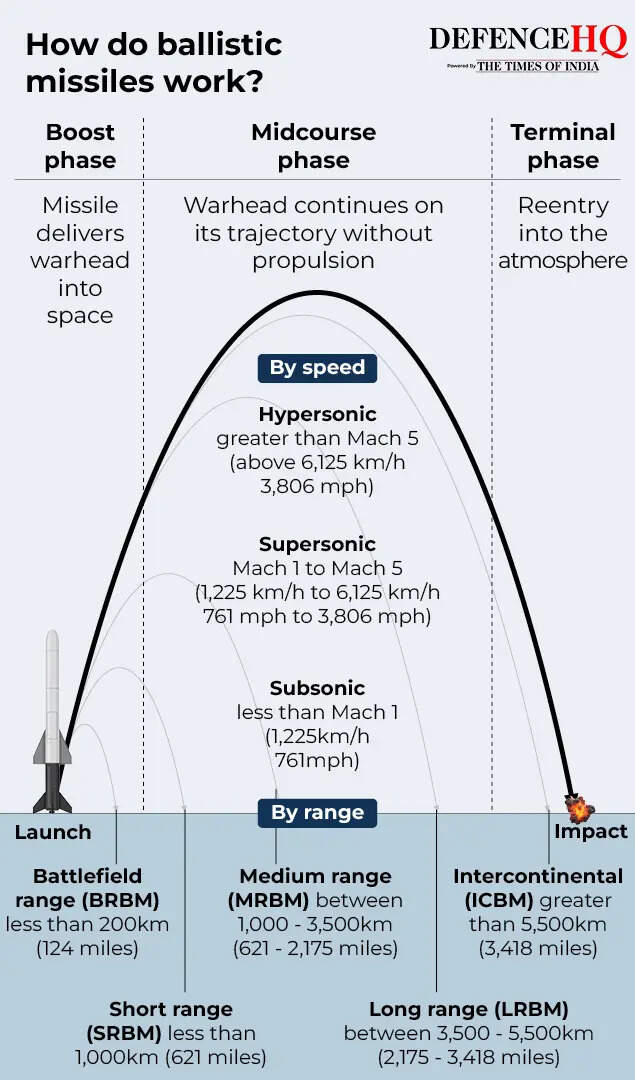
How to ballistic missiles work
What is Mach number?
Mach speed refers to velocity measured relative to the speed of sound. At normal conditions on Earth, sound travels at roughly 1,235 km/h.Example: Mach 1 equals the speed of sound. Likewise, Mach 10 means ten times the speed of sound. The faster an object moves, the harder it becomes to intercept. Modern hypersonic weapons generally operate at speeds above Mach 5.The distinction matters because ballistic missile warheads, especially during terminal descent, can travel at hypersonic velocities. Intercepting such systems becomes extraordinarily difficult due to their speed, altitude and limited reaction window.India recently tested a Long Range Anti-Ship Hypersonic Missile (LR-AShM) reportedly capable of reaching speeds close to Mach 10, reflecting a broader strategic shift toward high-speed survivable weapons.
What is MIRV?
MIRV stands for Multiple Independently Targetable Re-entry Vehicle.In a conventional ballistic missile, one missile carries one warhead aimed at one target. A MIRV-capable missile changes that equation dramatically.Under MIRV architecture:
- One missile carries multiple nuclear warheads
- Each warhead can be directed toward a different target
- The warheads separate during the midcourse phase
- They re-enter the atmosphere independently
Imagine a missile launched from one point in India. After exiting the atmosphere, the payload bus releases several warheads, each programmed to strike separate locations hundreds of kilometres apart.
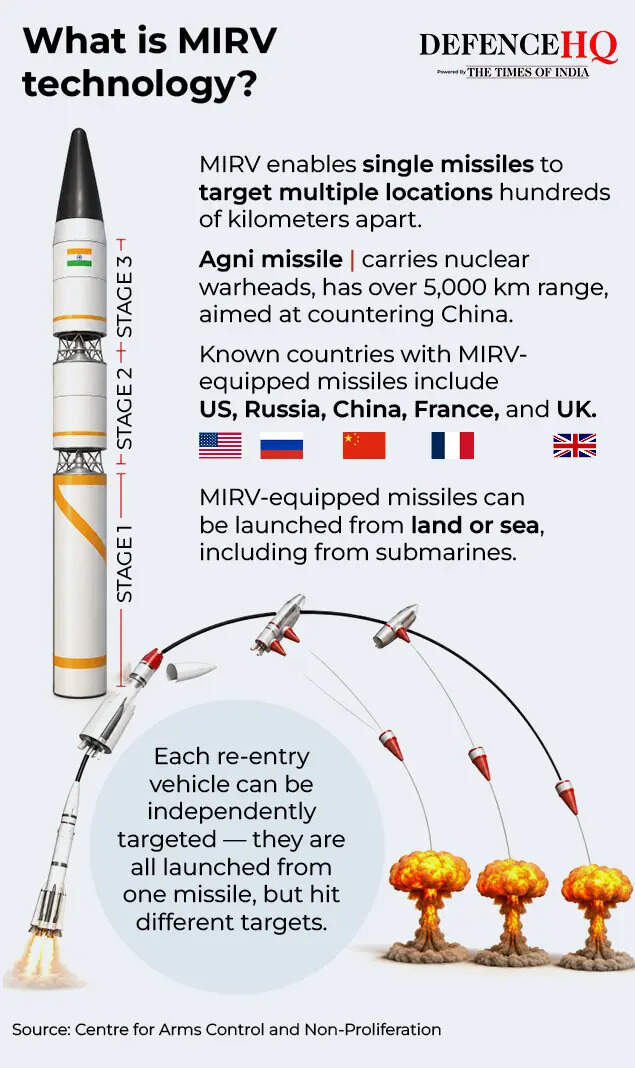
What is MIRV technology
This creates major strategic advantages:
- One missile can overwhelm missile defence systems
- Fewer launch platforms can threaten multiple targets
- Adversaries face uncertainty over interception
- Survivability of deterrence increases significantly
Countries such as United States, Russia and China have long deployed MIRV-capable systems. India demonstrated MIRV capability in recent years through the Mission Divyastra test linked to Agni-class systems. The Agni-VI is expected to integrate this capability in a more advanced form.
The Angi variants
The Agni missile family evolved gradually:
- Agni-I focused on Pakistan-centric deterrence
- Agni-II and III extended reach into China
- Agni-IV improved mobility and survivability
- Agni-V introduced canister launch capability and longer reach
Agni-VI is expected to go further in four critical areas:Unlike earlier Agni variants, the proposed Agni-VI is expected to combine longer range with more advanced strike capabilities. Reports suggest the missile could travel over 10,000 km and may feature MIRV capability, allowing a single missile to carry multiple warheads aimed at different targets. Like Agni-V, the missile is also expected to use a canister-based launch system and mobile launch platforms, reducing launch preparation time and improving survivability during conflict. Why India may still need Agni-VI despite China and Pakistan being nearbyCritics argue that India already possesses a credible nuclear deterrent and that the existing Agni-V gives India the ability to target large parts of China from secure positions deep inside Indian territory, while Pakistan remains well within the reach of shorter-range systems such as Agni-II and Agni-III. Yet the proposed Agni-VI is may not only about adding more range, as widely believed, strategic planners view long-range missiles as tools of survivability and assured retaliation rather than just distance.One major reason India may still pursue Agni-VI lies in the rapid evolution of China’s missile infrastructure. Beijing has spent years expanding silo-based systems, road-mobile launchers and advanced missile defence capabilities.
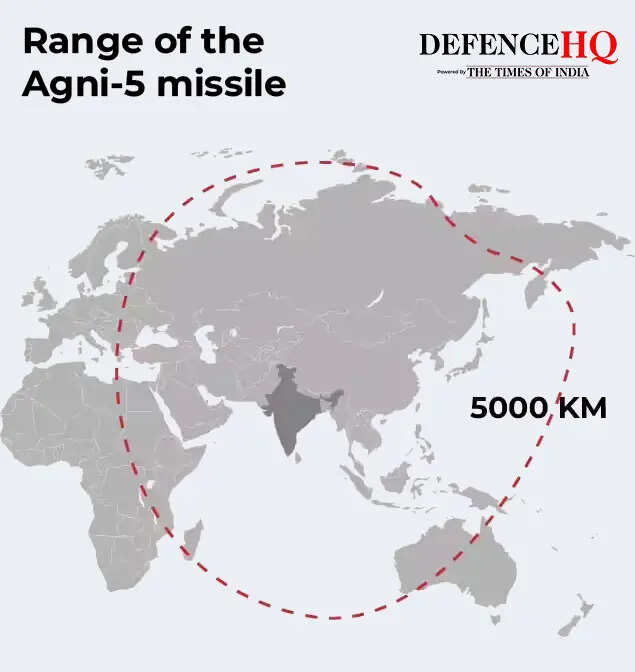
Agni-5 range
In such an environment, longer-range missiles give India the ability to launch from safer interior locations while maintaining deterrence capability. In practical terms, the farther a missile can travel, the deeper inside national territory it can be based, making it harder for an adversary to target launch assets during a conflict. For India, a 10,000-km missile may therefore be less about striking distant regions and more about ensuring that its retaliation capability survives even after a first strike.Another major factor is the MIRV capability, which would allow the missile to carry several warheads aimed at different targets. This significantly complicates missile defence calculations because instead of intercepting a single incoming warhead, adversaries may have to deal with multiple warheads approaching simultaneously. As countries such as China continue investing in layered missile defence systems, MIRV capability becomes increasingly important for maintaining the credibility of nuclear deterrence.Agni-VI would also carry strategic signalling value since nuclear deterrence is not driven by technology alone but also by perception. Possessing a true long-range ICBM places a country in a very small group of military powers with advanced strategic strike capability. Such systems firm up the geopolitical perceptions and influence how rivals assess military risk. While India’s official doctrine continues to be credible minimum deterrence, the development of more advanced missile systems inevitably signals growing strategic and technological confidence.There is also the question of future uncertainty as strategic weapons are built not for five years but for several decades and preparing for a security environment that may look very different in the future, including expanded Chinese naval activity, more sophisticated missile defence systems and advances in space-based surveillance and tracking technologies. Long-range and survivable missile systems provide flexibility against threats that may emerge over time rather than only those visible today.The recent tensions involving Iran and the United States have once again highlighted the importance of missile capability in modern warfare. Iran possesses one of the largest ballistic missile arsenals in the Middle East, though it is not known to field operational long-range ICBMs comparable to those operated by the United States, Russia or China. Instead, Tehran has built a layered deterrence strategy around ballistic missiles, cruise missiles, drones and saturation attacks aimed at overwhelming enemy air defence systems.India’s strategic environment, however, is fundamentally different as it has a declared nuclear weapons state operating under a formal no-first-use doctrine, and its deterrence posture remains focused primarily on China and Pakistan rather than distant military confrontation. Yet the Iran-US tensions still underline certain realities that are increasingly shaping modern warfare. Missile capability remains central to deterrence, air defence systems can be overwhelmed under sustained pressure and strategic depth matters greatly during prolonged crises.Therefore, India’s pursuit for ICBM reflects a broader global trend in which survivable and hard-to-intercept missile systems are becoming increasingly important to strategic stability.The discussion around Agni-VI also highlights a broader point often missed in public discourse. Missile power is not defined by range alone because long-range missile without survivability or rapid launch capability can be less effective than a shorter-range system that is mobile, difficult to detect and capable of guaranteeing retaliation. Modern strategic capability increasingly depends on a combination of accuracy, mobility, survivability, launch readiness and the ability to operate under real wartime conditions.
The political signalling around Agni-VI
India has traditionally maintained deliberate ambiguity around strategic programmes. The current signalling, including political messaging around ICBM status and MIRV capability, suggests a possible shift toward more visible deterrence communication.But the messaging indicates one thing clearly that the country wants adversaries to know that its strategic capabilities are evolving rapidly.In the end, Agni-VI is not merely about reaching farther but about ensuring that India’s deterrent remains credible in a world where missile defences, hypersonic weapons and strategic competition are readjusting the nuclear balance.