
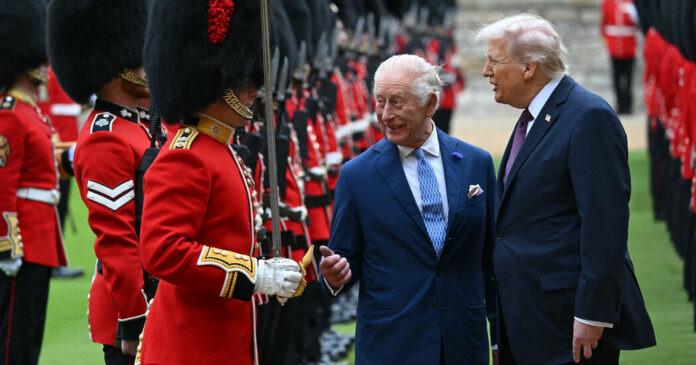

Nearly seven decades have passed since a British monarch traveled to the United States in the hope of repairing a relationship damaged by a disastrous military adventure in the Middle East.
In 1957, Queen Elizabeth II charmed President Dwight D. Eisenhower after Britain joined France and Israel in trying to seize back control of the Suez Canal from Egypt. Widely condemned, Britain’s actions caused a domestic political crisis and underscored the country’s status as a second-tier power.
Now, it is her son’s turn at royal diplomacy, this time with the tables turned.
King Charles III and Queen Camilla will arrive in Washington on Monday afternoon during Week 8 of President Trump’s war with Iran. This time, Britain’s refusal to take part in what Prime Minister Keir Starmer has characterized as the United States’ latest war of choice has infuriated Mr. Trump, and deeply strained relations between the two governments.
Officially, the king’s four-day visit has nothing to do with that dispute. Government officials say the monarch is above day-to-day politics and does not have a role in policy or commenting on affairs of the state.
Yet there is hope among people inside and outside No. 10 Downing Street that the pomp and pageantry, and some meetings with regular people, might remind Mr. Trump and his advisers how much the two countries have in common as the United States celebrates its 250th birthday this summer.
Even Mr. Trump, who has spent the past several months calling Mr. Starmer a coward and belittling the power of Britain’s naval forces, seems ready to dial down the temperature, at least while playing host to the royals. Asked by the BBC whether the king’s visit would help do that, the president said: “Absolutely. He’s fantastic. He’s a fantastic man. Absolutely the answer is yes.”
The ceremonial part of the trip will begin as soon as the king and queen touch down amid heightened security after the shooting Saturday night at the White House correspondent’s dinner, where Mr. Trump was set to deliver remarks before being rushed offstage.
The royal couple will be greeted with a red-carpet ceremony and a garden party — with tea, of course — held by the British Embassy. On Tuesday, the king will meet one-on-one with the president in the Oval Office.
That could be the part of the trip with the biggest political risk. Photographers are set to capture the two men, seated side by side, but British officials in charge of logistics said there were no plans for a questions-in-the-Oval moment — the kind that are common when prime ministers and other heads of government visit the White House.
Yet those are just the kinds of political performances that Mr. Trump craves. Could the president decide to complain about Mr. Starmer with the king sitting next to him? And what, if anything, might Charles say in response?
Those may not be idle concerns. This month, Mr. Trump told The Telegraph newspaper in Britain that he believed the king “would have taken a very different stand” on the war in Iran than Mr. Starmer, adding: “But he doesn’t do that. I mean, he’s a great gentleman.” Might the president try to draw the king out on those purported differences?
The king could also feel some pressure to respond to the Trump administration’s threats to withdraw American support for British sovereignty over the Falkland Islands, an archipelago off the coast of Argentina that is also claimed by the South American country. A Pentagon report raised the possibility of withdrawing U.S. backing for Britain as punishment for failing to participate in the attacks on Iran.
Argentina views Britain’s rule of the islands as an act of colonial force. Downing Street noted last week that people living in the Falkland Islands had previously voted overwhelmingly in favor of remaining a British overseas territory.
Britain’s news media is bracing for big news. A Daily Mail headline on Saturday said: “King Flies Into a U.S. Storm Over Falklands.” The Independent wrote: “The King and Queen Go to America … What’s the Worst That Could Happen?” And the BBC added: “King’s ‘High Stakes’ Visit With Trump Will Be Toughest Test Yet of His Reign.”
Ed Davey, the leader of Britain’s Liberal Democrats party, was so concerned about the potential for diplomatic disaster that he repeatedly urged Mr. Starmer to cancel the visit.
“I really fear for what Trump might say or do while our king is forced to stand by his side,” Mr. Davey told Mr. Starmer during a recent session in Parliament. “We cannot put His Majesty in that position.”
Mr. Starmer thanked Mr. Davey for his suggestion, but did not take it, saying that “what the monarchy is able to do through the bonds that they build is reach through the decades.”
“The purpose of the visit,” Mr. Starmer said, “is to mark the 250th anniversary of the relationship between our country and the United States, and that’s why the visit is going ahead.”
There could be other potential moments for awkwardness. There will most likely be toasts by the two men during the posh state banquet on Tuesday night. Mr. Trump’s grand ballroom is still under construction, so the gala will be in the much smaller State Dining room.
As his mother did in 1991, King Charles is scheduled to deliver an address to a joint session of Congress, on Tuesday afternoon. Aides said the king would steer clear of the messy business of the day’s news, and instead focus on the long sweep of history that binds the two countries.
They said the king would highlight moments when the United States and Britain had worked together to make progress in science, innovation, economics and defense. And he will celebrate what he believes will be a continuing partnership.
It is all but certain the king will not mention the gossip and scandals that have swirled around his family for the past several years. Charles has not yet fully reconciled with his son Harry, who now lives full time in California. The king’s brother Andrew Mountbatten-Windsor was recently arrested by the police on suspicion of misconduct in public office in connection with his ties to Jeffrey Epstein, the convicted sex offender.
Mr. Mountbatten-Windsor has not been charged and has denied wrongdoing, but the revelations about his longstanding friendship with Mr. Epstein and his accomplice, Ghislaine Maxwell, have tarnished the monarchy’s image.
Last week, Representative Ro Khanna, Democrat of California, called on the king to meet with victims of Mr. Epstein during his visit. Lawyers for the king and queen said in a letter to Mr. Khanna that because of “ongoing police inquiries” in Britain, the king was “unable to meet survivors or comment directly on the matters under inquiry.”
Instead, the king and his wife hope to present Americans with a refined image: a royal family dedicated to literacy, the environment, animals, business opportunities for British companies and support for young people.
In New York City on Wednesday, the royal couple will lay a wreath at the Sept. 11 memorial in Lower Manhattan, sharing the stage with Mayor Zohran Mamdani; the city’s former mayor Michael Bloomberg; and other officials. Charles will also visit a program in Harlem that mentors children and young people affected by food insecurities through sustainable urban farming.
To support literacy, the queen will celebrate Winnie the Pooh’s 100th birthday at the New York Public Library.
The couple will spend their final day in the United States in Virginia. They will lay a wreath at Arlington National Cemetery, and then the king will attend a “block party” celebrating the country’s 250th anniversary and visit with members of Indigenous communities and people involved in conservation initiatives at a national park.
The queen will visit a farm highlighting the horse racing industry.
If all goes as Buckingham Palace hopes, the visit will help strengthen the bonds between two countries despite the chill in relations.
In 1957, the queen’s visit did just that. In a toast to Queen Elizabeth II during a state dinner at the White House, Mr. Eisenhower talked about his deep respect for the British people and the royal family.
“I want to make a toast to the queen,” he said. “I want again to say that my faith in the future of these two great countries and the whole Commonwealth of the British nations, indeed of the whole free world, is absolutely unimpeachable.”