
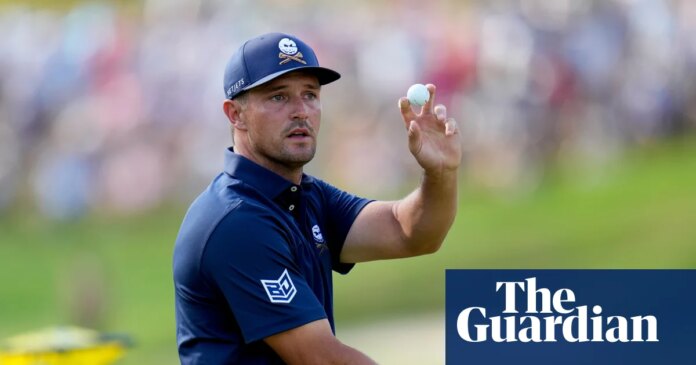

Golf: a feeder sport for aspiring YouTubers? When Bryson DeChambeau, faced with the expiry of his LIV Golf contract at the end of this year and the implosion, possibly even sooner, of the now Saudi-less LIV Golf, mused last week that he might give up life on tour to focus on his YouTube channel, most professional golf watchers scoffed. This was just a bluff, a move to gain leverage as DeChambeau, like every other LIV player, contemplates an uncertain future and negotiates the fraught path back to the PGA Tour.
“I think, from my perspective, I’d love to grow my YouTube channel three times, maybe even more,” DeChambeau said. “I’d love to do a bunch of dubbing in different languages, giving the world more reason to watch YouTube. And then I’d love to play tournaments that want me.”
To be fair, this is not the first time that DeChambeau has floated this type of package deal (YouTube clicks plus big tournament hits) as a way forward for his career. Nor is it the first time he’s brandished his online popularity as a stick to induce better terms from his paymasters. But it’s important to note the new certainty in his emphasis. DeChambeau’s stated goal is not to win golf tournaments, or challenge himself, or do it for his team or God or any of the usual forces that motivate professional athletes. His career objective now is to give the world more reason to watch YouTube. Green jackets, a place in the sport’s hall of fame, even money itself (since professional golf has to date been exceptionally kind to his bank balance): DeChambeau seems quite ready to give it all away for a life chasing views. Is this financial illiteracy, or a sign of sport’s changing priorities?
Perhaps DeChambeau is sui generis, a maverick determined to sacrifice it all for clicks. Or perhaps he’s a harbinger of a more meaningful shift in the relationship between athleticism and celebrity. Is organized sport disorganizing, splintering into something more personalized, ad hoc, and stunt-driven?
DeChambeau made $45m in on-course earnings over the past year, according to Sportico; before the Saudi Public Investment Fund announced it would be withdrawing its financial support for LIV Golf at the end of this year, he had reportedly been pushing for a new contract with LIV worth $500m. With the PIF suddenly out of the picture, LIV left to hand the hat around in search of new investors, and with the PGA not exactly in the habit of rolling out the welcome mat to past defectors, DeChambeau’s personal financial prospects look a lot more complicated than when he was pushing for that half-billion dollar deal.
He’ll stay rich regardless, so we don’t exactly need to hold the man in our prayers. And whatever the exact future shape of the Chambeaunomics, competitive golf has always been secondary to his real interest, which is making content. DeChambeau is arguably LIV’s biggest success story, and with two major championships to his name (the 2020 and 2024 US Open) there’s no question he is a genuine talent.
But he’s always been more interesting as a cultural story than a sporting one; his success as a cultural phenomenon has less to do with the golf he’s played on tour than with the profile he’s raised for himself online. On TikTok, where he has 2.3 million followers, Instagram (4.5 million followers), and especially on YouTube (2.7 million followers), where he puts in his longest and meatiest shifts at the content mill, DeChambeau and his dedicated “double-digit” production team pump out a neverending line of wildly popular videos, many of which extend past the hour mark.
There are challenges (“Can I Break a Public Course Record in One Try?”), product reviews (“Are the new Costco golf clubs even good?”), instructional videos (“How to Create Repeatability in Your Golf Swing”), stunt videos (“Golf, but Siri Picks All My Clubs”), videos with celebrities (“Kevin Hart is My New Caddie”), videos where the point is just to humiliate non-professional golfers (“1 Pro vs 5 Average Golfers (Not Even Close)”). In the “Break 50” series, DeChambeau teams with a celebrity and plays from the front tees in a quest to complete 18 holes in fewer than 50 strokes; recent guests include Steph Curry, Carlos Alcaraz, and Adam Sandler. (DeChambeau also appeared, along with seemingly every other figure of note in the world of golf, in Happy Gilmore 2.)
DeChambeau is also close to Donald Trump: he’s the chair of Trump’s council on sports; he’s done push-ups on the White House lawn; he and the president have, unsurprisingly, blazed a red-capped trail across TikTok and YouTube together. This proximity to Trump is usually interpreted as a political gesture but beyond golf and ideology, the bond between the two men probably has more to do with a shared love of attention. Bryson DeChambeau: it’s a name as sparklingly American as Mountain Dew. And what, really, could be more patriotically American than to give up the cause of professional sport to embrace life as a professional celebrity?
Every sport, of course, has to make room for the influencers now. These integrations can be planned (MrBeast firing a Kansas City Chiefs fan from a cannon) or spontaneous (IShowSpeed cornering Arsène Wenger as the former Arsenal manager eats a banana: “Yo Mr Wenger, you are a crazy guy my guy”). More often than not they’re thunderingly underwhelming: Twitch personality Mark Phillips live streamed an NBA game in Berlin earlier this year, and as hard as he tried to convince us he was blown away by the drama of an encounter between the Orlando Magic (final standing in the Eastern Conference: eighth) and the Memphis Grizzlies (final standing in the Western Conference: 13th), no one in the immediate vicinity appeared to share his enthusiasm.
But these appearances are still relatively marginal; they’re interjections from the sidelines rather than the event itself, a sprinkling of influencer silliness on the main meal of an NBA or NFL game. What makes DeChambeau’s threat to go full YouTuber so interesting is that it travels in a different direction: he’s not an influencer clowning about for attention in the world of sports but a professional athlete who believes he might have a better future as a clown. There’s now a full-blown race on in the golf press to crunch the numbers and figure out whether this trade – golf for reels – could ever make sense from a financial perspective. The conclusion: in a world where eyeballs are the true currency of sporting relevance and upstart specialist media properties like Good Good Golf – with a far lower profile than DeChambeau himself enjoys – are comfortably chalking up AI-sized funding rounds, there’s probably more sense to being a YouTuber first and a professional golfer second than the other way round, even for a 32-year-old in his athletic prime.
A move into full-time posting would, no doubt, be liberating and remunerative for DeChambeau himself, and I wish him all the best for the many long years of collaboration with the Nelk Boys that lie ahead. But it promises to be quite bad for sport, ushering us one step deeper into a future in which athletic heritage, the continuity of competition, and the very idea of on-field excellence are traded for gimmicks, stunts, and the dependable inanities of short-form content. Clips culture has already eroded many of sport’s slow pleasures, but if the ultimate point of organized sport is to become a mere supporting structure for the content maw, sport as we know it today – bulky, laggy, lossy, and all the more enjoyable for it – will inevitably need to be streamlined, rationalized, stripped to its clippiest essence. In this world to come, professional sport risks becoming obsolete, or at least profoundly confused about its own identity. Most of us watch sport for the sport; will we want to watch it for the celebrity YouTube appearances instead?