
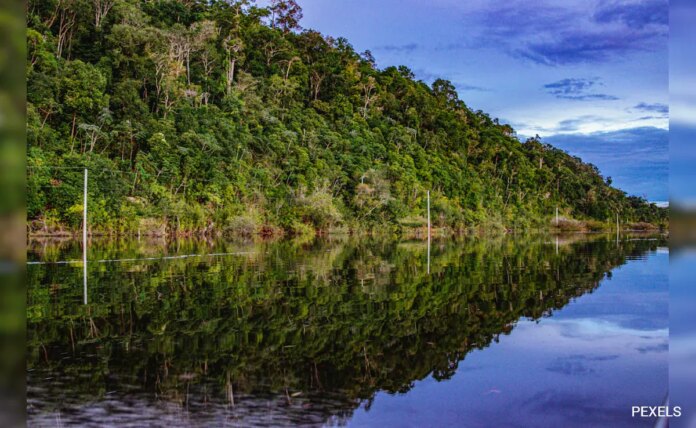

The Amazon, often called the “lungs of the world,” is edging dangerously close to a point of no return. New research warns that if deforestation continues, large swathes of the world’s greatest tropical rainforest could transform into dry, scrubby savannah at global warming levels of just 1.5–1.9°C—far sooner than previously feared.
Published in the journal Nature, the study from the Potsdam Institute for Climate Impact Research (PIK) reveals a troubling interaction between deforestation and climate change. Trees in the Amazon don’t just absorb carbon—they actively create their own rain. Up to half the region’s precipitation comes from moisture recycled by the forest itself. When trees are cut down, this vital feedback loop weakens, drying the air and making the remaining forest more vulnerable to drought, fire, and collapse.
Already 17-18% of the Amazon has been lost. The study finds that at 22-28% deforestation combined with 1.5–1.9°C of warming, the forest could lose its ability to sustain itself across vast areas. Without further deforestation, that tipping threshold would rise to a much higher 3.7–4°C of warming.
“We are pushing the Amazon far less resilient than we previously anticipated,” said lead author Nico Wunderling of PIK. “Even moderate additional warming could then trigger cascading impacts across large parts of the forest.”
A Domino Effect Stretching Across Continents
The consequences would ripple far beyond the rainforest borders. The Amazon influences rainfall patterns across much of South America. A sharp drop in moisture recycling could hammer agricultural heartlands from southern Brazil through Bolivia, Paraguay, and down to Argentina’s Rio de la Plata basin—threatening food production, hydropower, and water security for millions.
Brazil, Colombia, Ecuador, Bolivia, and Peru derive around 70% of their gross national product from sectors highly sensitive to reduced rainfall: agribusiness, hydropower, and heavy industry. Inland fisheries would suffer, deadly heat stress on humans would intensify, and wildfires would surge, blanketing cities in hazardous smoke.
The ecological and human toll would be devastating. Millions of Indigenous people, including isolated and uncontacted tribes, call the Amazon home. Countless species found nowhere else on Earth face extinction. And the carbon released from a collapsing forest would supercharge global warming in a vicious feedback loop. Disturbingly, shifts in the South American monsoon could even influence weather as far away as the Tibetan Plateau.
Scientists Urge Immediate Action
Professor Carlos Nobre, a pioneer who first raised alarms about an Amazon “tipping point” decades ago, praised the study as “very important.” Speaking about the new findings, he stressed urgency: “Deforestation has reached 17-18% of the Amazon forest and global warming is about to reach 1.5°C by 2030. It is essential to implement nature-based solutions… zero deforestation, degradation and man-made fires by 2030, and large-scale forest restoration.”
Johan Rockström, Director of the PIK and co-author, echoed the call: “The Amazon has played a vital role in stabilising the Earth system as a carbon sink, regulator of moisture recycling and host of Earth’s richest biodiversity on land. Continued deforestation is undermining this stability… These changes are not inevitable. Stopping deforestation, together with ecologically restoring degraded forests and rapid emission cuts can still reduce the risks.”
A Narrow Window for Hope
Global temperatures have already risen about 1.3°C above pre-industrial levels on a long-term basis, briefly surpassing 1.5°C in 2024. Without sharp cuts to fossil fuels, the world is on track to exceed 1.5°C permanently before 2040 and 2°C in the 2050s.
The message from the scientists is clear and sobering: the Amazon’s fate is not sealed, but the window to save it is closing fast. Halting deforestation, restoring damaged areas, and slashing emissions offer the best chance to keep the rainforest standing—and the planet’s climate system more stable.
The lungs of the world are gasping. Whether they continue to breathe may depend on decisions made in the next few critical years.