
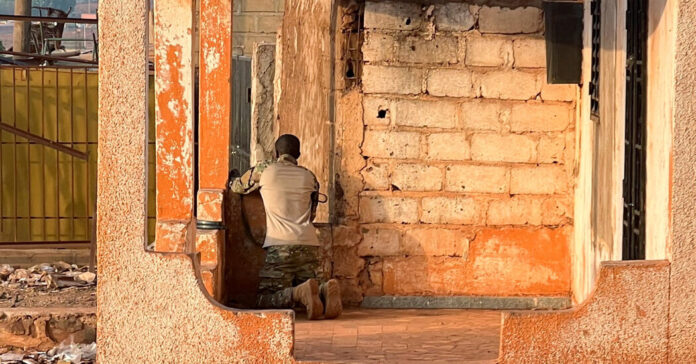

Many residents of Bamako awoke on Saturday to a huge boom.
“At about 5 a.m., we heard a giant explosion that made our houses shake,” said a businessman in Bamako who asked to be identified only by his first name, Abdoulaye, for security reasons. “We were really scared.”
The government put out an early, short statement on Saturday confirming multiple attacks by “as yet unidentified armed terrorist groups,” saying that its forces were still battling them and that further information would be given later.
But as further official information did not materialize, many turned to social media.
There, videos that appeared to show the destroyed house of Gen. Sadio Camara, the defense minister, were popping up. It is unclear what happened to Gen. Camara, who experts said had been Mali’s main point of contact with Russia, whose Africa Corps paramilitary group works with the ruling government junta.
The territory that is now Mali was once the scholarly and commercial engine of a succession of West African empires, famed for the thousands of medieval manuscripts in Timbuktu, the towering mud-brick architecture of the Niger River valley, and a vibrant musical tradition that attracted crowds of global tourists. But in the past 14 years, it has been buffeted by rebellions, jihadist threats, the arrival and later unceremonious exit of French forces, and several military coups.
JNIM used car bombs and armed drones in coordinated attacks across the country, according to Héni Nsaibia of the Armed Conflict Location & Event Data Project. Battles were still going on and the situation in several cities remained unclear as Saturday drew to a close. Bamako and Kati, the garrison town attached to the capital where the military junta resides, were major targets. These attacks were repelled, Mr. Nsaibia said.