

Taking a cue from its successful West Bengal formula, the Bharatiya Janata Party is focusing on consolidating the women and the extremely backward vote banks for the Assembly polls next year. The party has just performed a social reset in the state — which sends the highest number of Lok Sabha members, giving representation to Brahmin, Jat, Gurjar, Lodh, Paswan and extremely backward caste groups in the state government.
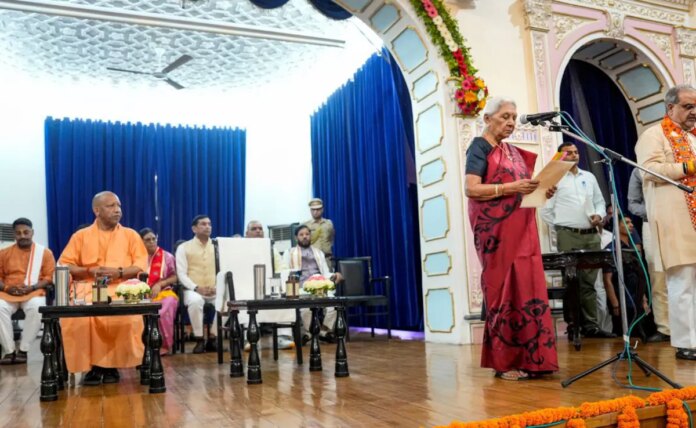
The Yogi Adityanath government, in its perhaps last Cabinet reset before the Assembly polls, gave place to former BJP state president Bhupendra Chaudhury and Samajwadi Party rebel Manoj Pandey in the Council of Ministers. State ministers Ajit Pal Singh and Somendra Tomar were promoted to the post of minister of state with independent charge. Four new state ministers – Krishna Paswan, Surendra Diler, Hansraj Vishwakarma, and Kailash Rajput – were also sworn in.
With the Cabinet expansion, the Uttar Pradesh BJP has sought to mollify upset castes and turncoats and tried to strike a regional balance.
The Cabinet expansion was pending for a long time, giving rise to speculation that all was not well between Lucknow and Delhi. The party’s sources, however, denied any internal tussle. They attributed the delay to the party’s focus on the West Bengal and Assam elections.
BJP General Secretary Vinod Tawde had already done the homework required for the expansion during the elections.
According to BJP leaders, a team will be formed under the UP chief, Pankaj Choudhury, soon, to make organisational tweaks needed for the upcoming polls.
Also read: After BJP’s Historic Bengal Win, PM Modi’s Big UP Election Prediction
Social Engineering
The Yogi Adityanath government has sent overtures to several vote banks through the Cabinet expansion. It has tried to mollify the Brahmin vote bank by including Manoj Pandey in the Cabinet.
The BJP leadership believes keeping leaders like Manoj Pandey and Brijesh Pathak in the Cabinet sends the right signal to the sizeable Brahmin community. The caste group’s relation with the BJP was strained due to issues like the UGC guidelines.
Similarly, Bhupendra Chaudhary is being projected as the Jat representative of western UP, Somendra Tomar for the Gurjars, Krishna Paswan for the Dalit-Pasi community, and Surendra Diler for the Valmiki community. There is also a focus on backward and extremely backward groups like the Lodh and Vishwakarma.
The broad message with the latest expansion is that the BJP has moved ahead of the politics revolving around non-Yadav OBCs and is focusing on micro social blocks.
The party is bridging the gap in areas where it couldn’t perform in the 2024 Lok Sabha elections. In Western UP, Jat equations weren’t stable in 2024, and a big chunk of Dalit votes found Mayawati’s alternative in Akhilesh Yadav, who attracted extremely backward groups with his PDA pitch. With the expansion, the party seeks to iron out these issues.
Also read: Yogi Adityanath Meets PM, Speculation Of UP Cabinet Reshuffle Intensifies
Mission 2027
In UP, the biggest trump card for the BJP is Yogi Adityanath. He has a clean image and is known for making the state’s law and order robust. However, governance is not enough to win in Uttar Pradesh. The party gives an equal weightage to social representation.
As the BJP scored a landslide victory in West Bengal, the party realised that the model that provides a strong voice to women, extremely backward groups, Dalits and regional aspirations is more effective.
The BJP is also trying to strike a regional balance by providing representation to all major regions within Uttar Pradesh.
The prime minister, chief minister, state president, and many senior ministers come from Purvanchal. Consequently. This time, however, the representation of Awadh and the West has increased. By including leaders from Western UP (Jat-Gurjar), Purvanchal (Rajbhar-Nishad), and Central UP (Kurmi-Pal), the effort is to consolidate the vote banks of each region.
Fight Against Anti-Incumbency
The anti-incumbency might haunt the BJP, as it has been in power in the state since 2017. The party was jolted in the 2024 general elections with the Samajwadi Party’s unexpected performance.
Experts had pointed out that the BJP repeated candidates.
The party doesn’t want to commit the same mistake. Hence, it brought in new faces.
The party didn’t remove old ministers as it doesn’t want to promote discontent and factionalism.
Panchayat polls were postponed because the party didn’t want factionalism to hurt it in the 2027 polls.
By including turncoats, the party has also sent a subtle message to leaders of other parties who are planning to switch.
This expansion isn’t merely a boost to the number of ministers, but is also being considered a key to power in 2027.