
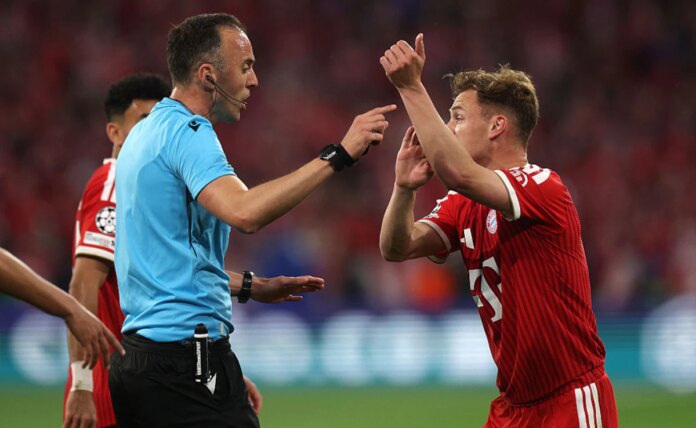

The UEFA Champions League 2026 semifinal clash between Bayern Munich and Paris Saint-Germain has reignited a debate that has simmered for over a decade – Is there a systemic bias, or an incomprehensible run of misfortune, directed toward German clubs in European competitions? While many Bayern Munich supporters are calling the team’s failure to qualify for the Champions League final a “robbery”, a clinical analysis of officiating in the second leg of the semi-final clash on Wednesday night suggests the claims might not be entirely wrong. In fact, the recent trends point towards the reputation of errors against Bundesliga sides has, and even the German national team, become increasingly consistent.
A couple of hand-ball shouts from the Bayern Munich camp were turned down by the referee Joao Pinheiro in the game. After conceding an early goal through Ousmane Dembele in the 3rd minute, Bayern continued to trail till the final minute of the injury time, with Harry Kane striking in the 90+4th minute to make it 1-1. However, the solitary goal from the England No. 9 wasn’t enough for Bayern to level the aggregate scores, as PSG went through to the final, 6-5.
The Hand-Ball Controversies
The most glaring error from the Bayern vs PSG fixture in Munich occurred during a high-stakes transition. When Konrad Laimer’s pass struck the outstretched arm of PSG full-back Nuno Mendes. The referee was quick to stop the game, but what shocked everyone was the fact that he gave the free-kick in favour of PSG, and not Bayern Munich.
Following communication from the fourth official, the free-kick was awarded to PSG under the premise that Laimer had handled the ball in the build-up. Replays definitively cleared Laimer. Hence, no offence was committed by the Bayern player.
The decision didn’t just rob Bayern of a free-kick but also a potential send-off of Mendes. Since the referee incorrectly penalised Bayern, he failed to address the actual offence, which was Mendes’ handball. The PSG defender made his body unnaturally larger, intercepting a pass in a three-on-three situation.
This constitutes a “Stop of a Promising Attack” (SPA), a mandatory yellow card offence. Having already been cautioned, Mendes should have been sent off.
The referee’s failure to apply the laws correctly didn’t just deny Bayern a dangerous free-kick, it fundamentally altered the tactical landscape of the match by allowing PSG to keep 11 players on the field.
The Joao Neves-Vitinha Incident: Conversely, the handball shout involving Joao Neves serves as a reminder of the complexity of the IFAB Laws. When Vitinha attempted a clearance that struck Neves’ arm at close range, that too in PSG’s penalty box. The calls for a penalty were made by the Bayern players and fans. However, the Laws provide specific protection for “teammate deflections.”
According to IFAB guidelines, a handball is typically not penalised if the ball touches a player’s hand/arm directly from the head or body (including the foot) of another player who is close. Given the unexpected trajectory and the fact that the ball originated from his own teammate, the decision not to award a penalty was technically sound.
No End To ‘German Tax’ In Europe
Over the years, Bundesliga teams as well as the German national side have had to face many such controversial exits from European competitions. Be it the decisions that went against Bayern in the Champions League matches against Real Madrid in 2017 and 2024, the setbacks that Borussia Dortmund faced against Manchester City and Chelsea in 2021 and 2023, respectively or even the German national team’s defeat against Spain in the semifinal of Euro 2024.
For some reason, German sides have had to face the brunt of poor refereeing decisions time and again. For some reason, the debatable calls seem to go against them more often than not.
With the Bayern vs PSG game the latest example, it needs to be asked why the “50/50” decisions almost never favour the German sides?
Featured Video Of The Day
Tushar Deshpande’s Brilliant Final Act Ensures Thrilling Win For RR Over Gujarat Titans
Topics mentioned in this article