


New Delhi:
What Google was in 2010, ChatGPT is in the 2020s. Maybe more.
A decade ago, doctors would sigh when patients walked in after “self-diagnosing” on Google. Today, many doctors say the same thing about medical advice pulled from ChatGPT.
But this isn’t limited to health. People now ask ChatGPT about relationships, careers… and money. And that raises a serious question. Follow Markets Live Updates
Markets are volatile. They always were. They always will be. Investor decisions are often driven by fear, greed, hope and regret.
Can ChatGPT Act As A Portfolio Manager?
We asked ChatGPT to give us portfolio allocation for Rs 10 lakh. Here’s what it said:-
When you speak to people in the wealth industry, a clear pattern emerges. Nobody dismisses AI. Nobody fully trusts it either.
They all say the same thing in different words: AI is a powerful assistant. Not a decision-maker.
“AI already works across three critical layers of investing – portfolio construction, alpha hunting through pattern detection, and automated execution that removes panic and FOMO from decisions,” says Sumit Gupta, Co-Founder of CoinDCX. He adds that AI can scan thousands of data points. It can rebalance portfolios without emotion. It does the heavy lifting better than humans.
But Gupta calls AI a “rearview mirror”. It understands what has happened. It struggles with what has never happened – Black Swan events, geopolitical shocks, sudden policy turns.
That is where humans still matter.
A similar thought comes from Akshat Garg, Head – Research & Product at Choice Wealth. He says people forget that advisors don’t just manage money. They manage investors.
“An advisor remembers that you almost sold everything in March 2020. They know your daughter’s college starts in four years. They hear the hesitation in your voice when you claim you can take risk. ChatGPT cannot see that. It cannot sense anxiety. It cannot push back when emotions are driving bad decisions,” said Garg.
To check how ChatGPT deals with market uncertainty, we asked it how to navigate the current crisis (triggered by the US-Iran war). Here’s what it said:-
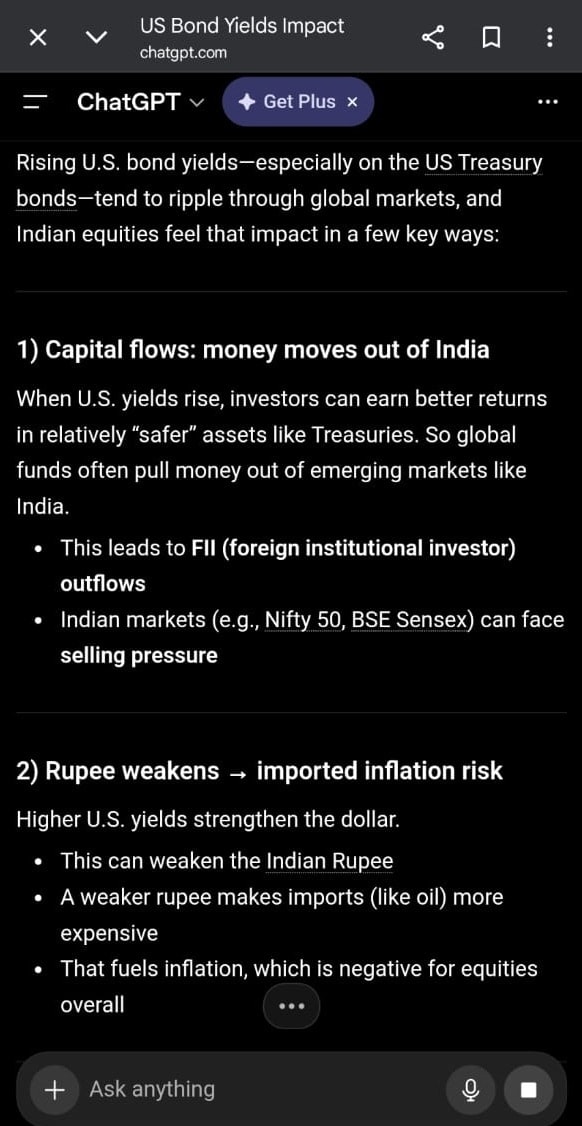
ChatGPT In The Indian Market Context
Shiva Grover, Founder of Equitrust Solutions, points out that over 35 per cent of mutual funds in the US use AI-driven strategies. In India, the number is close to 1 per cent. That gap shows opportunity. And also a reason for caution.
Indian markets are often shaped by regulatory surprises and geopolitical shocks. AI reads historical data well. It can go blind when something happens that has no past template.
“The danger is blind trust,” Grover warns. “No algorithm should be making your stop-loss decisions.” There is another subtle risk most investors don’t realise.
Similarly, Navy Vijay Ramavat, Managing Director at Indira Securities, says AI outputs depend heavily on how questions are framed. If you are already bullish on a sector and ask AI to analyse that sector, your bias quietly enters the answer.
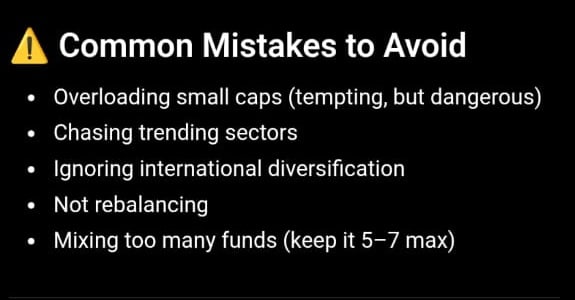
In other words, AI can end up confirming what you already believe. We also asked ChatGPT to tell us the common mistakes investors should avoid. Here’s what it said:-
Siddharth Maurya, Managing Director at Vibhavangal Anukulkara, explains, markets don’t run only on logic. They run on sentiment, policy shifts, uncertainty and psychology. “AI is excellent for research, comparison and learning. But overdependence can lead to overtrading and risky behaviour.”
Put all this together, and a pattern becomes clear.
| AI is very good at | AI is not good at |
| Research & scenario analysis | Understanding your fears |
| Portfolio tracking | Handling unprecedented events |
| Risk flagging | Taking final buy or sell calls |
| Explaining concepts | Managing your behaviour in a crash |
And there is one more thing most users miss – the quality of advice depends on the quality of the prompt. Vague questions give generic answers. Detailed context gives meaningful insights.
Some prompts that work well:
- “Build a diversified portfolio for a 35-year-old Indian investor with moderate risk appetite and 10-year horizon.”
- “Stress-test this portfolio in a 2008-like crash scenario.”
- “What risks exist in a 60% equity, 30% debt, 10% gold allocation?”
- “How do rising US bond yields affect Indian equities?”
What you need to tell AI for better financial advice:
- Your age
- Income and EMIs
- Financial goals and timelines
- Risk appetite
- Existing investments
- Tax bracket
- How you behaved in past market falls
Without this, ChatGPT gives textbook advice. With this, it becomes a powerful research companion. As financial experts say, “this is not AI versus humans”. This is about humans who know how to use AI well.