
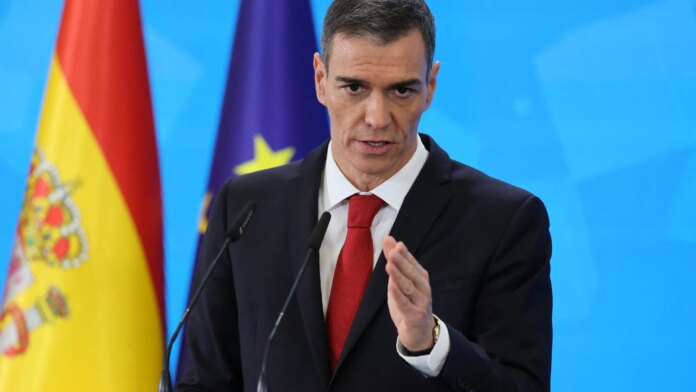

Spanish Prime Minister Pedro Sánchez dismissed reports that the U.S. is floating the idea of suspending Spain from the NATO alliance.
An internal Pentagon email reportedly suggested various ways the Administration could punish NATO allies it believes let the U.S. down by not actively supporting operations in the Iran war, according to Reuters.
“We do not work with emails,” Sánchez told reporters when asked about the matter at the European Union summit in Cyprus on Friday. “We work with official documents and positions taken, in this case, by the government of the United States.”
Reaffirming Spain’s opposition to the Iran war, which he has repeatedly referred to as “illegal,” Sánchez added: “The position of the government of Spain is clear: absolute collaboration with the allies, but always within the framework of international legality.”
NATO, meanwhile, has said there are no provisions to expel members.
“NATO’s Founding Treaty does not foresee any provision for suspension of NATO membership, or expulsion,” a NATO official told TIME.
TIME has reached out to the Pentagon for comment.
Since the start of the Iran war, Spain has been among the most vocal European critics, accusing the U.S. of dragging the world into a conflict that has brought nothing but “insecurity and pain.”
Spain denied the U.S. permission to use jointly-operated bases to attack Iran and went on to close its airspace to U.S. planes involved in the conflict.
Months earlier, Spain resisted Trump’s calls for all NATO members to increase defense spending to 5% of GDP.
Spain’s opposition to the conflict in the Middle East, and its defiance to heed Trump’s calls for support from NATO allies, has prompted strong rebuke from the U.S. President.
“Spain has been terrible. I told Scott [Bessent, Treasury Secretary] to cut off all dealings with Spain,” Trump warned in March, threatening economic repercussions. “We’re going to cut off all trade with Spain. We don’t want anything to do with Spain.”
And it’s not only Spain that has incurred the wrath of Trump, as he has also made threats against the United Kingdom, with relations between the once-close allies now strained amid the Iran war.
The discussed Pentagon email reportedly suggests reviewing the U.S. position on Britain’s claim to the Falkland Islands, as well as removing “difficult” allies from key NATO roles and positions.
Trump’s tensions with NATO have been years in the making, as he was critical of the alliance throughout his first term.
Last month, Trump warned NATO allies of a “very bad” future should they not help secure the Strait of Hormuz. European countries responded to Trump with caution and resistance, declining to send warships to the vital trade waterway.
Shortly after, Trump said he was strongly considering pulling the U.S. out of the alliance, insisting they had failed his “test” when asked to assist the U.S.
Experts told TIME that although Trump could explore a select few avenues to pursue leaving NATO, the legalities involved would be murky, at best.
But the mere suggestion of the U.S. leaving NATO has caused a lot of damage, they added.
“The very idea of a U.S. exit erodes trust, cohesion, and the credibility of collective defense,” Ilaria Di Gioia, a senior lecturer in American law at Birmingham City University, told TIME.
“Trump’s repeated questioning of the alliance weakens deterrence, shakes European security planning, and emboldens adversaries.”