
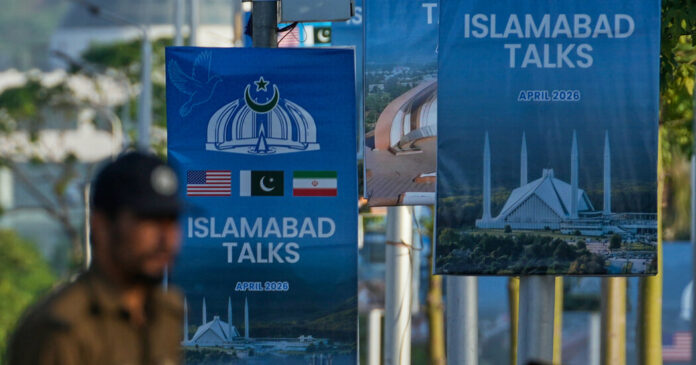

The United States and Iran on Friday were taking steps to resume peace talks, as Defense Secretary Pete Hegseth said that the U.S. blockade of Iranian ships and ports would continue for “as long as it takes” to get Tehran to agree to a deal.
Steve Witkoff, a U.S. special envoy, and Jared Kushner, President Trump’s son-in-law, planned to travel to Islamabad, Pakistan’s capital, on Saturday for negotiations, Karoline Leavitt, the White House press secretary, said on Friday.
“Steve and Jared will be heading to Pakistan tomorrow to hear the Iranians out,” Ms. Leavitt told reporters outside the White House. “We hope progress will be made, and we hope that positive developments will come from this meeting.”
Mr. Trump, Vice President JD Vance, who has been leading the talks with the Iranians, and Secretary of State Marco Rubio “will be waiting here in the United States for updates,” Ms. Leavitt added.
Iran’s foreign minister, Abbas Araghchi, arrived in Islamabad on Friday, Iranian state media reported. He was carrying a written response to a U.S. proposal for a peace deal, according to two senior Iranian officials familiar with his plans.
Earlier, the Iranian officials, who spoke on the condition of anonymity to discuss sensitive diplomacy, said Mr. Araghchi had been expected to meet with Mr. Witkoff and Mr. Kushner this weekend. But later, a spokesman for Iran’s foreign ministry, Esmail Baghaei, said in a post on X that no meeting was planned between Iran and the United States in Pakistan and that Iran would convey its position through Pakistani officials.
While Iran has publicly rejected peace talks during the U.S. naval blockade of its ports, the two Iranian officials said that Tehran has been exchanging messages through Pakistan and engaging in diplomacy to resume talks. The Trump administration has said the military cordon is aimed at crushing the Iranian economy and pressuring Tehran to make a deal.
Mr. Hegseth said on Friday that while the naval blockade would continue, the U.S. military remained poised to attack Iran again on Mr. Trump’s orders.
“Iran knows that they still have an open window to choose wisely at the negotiating table,” Mr. Hegseth told reporters at the Pentagon.
Many sticking points remain, including the reopening of the Strait of Hormuz; the fate of Iran’s highly enriched uranium; and Tehran’s demand that about $27 billion in frozen assets held abroad be released.
The United States and Iran agreed to a cease-fire more than two weeks ago. Still, tensions have remained high in and around the strait, a crucial conduit for Persian Gulf crude oil and natural gas. On Tuesday, Mr. Trump said he was extending the cease-fire indefinitely. But both Iran and the United States have continued to seize vessels they said have violated their restrictions on shipping in the waterway.
On Friday, the U.S. Treasury Department rolled out a blitz of new sanctions targeting 40 shipping firms and vessels it said were part of Iran’s “shadow fleet” of oil tankers. It also imposed sanctions on a China-based independent refinery, Hengli, which the Treasury identified as one of Iran’s largest customers for crude oil and other petroleum products.
The United States and Iran moved to resume talks as clashes between Israel and Hezbollah, the Iranian-backed militia, intensified in Lebanon on Friday, straining a separate cease-fire that was also extended by the White House.
Mr. Trump announced a three-week extension of the truce in Lebanon on Thursday, after hosting Israeli and Lebanese diplomats at the White House. Hezbollah, which is not part of the negotiations, has signaled it intends to abide by the truce if Israel does the same.
Strikes between Israel and Hezbollah have plummeted since an initial cease-fire was announced last week. But both sides have continued to exchange fire, raising fears that the truce could collapse into an all-out war.
“Cease-fire? What cease-fire while drones are still hovering above us?” said Fatima al-Masri, 49, who was in the southern Lebanese town of Qana on Friday. She was visiting the grave of her husband, an emergency worker, who had been killed in the conflict.
“What cease-fire while we are still losing our men and our loved ones?” she said, adding, “We want this war to be over.”
The current conflict that began last month has killed about 2,500 people in Lebanon, the country’s health ministry said, as well as two civilians and 15 soldiers in Israel, officials said.
The fighting began last month, when Hezbollah fired rockets into Israel in support of Iran, setting off a large-scale Israeli bombing campaign and ground invasion of southern Lebanon. Israeli forces are still deployed in a broad section of the country’s south, which Israeli officials have said they plan to occupy indefinitely.
Israel appeared to escalate its operations on Friday, issuing evacuation warnings for the southern Lebanese town of Deir Aames before launching airstrikes hours later. The town lies beyond the six-mile-deep “forward defense line” that Israel said it would control amid the cease-fire, suggesting that Israel’s strikes were widening.
The Israeli military said in a statement that Hezbollah had launched rockets from the town a day earlier toward northern Israel. Hezbollah also said it had again fired drones at Israeli troops in southern Lebanon on Friday.
Israel’s defense minister, Israel Katz, has pledged to continue demolishing border towns and villages amid the cease-fire. Hundreds of thousands of Lebanese remain displaced from the region, many with little idea if or when they can return.
During the talks at the White House on Thursday, Lebanon called for an end to those demolitions, according to a senior Lebanese official briefed on the negotiations who spoke on condition of anonymity to discuss sensitive diplomacy.
Hezbollah, for its part, expressed contempt for the state of the cease-fire on Friday, pointing to the continued Israeli military operations and reiterating its pledges to respond with force.
Mohamad Raad, Hezbollah’s leader in the Lebanese Parliament, said in a statement that the truce was “not a cease-fire at all,” and he urged the Lebanese government to withdraw from direct negotiations with Israel.
“The authorities should feel ashamed before their people,” Mr. Raad said, raising already simmering tensions between the Lebanese government and Hezbollah, a group it does not control.
Israel’s strikes this week killed Amal Khalil, a reporter for the Lebanese newspaper Al-Akhbar, and wounded another person in southern Lebanon, further rattling the tenuous truce.
The cease-fire agreement, released last week by the State Department, said that Israel would cease “offensive military operations” in Lebanon but “preserve its right to take all necessary measures in self-defense, at any time, against planned, imminent or ongoing attacks.”
Prime Minister Benjamin Netanyahu of Israel accused Hezbollah in a recorded video statement on Friday of moving to “sabotage” peace efforts between Israel and Lebanon, signaling the military had no intention to cease attacks against the group.
“We have maintained full freedom of action against any threat, including emerging threats,” Mr. Netanyahu said. “We attacked yesterday, we attacked today. We are determined to restore security to the residents of the north.”
Reporting was contributed by Helene Cooper, Alan Rappeport, Pranav Baskar, Sarah Chaayto, John Ismay, Michael Levenson and Abdi Latif Dahir.