
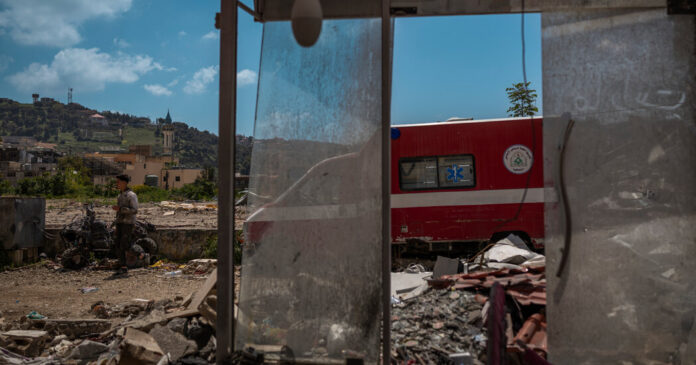

Clashes between Israel and Hezbollah intensified on Friday despite a newly extended cease-fire announced just the day before. The fighting cast doubt on the truce as Lebanon and Israel prepare for higher-level peace negotiations.
President Trump announced the three-week extension of the cease-fire on Thursday after hosting Israeli and Lebanese diplomats at the White House. Hezbollah, the Iranian-backed group Israel is targeting, is not part of the U.S.-mediated talks, but it has signaled it intends to abide by the cease-fire if Israel does the same.
The conflict has killed roughly 2,500 people in Lebanon. Two civilians were also killed in Israel, along with 15 soldiers.
Israel and Hezbollah’s strikes have fallen significantly since the original cease-fire was announced last week, although both sides have repeatedly exchanged fire — raising fears that the truce could collapse again into an all-out war.
“Cease-fire? What cease-fire while drones are still hovering above us? What cease-fire while we are still losing our men and our loved ones?” said Fatima al-Masri, 49, who was in the southern Lebanese town of Qana on Friday visiting the grave of her husband, an emergency worker killed in the conflict.
“We want this war to be over,” she said.
The latest conflict began last month when Hezbollah fired rockets into Israel in support of Iran, triggering a large-scale Israel bombing campaign and ground invasion of southern Lebanon. Israeli forces are still deployed in a broad section of the country’s south, which Israeli officials have said they plan to occupy indefinitely.
Israel appeared to escalate its operations on Friday, issuing evacuation warning for the southern Lebanese town of Deir Aames before launching airstrikes hours later. The town lies beyond the six-mile-deep “forward defense line” that Israel said it would control amid the cease-fire.
The Israeli military said in a statement that Hezbollah had launched rockets from the town on Thursday toward northern Israel. Hezbollah also said it had again fired drones at Israeli troops in southern Lebanon on Friday,.
Israel’s defense minister, Israel Katz, has pledged to continue demolitions of border towns and villages amid the cease-fire. Hundreds of thousands of Lebanese are displaced from the region.
During the latest round of talks in Washington on Thursday, Lebanon had called for an end to those demolitions, according to a senior Lebanese official briefed on the negotiations, who spoke on condition of anonymity to discuss sensitive diplomacy.
Hezbollah, for its part, expressed contempt for the state of the cease-fire on Friday, pointing to the continuation of Israeli military operations and reiterating its pledges to respond with force.
Mohamad Raad, the leader of Hezbollah’s parliamentary bloc, said in a statement that the truce agreement was “not a cease-fire at all” and called on the Lebanese government to cancel direct negotiations with Israel.
“The authorities should feel ashamed before their people,” said Mr. Raad, raising already simmering tensions between the Lebanese government and Hezbollah, which it does not control.
Israel’s strikes earlier this week also killed a journalist and wounded another in southern Lebanon.
The cease-fire agreement, released last week by the State Department, stipulated that Israel will cease “offensive military operations” in Lebanon but “preserve its right to take all necessary measures in self-defense, at any time, against planned, imminent, or ongoing attacks.”
Prime Minister Benjamin Netanyahu of Israel accused Hezbollah of moving to “sabotage” peace efforts between Israel and Lebanon, signaling no intent to cease attacks against the group in a recorded video statement, which was released Friday.
“We have maintained full freedom of action against any threat, including emerging threats,” he said. “We attacked yesterday, we attacked today. We are determined to restore security to the residents of the north.”