
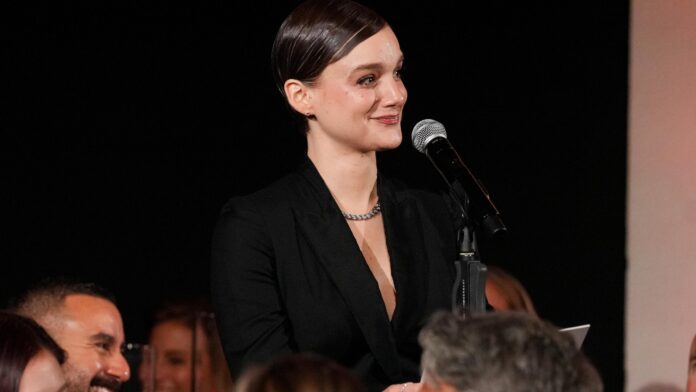

A standout group of artists, innovators, politicians, athletes, and more came together at a gala in Manhattan on Oct. 29 to celebrate the 2026 TIME100 Next list.
The evening included a performance from Grammy-nominated singer Raye, whose recent hit singles, including “Where Is My Husband!’” have rocketed her into stardom after more than a decade of making music.
The evening also allowed a space for honorees to toast to what gives them hope for the future, and who helped them achieve success. Among those who spoke were Philadelphia 76ers guard Tyrese Maxey, actor Himesh Patel, singer-songwriter and content creator Alex Warren, Food4Education founder Wawira Njiru, and Saturday Night Live star Ashley Padilla.
Here’s a rundown of what each honoree said:
Tyrese Maxey
Tyrese Maxey gave the evening’s first toast, beginning his remarks by recognizing all the other 2026 TIME100 Next honorees in attendance.
“For me, it’s just an honor to be amongst all of you and be able to speak today,” Maxey said. “What motivates me, honestly, is y’all.”
Maxey shared a motto that he’s strived to follow since he was a kid: to get “1% better every single day.” He added that his father encouraged him that “the sky’s the limit.”
Maxey went on to highlight that his platform has enabled him to pursue other passions, including launching a nonprofit foundation to “give back” to the community.
The NBA All-Star closed out his toast by applauding all the honorees in the room.
“Shout out to all y’all,” he said. “I do really appreciate y’all because y’all are extremely inspirational to me, myself, and all of us around.”
Himesh Patel
During his toast, Himesh Patel spoke about how many of the people in the room “hold power and influence.”
“In these precarious times, I believe it’s imperative for each of us to think about where we hold it, and how we use it to do good in the world,” Patel said.
Patel went on to talk about his own story. He grew up in a village in Cambridgeshire, England, where his parents ran a corner shop, and he delivered newspapers. When he landed his first acting gig at the age of 16, he continued, his parents “made sure” that he kept up his paper route each day.
“As immigrants who built everything they had with their own hands, they know that nothing is certain except the fact that nothing is certain,” Patel said of his parents. He said that his story feels “unlikely because it’s sometimes been hard to believe I ever belong in rooms like this.”
Patel observed that when TIME was founded in 1923, his ancestors were living in a village in Gujarat, India, where they “were still subjects of colonialism.”
“103 years later, here I am, standing amongst you. I have those ancestors to thank,” he said. “Because they resisted their oppressors, they fought for their independence. In the face of fear, they chose to hope. Because my parents crossed oceans, defied the odds to build a new life in an unknown land. In the face of uncertainty, they chose to hope.”
Patel called hope “an act of defiance,” and ended his remarks by encouraging everyone in the room to “choose to hope.”
“All of us here are being told that we hold power and influence,” Patel said. “I’m using mine, standing here amongst all you incredible people to say: in these precarious times, in the face of fear and uncertainty—I choose to hope. Maybe you will too. Because imagine the power and the influence that act could hold.”
Alex Warren
Alex Warren opened his toast by sharing a story: when he was 7 years old, he climbed a tall tree and shouted down to his father, who was at the bottom and was prepared to catch him: “What if I fall?”
“Without hesitation, he responds, ‘What if you fly?’” Warren recalled. “That was my dad. He was always so quick to instill hope and question what you thought was impossible. My dad was a superhero, and I wanted to impress him. I performed talent shows in our living room, singing my heart out. No matter what lyrics I sang, wrong strings I would play, you couldn’t hear them over the cheers of a proud father.”
Warren said that he practiced performing every day, hoping to one day achieve his dreams of being a singer.
“I was too busy trying to show my dad how high I could fly that when I finally looked down, he wasn’t there to catch me,” Warren said. “I was 9 years old when I woke up to my mom asking me if I wanted to say goodbye to my dad, and the room that was filled with music and cheer the days prior was taken up by the deafening sound of silence.”
Growing up, Warren recalled being surrounded by people but feeling “so alone” much of the time. Music brought him comfort, he said, as he found people who listened to and appreciated his own work.
“I was never really alone, and now every night, no matter what lyrics I sing or wrong strings I play on my guitar, millions of people around the world are screaming these songs loud enough for anyone we have lost to hear,” he said. “So let’s raise our glass … and toast, but not to flying, but having someone there to catch you if you fall.”
Wawira Njiru
Njiru, the co-founder and CEO of Kenya-based nonprofit Food4Education, began her toast by reminding the room that while it often feels like the future is built by new inventions, technologies, and machines, it is actually built by people.
“The most valuable resource on this planet has never been the things we extract—oil, or gold, or data. It’s the things we grow. The things we nurture,” Njiru said. “And right now, the world’s largest reserve of it is sitting in African classrooms.”
Food4Education delivers over 600,000 meals each day to children across more than 1,500 schools across Africa. These are young people that we need to be investing in, Njiru said.
While artificial intelligence “promises to make our lives better,” she reminded the crowd that “somebody still has to do the physical stuff, the real stuff, the hard stuff, the human stuff.”
She spoke to her own experience growing Food4Education from a nonprofit that fed just 25 students to one that aims to feed 1 million children each day by 2027.
Though she and her staff grew their organization like a business, she said they did without “losing sight of the people [they] serve.”
When Njiru looks at the children who are in her nonprofit’s food line, she sees “the future.”
“The next scientific breakthrough, creative revolution, or great innovation could come from anywhere, from anyone,” she finished. “That’s what gives me hope: what’s possible when we invest in—and with—people.”
Ashley Padilla
Padilla, who captured hearts as a star cast member of SNL this past year, made the room laugh with a toast full of jokes and references to her most notable sketches.
“You may know me from a sketch where I fart in front of all my coworkers and then get very, very mad about it right after,” Padilla said, prompting laughs throughout the room. “And if you don’t know me from that, then you don’t know me at all.”
But soon, Padilla shared a vulnerable moment, saying it “is hard to give a toast when you know you should not be here.”
“There were so many chances to mess up my life along the way. I tried to quit comedy. I tried to quit on myself an embarrassing amount of times,” she said. “I told myself it was too hard, too painful, too impossible.”
But despite the negative self-talk along the way, Padilla said that there was always a voice in the back of her head telling her to “keep going.”
“I can viscerally remember hearing it in the backseat of my mother’s car, tears streaming down my face because I was failing school,” she recalled. “And there was that sound inside me that I should keep going.”
In the end, this was the message of Padilla’s toast, thanking that voice, “whispering inside all of us, pushing us all to keep going.”