
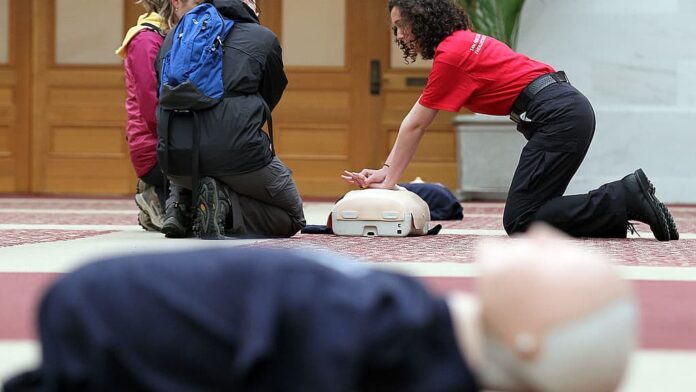

Some may hesitate to perform CPR because of legal concerns over causing injury—like rib fractures—while administering CPR, but every state has Good Samaritan laws providing protections to people who render emergency aid in good faith. A 30-year review of U.S. litigation across all 50 states from 1989 to 2019 found no cases in which a layperson who provided CPR was held liable for causing harm.
The U.S. has also made significant progress in bringing CPR education into schools. In 1984, Alabama became the first state to require CPR instruction for high school graduation. Over the four decades since, communities have taken different approaches to bring CPR into the classroom. In West Virginia and Alaska, educators’ unions formally backed legislation requiring CPR education, while efforts in Washington and Illinois advanced in memory of students lost to cardiac arrest.
Today, 43 states require some form of CPR education before high school graduation. California, Colorado, Hawaii, Massachusetts, Nebraska, New Hampshire, and Wyoming are the seven that remain. Several are already taking steps to expand CPR education. Massachusetts invested $425,000 to expand CPR education in public schools, while Colorado includes hands-on CPR and AED instruction in its statewide health education guidelines but stops short of requiring schools to provide it. California Gov. Gavin Newsom recently signed a resolution directing the Instructional Quality Commission to include high school CPR in the state’s next health curriculum framework. San Francisco is taking an even broader approach, with paramedics and firefighters working to train 100,000 community members in CPR.