
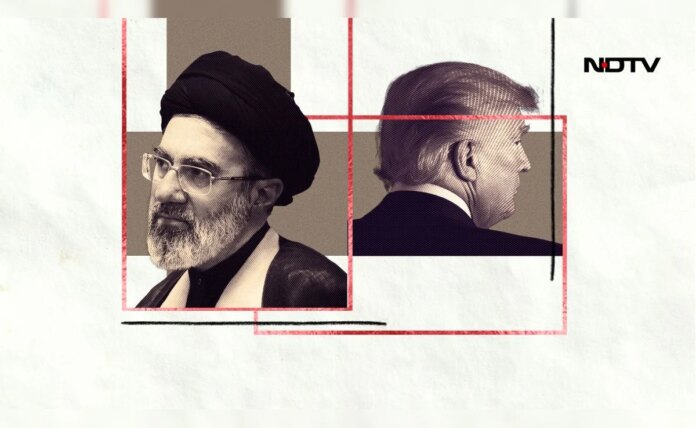

America has achieved its core objective: Iran’s nuclear threat is comprehensively set back years, if not decades. Staying in the Gulf now serves no purpose; the longer the standoff drags on, the greater the risk of a war that could cripple global energy lifelines. A strategic walkaway – trading dominance for deterrence – may be the only way to prevent it.
An indefinitely extended ceasefire should bring relief. In the Middle East, it brings a quieter dread. The truce that paused the 40-day US-Israel-Iran war has entered its third week – a pause, not a peace, in which everyone is reloading. America’s seizure of an Iranian vessel and Tehran’s calibrated retaliation show that no calm ever arrived. The Strait of Hormuz has become a stage for two exhausted adversaries in a high-stakes game of chicken, one radar blip from a conflagration neither wants.
Advertisement – Scroll to continue
The question is straightforward: Where do we go from here?
The Balance Sheet
The war was an asymmetric dismantling. Iran absorbed the seismic shock of “Epic Fury” without state collapse – proof of its technocratic capacity, security apparatus, ideological resolve and nationalist sentiment. It defended its territory and projected defiance to rally support. Its leverage over the Strait of Hormuz is now its undisputed geopolitical currency.
But the other side of the ledger is just as stark. American air and naval forces achieved their objectives. Iran’s navy has been reduced to fast-attack craft and seabed debris; military-linked industry is severely damaged. B-2 bombers have entombed the highly enriched 440kg uranium stockpile under tons of concrete and granite – a radioactive grave surveilled ceaselessly from above. Breakout time has been reset from weeks to years, perhaps indefinitely. The bill: over $300 billion in Iranian infrastructure damages, a generational setback.
The Realpolitik Calculus
Continuing the blockade and “Economic Fury” sanctions yields diminishing returns and mounting risk. The blockade is a tripwire; the longer the Fifth Fleet plugs the Strait of Hormuz, the greater the chance of a miscalculation that reignites war. Stalemate is not stability – it is the prelude to crisis.
Some in Washington and Tel Aviv ask: Iran is on its knees, why not finish the job? The temptation is understandable – and catastrophically misguided.
“Epic Fury” was devastating because it was calibrated. It struck nuclear and military targets while avoiding the regime’s absolute red line: energy infrastructure. Should the war restart, there is nowhere left to go but up the escalation ladder, and the only remaining rungs lead directly to Iran’s refineries and export terminals.
Iran Is Not Unprepared
An attack on those targets would pose an existential threat, and Tehran has prepared for exactly this. Its missile and drone forces, degraded but far from destroyed, would be unleashed not on American warships but on the soft underbelly of the global energy system. Aramco’s Abqaiq facility could be struck repeatedly; the UAE’s oil infrastructure would burn. Most ominously, the vulnerable desalination plants supplying over 90% of the Persian Gulf’s freshwater – and Israel’s own capacity – would be systematically targeted.
The result would be a regional catastrophe rendering the littoral states of the Persian Gulf uninhabitable. This is not alarmism; it is the logical terminus of an escalatory pathway both sides have so far had the prudence to avoid. To restart the war is to choose that terminus.
Abandonment, Of A Different Kind
This reality makes a cynical but pragmatic exit imperative. The United States should abandon the conflict in its entirety – not via a treaty photo-op, but through quiet strategic de-escalation rooted in offshore balancing. The hawks’ objection is predictable: why walk away now? Because the nuclear programme is entombed, the navy wrecked, the industrial base shattered. An indefinite garrison achieves nothing; remaining merely converts a punitive success into an open-ended occupation of a waterway and a catastrophic escalation.
Yet a half-measure exit – withdrawing the fleet while maintaining full financial warfare – is not de-escalation at all. It merely shifts the domain of conflict. Reopening the Strait while keeping the economy suffocated by sanctions removes any incentive for Tehran to behave as a status-quo power. Denied revenue to rebuild, Iran would weaponise the very access America claims to have restored. The blockade would migrate from the sea lanes to the global economy. A withdrawal from the Gulf must, therefore, be paired with a de facto relaxation of “Economic Fury”. The two levers are not independent; pulling one without the other guarantees that the mechanism jams.
Washington can frame this as a mission-complete transition. The uranium is entombed; any attempt to rebuild enrichment sites will be met with precise air strikes. By stepping back, the White House can sell a narrative of punitive victory: Iran is denied the bomb and forced to live with the consequences of its intransigence. No Marshall Plan, no sanctions relief, no compensation. In Washington’s transactional vernacular, that is the punishment.
The Iranian Equation
For Tehran, this is the bitterest of pills, but one it can swallow. Under this de facto arrangement, Iran does not surrender. It can claim it weathered the American storm, that its sovereignty remains intact. National pride remains unsullied.
This path also offers Iran the only sustainable exit from economic oblivion. To rebuild, Iran must sell oil. To sell oil, it needs secondary sanctions to be eased – not lifted entirely, but rendered non-enforceable through deliberate inattention to third-party energy transactions. A United States that leaves the Persian Gulf but maintains aggressive financial enforcement has not left the conflict at all; it has simply changed its weapon. Such a posture would force Iran to continue asymmetric pressure on the Strait precisely to extract the relief its survival demands.
The logic for the West is clear: an Iran consumed with rebuilding refineries and bridges is an Iran with no appetite for adventurism. But that path must be visible from Tehran. A shuttered economy offers no such vista.
The Regional Balance
This equilibrium requires two actors to recalibrate. The scenario outlined above – energy-infrastructure warfare – is not hypothetical for Riyadh, Abu Dhabi, or Tel Aviv. It is a nightmare they have spent decades trying to insure against.
The Strait cannot be permanently policed by the Fifth Fleet. Gulf states have long enjoyed American protection. Although they have bought American weapons in return, the baseline operational cost has been at the US taxpayers’ expense. A drawdown forces the Gulf states to assume greater responsibility. The message is blunt: “We removed the nuclear sword. Now manage the dagger of the Strait”. Iran, desperate for trade and wary of bypassing routes like the India-Middle East-Europe Economic Corridor, will be forced to negotiate. They may charge transit fees, but they must find a balance to avoid encouraging Hormuz workarounds and incur universal condemnation that will isolate them further.
Israel must accept a reality short of total victory but far better for them than the pre-war status quo – and infinitely better than the alternative. Iran is weakened, its navy largely gone, its nuclear programme inaccessible. But its capacity to inflict grievous harm on Israeli infrastructure, including desalination plants, remains. However, Tehran’s appetite for a missile exchange with the IDF is, for the foreseeable future, non-existent, provided its own existential red lines are not crossed. The world economy and the American voter have lost patience for a conflict that holds energy markets hostage. The current state provides Israel with a decade of strategic quiet – imperfect, but more durable than perpetual brinkmanship.
The Politics of the Exit
For this arrangement to hold, it must be sellable in the living rooms of Ohio and the evening squares of Tehran.
For the White House, the narrative is simple: the nuclear programme is buried and under aerial surveillance; offensive military capacity massively degraded; Persian Gulf withdrawal fulfils the promise to disentangle from open-ended commitments. The $300 billion reconstruction bill left on Iran’s ledger ensures it is consumed with recovery for a generation. The American voter can accept a proposition: the bomb is gone, troops are not bogged down, and the oil flows again.
For Iran’s leadership, the calculus is more painful but not impossible. They did not sign a surrender. They absorbed a devastating campaign and remained standing. The fleet’s departure can be presented as the enemy’s failure to impose its will – aligning with the Islamic Republic’s foundational idea of resistance. A quiet relaxation of the economic stranglehold allows Iran to point to a return of trade and the slow task of rebuilding, a process that becomes the government’s organising principle. National pride, the essential fuel of the Islamic Republic, has not been exhausted.
Neither side gets a parade. Neither side gets a treaty named after a European capital. But both get an exit from a crisis that promised only ruinous escalation. In the barren arithmetic of this moment, a quiet, mutually understood stalemate may be the only form of peace that both constituencies can be persuaded to buy.
(The author is an academic based at the School of Public Policy at UCL, London, and a consultant and Iran specialist)
Disclaimer: These are the personal opinions of the author