

Gold is viewed as a safe place for people to park their money during unstable times. But it can also be its own engine of instability. When the price climbs high enough, all sorts of sketchy characters are drawn into a shadowy industry where laundering illegally mined gold into legal bullion is as simple as melting and mixing it.
And when the price is as high as it is today — almost $5,000 an ounce — even the most prestigious players in the gold industry can get sucked into indirectly doing business with drug dealers and dictators. Today, my colleague Justin Scheck writes about the remarkable investigation he and other colleagues published this week, on how the U.S. and Canadian mints ended up buying gold that comes from a Colombian drug cartel.
At this point, we’re 25 years into a gold frenzy.
It’s fanned by media personalities like Tucker Carlson — who is now selling gold — and by more staid institutions like central banks and big investment managers in wealthy countries. They’re selling to customers who are all buying for essentially the same reason. They’re afraid everything else — stocks, bonds, even dollars — might lose value in the face of various forms of instability, like war or terror attacks.
But this gold frenzy has had an ironic side effect: It’s led to a wave of destructive mining that funds wars and terror attacks.
Gold funds Sudan’s brutal civil war and Russia’s invasion of Ukraine. Surging gold prices have helped Venezuela and Iran temper the effects of financial sanctions. Illegal miners deforest and pollute the Amazon, poisoning people there with mercury. Terrorist groups are getting into the gold business, too.
Put succinctly, wealthy people and governments buy gold to seek refuge from violence and instability — and in doing so, they fuel more violence and more instability.
That might sound like an abstract connection, and sometimes it is. But sometimes, it isn’t. As my colleagues and I found out in an investigation we published this week, sometimes it takes the form of the U.S. Mint buying and selling gold that comes from mines run by Colombian drug cartels.
Clan del Golfo gold
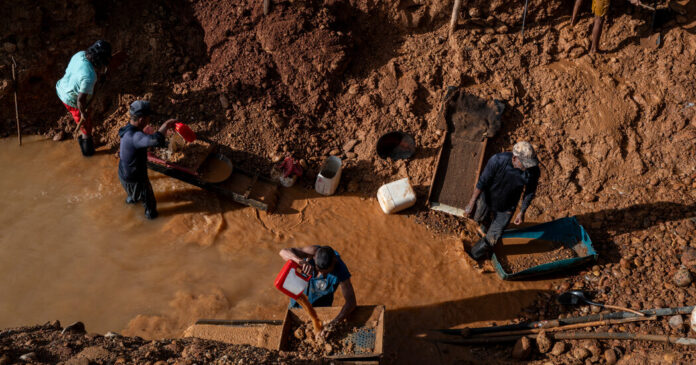
The miners call the ranch La Mandinga, a name for an evil spirit. When I visited with colleagues, we saw hundreds of miners extracting gold by tearing up the land with high-pressure hoses and excavators, and using mercury to separate the gold from sand.
For the past eight years, Colombia’s biggest cartel, the Clan del Golfo, has run La Mandinga. Nobody mines without cartel permission, and everybody pays. (The cartel called it a “tax” in a statement they put out after our story published.)
The ranch’s open-air mines are both illegal and environmentally destructive. The Clan del Golfo also uses the proceeds to maintain control over its territory through murders and bombings.
Institutions like the U.S. Mint aren’t supposed to be contributing to this sort of thing. The massive gold sellers that supply wealthy governments and investors have detailed policies to keep criminal gold out of their supply chain, and full-time staff to enforce those policies. The U.S. Mint is even required by law to make its investor-grade coins from only U.S.-mined gold.
But for decades, it has instead looked the other way as gold from foreign sources, some unethical or illegal, has entered its plant in West Point, N.Y., to be melted down and made into coins.
The Mint makes coins with a Lady Liberty design out of gold from Mexican and Peruvian pawn shops and from a Congolese mine that is owned partly by the Chinese government, records and interviews show. Some Mint gold has come from a company in Honduras that dug up an Indigenous graveyard for the ore underneath.
The Mint can do that thanks to some technical sleight-of-hand involving a long chain of suppliers, and an effort to redefine the meaning of “U.S. gold” to include foreign gold, as long as the foreign gold’s supplier also buys American gold.
But maybe as important as how the Mint does this is why the Mint and its suppliers do this. The price on gold is so high now that even the most prestigious institutional buyers don’t have an incentive to look too closely at where it’s coming from.
A low-margin business
It’s not just the U.S. Mint that engages in these practices. We also found in our investigation that the Royal Canadian Mint, which claims to use cutting-edge technologies to trace the origins of its gold, does the same thing. Canada is buying cartel gold too.
The prevalence of the practice speaks to how hard it is to stop.
Gold is a commodity, and that makes the gold industry a low-margin business. The big refiners that supply both the U.S. and Canadian mints can’t really demand more than the prevailing world price.
At the other end of the supply chain, the shirtless miners who toil in the dirt for a few grams of gold a day receive about 90 percent of that world price. Between the miner and refiner are a small middleman, an exporter in Colombia, security and transportation companies, and a middleman in Texas.
Each link gets a small slice of the profits; there’s not much left by the time the big refiner gets the gold. And since they can’t raise the price, the only way to make more money is for everyone on this chain, from miner to middleman to refiner, to process more.
In this kind of system, few are willing to turn away even suspect supplies. And so the vicious cycle feeding all this — the anxiety that leads to gold buying, which raises the price of gold, which fuels illegal mining, which funds terrorists, drugs and dictators — churns on.
MORE TOP NEWS
A blow to OPEC
The United Arab Emirates said yesterday that it would leave OPEC after more than 50 years, a decision that is expected to weaken the oil cartel’s influence.
The U.A.E., which generates roughly 12 percent of OPEC’s overall production, had long floated the idea of quitting the cartel, complaining that its quotas had curtailed its oil exports. The country is now expected to increase its energy production.
The shake-up comes at a time of geopolitical strain caused by the war with Iran, which has sent oil and gas prices soaring. The decision has rocked the region, underscoring how the U.A.E., at odds with Saudi Arabia, is increasingly charting its own course.
The king’s message to Congress
King Charles III delivered an optimistic assessment of American-British relations at what is arguably their lowest point in decades. He told a joint session of Congress that the two countries had always found a way to come together.
The king’s message, delivered with a dose of understated humor, carefully skirted tensions over Britain’s reluctance to support the U.S.-Israeli war in Iran. “We meet in times of great uncertainty,” he said. Here’s the latest.
Later in the day, the king and Queen Camilla will attend a state banquet at the White House. Today, they travel to New York City for a visit to the Sept. 11 memorial and a celebrity-filled gala in the evening.
OTHER NEWS
WHAT ELSE IS HAPPENING
TOP OF THE WORLD
The most clicked link in your newsletter yesterday was about Trump and Iran’s nuclear stockpile.
SPORTS
Film lovers across social media have been wondering why the average movie today lacks the “look” of one from 25 years ago: Images now are often dark and blurry. Experts say that movies are in fact getting murkier and that the advent of digital is partly to blame.
MORNING READ
South Korea is aging faster than any other country. In just 15 years, the number of people over 65 has doubled to more than one fifth of the population.
That’s created big challenges for the country’s doctors, social workers and family caregivers to support its elderly. So A.I. is helping: A chatbot checks on tens of thousands of seniors who live alone. The technology still has problems. It occasionally cuts off a user in midsentence or hallucinates — like the time it offered to send bags of rice to a resident. Yet users have embraced it with a warmth that has surprised even its creators. Read more.
AROUND THE WORLD
Meet the greatest living American songwriters
More than 250 music insiders and six New York Times critics weighed in on who defines the new American songbook. They came up with 30 names.
Some choices were obvious, like Taylor Swift, Bob Dylan and Bruce Springsteen. Some might surprise you. Times critics spent weeks arguing about what constitutes greatness in music. Does Joni Mitchell count as an American songwriter? Our critics decided not to steal that honor from Canada.
The oldest member of the pantheon, Willie Nelson, was born in rural Texas in 1933 and the youngest, Bad Bunny, is a child of 1990s Puerto Rico. Scroll through the full list here.
Who do you think are the greatest songwriters? Cast your vote. (You can submit up to 10 names.) And watch Swift explain her craft in this rare interview.
RECOMMENDATIONS
Read: A sweeping family epic based in Pakistan and a true crime story from London are among our best books of the year so far.
Sturdy and satisfying, mushroom pozole has long been a vegetarian anchor of tables across Mexico. Start by browning the mushrooms to build serious flavor. The jamminess of guajillo chiles and the raisin-like flavor of ancho help build a broth that’s complex, velvety and quietly intense.