
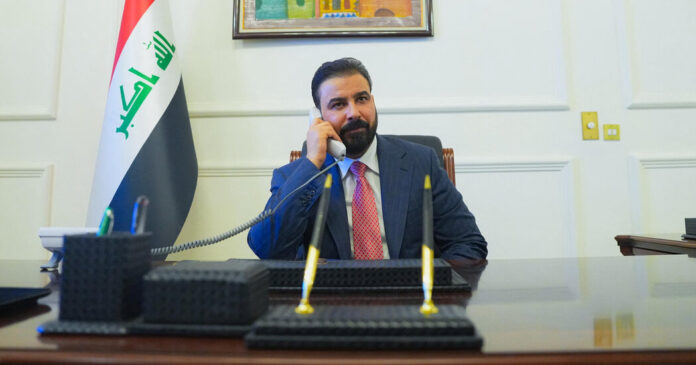

Ali al-Zaidi has no political experience, has never worked in international affairs, and even inside his own country is a relative unknown.
Now, as Iraq’s newly designated prime minister, he faces the daunting task of cobbling together the next coalition government of a country caught in the middle of the war between the United States and Iran.
Yet the choice of Mr. al-Zaidi, a wealthy businessman who owns a popular television station and holds lucrative state contracts for foodstuffs, has managed to break months of political gridlock. And — no small matter —his nomination appears to have gone unchallenged by the Trump administration, at least initially.
“He’s so far from even the usual ideas of a compromise candidate,” said Renad Mansour, an Iraq analyst at the London-based think tank Chatham House. “He’s the first that has had no political role or experience in government. That’s why many are surprised with the choice.”
Against a backdrop of rising U.S. pressure, Mr. al-Zaidi’s nomination is in some ways puzzling. He is an owner of Al-Janoob Islamic Bank, which is under U.S. sanctions. It was banned from U.S. dollar transactions in 2024 over American accusations that it was laundering money, in particular on behalf of Iran and powerful Iraqi militias allied to the Iranian government.
Unlike several other candidates whose names were floated for the job since elections last November, Mr. al-Zaidi, 43, enjoys good relationships across Iraq’s political spectrum, according to people involved in the deliberations, including leadership figures close to both Washington and Tehran.
Whether he can manage to form a government within the 30 days allotted to him remains unclear, said Mr. Mansour.
That a candidate had to be found so far outside the political field speaks to the serious deadlock inside Iraq’s largest political bloc, the Coordination Framework, which represents the country’s Shiite Muslim majority.
It is also a symptom of the broader power struggle in which Iraq is mired.
Since the U.S. invasion of in 2003, the central government in Baghdad has struggled to strike a balance between the interests of its former occupier and those of Iran, the regional Shiite power next door. That balancing act has grown increasingly tenuous since late February, when the United States and Israel attacked Iran, turning neighboring Iraq into one of the war’s battlegrounds.
Even before the war, Washington had been ratcheting up pressure on Baghdad to rein in the Iranian-linked militias in Iraq. After the conflict began, many of those militias joined in solidarity with Iran, lobbing missiles and drones at U.S. diplomatic and military targets in Iraq, as well as at Washington’s Iraqi partners and, at least once, at Iraqi military forces themselves.
Iraq’s Shiite militias, first formed with Iranian backing to fight the U.S. occupation, grew in influence after joining the international fight in 2014 against the jihadist Islamic State. They leveraged their popularity to establish political parties and vied for parliamentary seats, enmeshing themselves into Iraq’s economy and politics in the process.
Some of the militias’ political wings controlled ministries in the last government. And in Iraqi elections in November, even as U.S. officials warned they would not tolerate militia influence in the next government, militia-affiliated parties gained a still greater share of parliamentary seats.
The situation grew even thornier after the war against Iran began, and continues to simmer even with an indefinite cease-fire in place.
Iraqi officials are under heavy U.S. pressure over their apparent reluctance or inability to stop the recent militia attacks. Last week, Washington suspended funds to Iraqi security forces and even cut the flow of U.S. dollars to Iraq.
Yet just this week, a day after Washington issued a reward for information about a militia leader it accused of being behind attacks on U.S. targets, that commander was photographed at a political bloc meeting for selecting a prime minister nominee.
Some Iraqi officials see the formation of Iraq’s government as “a protective shield,” said Ghaith Shaba, a lawmaker from the political bloc.
“We are living in the heart of the storm,” he said, “and our greatest fear as civil and national powers is that Iraq will transform from a state of institutions into an arena for settling scores.”
U.S. officials appear likely accept Mr. al-Zaidi’s nomination despite the sanctions against his bank, said Victoria J. Taylor, who led Iraq policy at the State Department during the Biden administration, and is currently at the Atlantic Council, a think tank.
“They’ve clearly decided they want to see a government formed sooner rather than later,” she said.
“They likely see the path ahead with a new prime minister as providing an opportunity to press this new government to take stronger action against the militias,” she said.
The U.S. Embassy in Baghdad declined to comment on the nomination.
In addition to banking, Mr. al-Zaidi also owns a popular television channel, Dijlah TV, and held the contracts to provide food to the Iraqi military and food baskets to the population paid for by Iraq’s trade ministry.
Iraqi political analysts say he enjoys close relations with two of the most powerful figures inside Iraq’s largest political bloc: Mohammed Shia al-Sudani, the current prime minister, and the head of Iraq’s supreme judicial council, Faiq Zaidan, who is seen as close to Washington.
But though he enjoys friendly relations across much of Iraq’s political spectrum, ultimately the standard by which both Washington and Tehran will judge him is how he confronts the militias.
“He will have to confront and clash with the issue of disarmament and restricting weapons to the hands of the state,” said Sarmad al-Bayati, a political scientist in Baghdad. “This is the biggest challenge he will face.”