
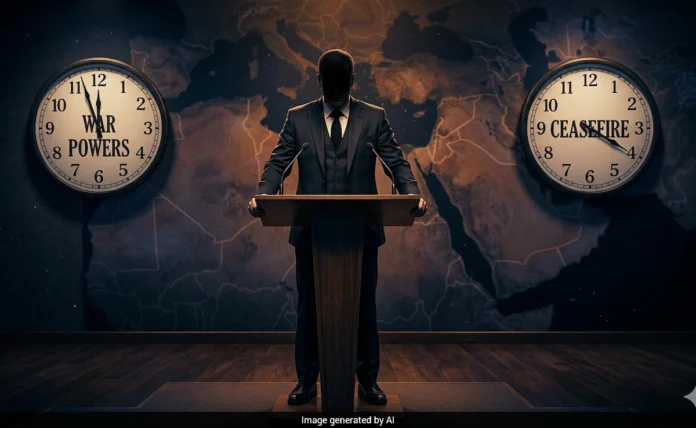

The clock is ticking, loudly, for Donald Trump as he tries to negotiate an end to the Iran war, a conflict that seems not to have gone to plan, though he has made it clear he thinks otherwise.
The US president faces an inflection point this week – May 1 is the last day he can continue to order military action without violating the War Powers Resolution, or the War Powers Act.
Advertisement – Scroll to continue
Under that law he cannot deploy American forces for more than 60 days at a time without Congressional approval. In simpler words, without the US declaring war on Iran.
Trump does not have that approval, not yet anyway.
He does have options, including seeking a 30-day extension or an AUMF – an Authorisation for Use of Military Force – but the ferocity of Democratic opposition complicates the process.
This means the war can’t legally extend past May 1 without Congressional backing, though past presidents, including Barack Obama, have sometimes ignored this requirement.
But, if enforced, it means Trump can’t maintain his Strait of Hormuz blockade.
The Hormuz is a critical waterway that handles around 20 per cent of the world’s oil and gas demands and which, some reports suggest, is the centrepiece of a larger American strategy to starve China of fuel and position the US in strategic positions on key maritime chokepoints.
NDTV Special | Iran Crisis Turning US Crude Into World’s Safe Bet
It also means the ceasefire – now at the limit of the “three to five days” Axios said Trump gave Iran last week to work a long-term peace deal – will likely become a ‘win’ for Iran.
And that leaves Trump between a deadline and a hard place; the president will not like being pulled out of Iran without an off-ramp that frames the war as victory for the US and offers voters a shiny prize – Iran’s oil or enriched uranium – to aim at during the November mid-term election.
That is the asymmetry Trump and his White House must deal with – the convergence of a deadline he doesn’t control (the War Powers hard stop) with one he does (the ceasefire).
The 3 ways Iran war ends
This is simple – deal, more fighting, or limbo.
A peace deal
If the US and Iran can get a long-term peace deal over the line – it will have to be one with enough caveats to allow both to claim a ‘victory’ – Trump sidesteps War Powers Act pressure.
He can bring troops home and claim to have kept his vow of never dragging the United States into a ‘forever war’. Crucially, it also allows him a chance to repair and replenish a military that has chewed through stocks of missiles, specifically Patriot interceptors and Tomahawks.
Probability: Low but not impossible. Tehran has offered a proposal to end the war so long as the US stops air strikes and lifts its blockade. In return, it will re-open the Strait of Hormuz.
Iran Offers 3-Condition Hormuz Deal, Trump Unlikely To Accept
A fully open-for-business Hormuz will be a big step in normalising energy supplies worldwide, including India that buys around 40 per cent of its crude oil needs from West Asian refineries.
More fighting
Congress authorises an extension of US military action against Iran, relying on loopholes past presidents exploited to allow Trump to continue running the Hormuz blockade and prep for more fighting. This could include a ground invasion scenario to grab Iran’s oil and uranium.
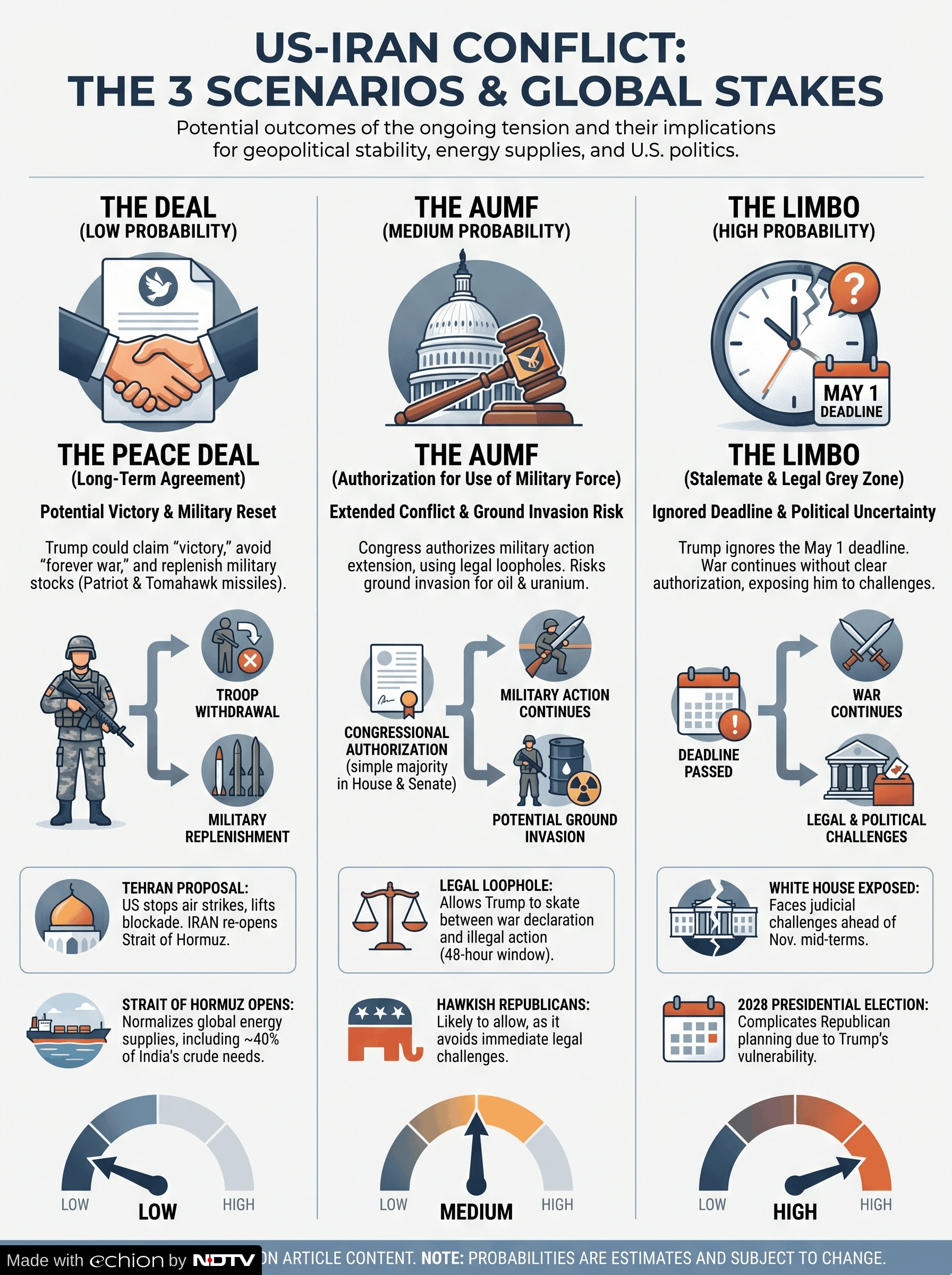
The AUMF is the legal backing Trump needs – and which hawkish Republicans seem happy to allow – to skate in-between declaring war and military action becoming illegal in 48 hours.
Probability: Medium. The Republicans have the number and an AUMF needs only a simple majority (over 50 per cent or half those voting) in the House and Senate to pass.
Limbo
A stalemate. The May 1 deadline comes and goes. Trump ignores it. The war continues.
This leaves the Congress and the White House in a legal grey zone, and is possibly the outcome Trump will be least happy with since it exposes him to judicial and political challenges ahead of the November mid-term. It is also likely an outcome the Republicans’ won’t like since Trump being exposed to attacks complicates their planning for the 2028 presidential election.
Probability: High.
3,2,1…
Three scenarios. Two deadlines. One war. And a president who doesn’t like any result he can’t call a win.