

Thiruvananthapuram:
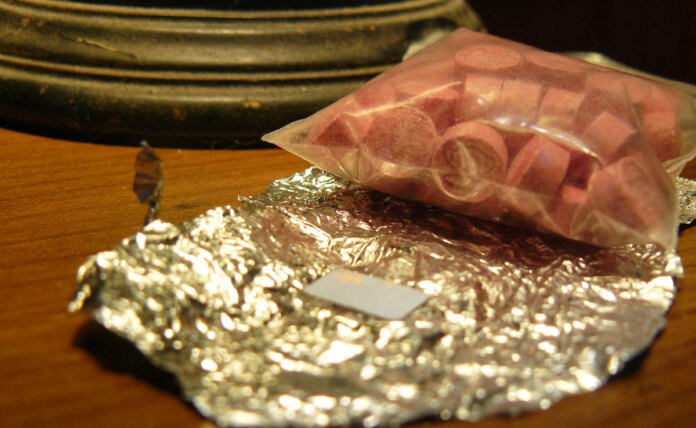
On April 23, a car was pulled up at Kerala’s Pantheerankavu toll plaza by excise officials for inspection. Approximately 3.5 kilograms of MDMA, worth Rs 3 crore and 56-gram pills, concealed in a hidden chamber.
Two people were arrested – Fathima Nasreen, a 20-year-old social media influencer with 25,000 followers, and P K Shafeeq, a 29-year-old repeat offender from Kondotty.
Preliminary probe revealed it was sourced directly from Rajasthan and the couple drove all the way from the border state to sell it at a main distribution hub at Ramanattukara in Kozhikode.
Local reporters in Kozhikode said Fatima showed no remorse, expressing no embarrassment or anxity as cameras pointed at her.
The case is a stark reminder of systemic failure, about how a trafficker once caught and released resurfaces with bigger quantities and younger women operatives, cases remain buried in files and the frustration of a retired enforcement officer.
On the same day, not so far away, 21-year-old Sheetal Shivadas was caught along with Firoz Moosa (29) with 11.83 grams of MDMA and 5.44 grams of cannabis, recovered from an apartment in Ulliyeri near Malabar Medical College. In the apartment, packaging materials and electronic scales found, indicating distribution operation.
Last year, Yasar Arafath, 34, and youtuber Rincy Mumtaz, 32, both from Kozhikode, were nabbed from Kochi, with 22 grams of MDMA and similar case of girl being active partner in drug trade was revealed.
The Ghost Keeps Coming Back
Anilkumar T, retired Assistant Excise Commissioner and former head of the State Excise Enforcement Squad, was watching the news when his phone rang. A junior officer asked, “Is this the same Shafeeq we caught before?”
He knew immediately. “Two to three years ago, we caught him in a Bolero jeep with a hidden chamber smuggling ganja from Andhra Pradesh,” Anilkumar recalls. During that 2023-24 bust in Wayanad’s Mananthavady region, Shafeeq threw Rs 15 lakh cash into a well and absconded.
“He should have faced serious charges. But somehow he is out. And now he has dealt 3.5 kilograms of MDMA in 2026,” he said.
Why was a repeat offender with a prior criminal record free to operate again? And more importantly, how did he escalate from cannabis smuggling to synthetic drugs? The answer points to structural gaps in Kerala’s drug enforcement system.
The Malabar Corridor
When asked where Kerala’s drug problem is concentrated, Anilkumar says, “Malabar region. Kozhikode specifically. Then Kochi.” Due to closer proximity to Bengaluru-Mysore corridor, both cities function as transit hubs. Kochi has port access and strong air connectivity. Kozhikode connects multiple interstate road corridors linking Tamil Nadu, Karnataka and Andhra Pradesh, especially Bengaluru where MDMA is manufactured.
“The real manufacturers are in Bangalore. The real distributors operate out of Delhi. What we are catching are street retailers,” he says.
Out of every 100 cases, he adds, perhaps only one investigation moves beyond the arrest point. Most cases stop at the courier level. Supply chains remain intact.
Shift From Marijuana To MDMA
To understand why Shafeeq shifted from marijuana to MDMA, investigators point to developments outside Kerala, particularly in Andhra Pradesh and Odisha, once among India’s largest cannabis supply belts.
For decades, marijuana cultivation thrived across forest regions there with the protection of entrenched trafficking networks that operated in areas influenced by the Maoist movement. The terrain, weak state presence and insurgent control created conditions that allowed cultivation and transport to continue largely undisturbed.
That ecosystem began to collapse over the past few years. Sustained anti-Maoist operations by the Centre weakened insurgent influence across large parts of Andhra Pradesh and Odisha. As enforcement tightened, cannabis cultivation across nearly 10 to 11 districts was systematically destroyed by early 2025. What had once functioned as a stable supply corridor for traffickers across southern India became increasingly risky and commercially unviable.
“They had to find alternatives,” Anilkumar explains. “MDMA production in Bangalore already existed. Networks simply shifted.”
The economics favour synthetic drugs. Marijuana is bulky and difficult to conceal. MDMA is compact and easier to transport. Two kilograms of cannabis requires space. Two kilograms of MDMA can be hidden inside a small compartment. “A trafficker who moved 50 kilograms of marijuana can now move 2 to 3 kilograms of MDMA and make similar profit with far lower detection risk,” he says.
“Women attach long finger nails and hide drugs under these nails wrapped in transparent foils. It makes detection difficult,” he says.
The weakening of traditional marijuana supply zones and the rise of urban synthetic drug labs together accelerated this transition, reshaping trafficking routes that now increasingly pass through Kerala.
Calculative Use Of Young Women
Sheetal Shivadas’ case is not rare. The Kozhikode arrests in April fit into a pattern that investigators say has been emerging steadily across Kerala’s narcotics cases over the past 18 months.
In January 2025, in Mattancherry in Kochi, a woman identified as Ayesha, aged 39, was arrested along with her partner after officials recovered 300 grams of MDMA, 6.8 grams of cannabis and Rs 3 lakh in cash. Investigators later traced possible international supply links connected to Oman.
Two months later, in March 2025, a pre-dawn raid on a hotel room in the Fort Kochi-Mattancherry region led to the arrest of two women and three men with another 300 grams of MDMA. Among those arrested was Maggie Ashna, a Keralite who had migrated to Oman for employment and was allegedly recruited into the trafficking network with the promise of Rs 1 lakh per trip to transport MDMA into Kerala. She was arrested during her first attempt.
In May 2025, a similar pattern surfaced in Thrissur when Deekshitha, aged 22, was arrested alongside a 30-year-old repeat offender after officials seized 180 grams of MDMA. Investigators said she was involved in local distribution, while logistics and sourcing remained with senior operatives.
The pattern continued in December 2025 in Kakkanad in Kochi, where Kalyani PS, aged 22 and working as a movie promoter, was arrested during a hotel raid with 20.22 grams of MDMA. Officials said she had earlier been linked to similar networks and remained vulnerable to re-recruitment despite prior enforcement action.
Over less than 18 months, at least six major MDMA seizures in Kerala involved women positioned at visible points within the supply chain. Some appeared to be first-time offenders, while others had prior exposure to enforcement action.
Traffickers are using young women, with many of them turning suppliers for quick money and a flashy lifestyle. Others are driven by the poverty they have witnessed. “These are not accidental choices,” Anilkumar says. “Networks identify who they can recruit and position each person strategically.”
“Why young women?” Anilkumar asks. “Because the calculation is strategic. A woman at a checkpoint faces less scrutiny. A woman on a campus is trusted by students. A social media influencer provides legitimacy and poverty makes them vulnerable.” Officials say women provide easy access to entertainment or youth networks.
There is also an element of control. “Once dependency begins, walking away becomes difficult. She is trapped between trafficker and the law,” he says.
Why Investigations Stop At Street Level
When Shafeeq was arrested in 2023-24, investigators had evidence of hidden chambers, interstate sourcing and organised smuggling routes. By enforcement standards, it was a strong case.
Yet he returned to supply and distribution of drugs. “The system is not designed to monitor repeat drug offenders after release,” Anilkumar says. The chargesheet must be filed within 180 days after their arrest. Most of the time, this lapses and those who come out return to the trade.
Earlier investigations also did not move upstream to identify suppliers outside the state. Interstate coordination requires time and administrative clearance. Tracking MDMA networks would have required investigations into Bangalore-based labs and foreign-linked operators. “It is easier to arrest the street-level courier,” he says. The network survives.
The retired officer blames the current leadership in excise enforcement. “Senior leadership prioritises administrative politics over narcotics control. Excise department is sidelined from its core mandate – enforcement – and that is why no one has the capacity to catch the big fish in the excise department,” Anilkumar says.
“As long as law doesn’t catch up with the Nigerian syndicate in Bengaluru who are manufacturing it, these drug syndicates will thrive,” he lamented.