

Jaipur:
It was called Operation Vishgrahan, or “sniffing out the poison.” A codename inspired by modern-day drugs that are often sniffed or inhaled as a method of consumption. It became the Rajasthan Police Anti-Narcotics Task Force’s most dramatic drug bust, one that involved an exchange of fire between police and smugglers, and led to the arrest of six hardened criminals in a network spanning several states.
But how did the police reach a remote village along the Jodhpur-Jaisalmer highway, in the fields of Balesar, only to uncover a full-fledged factory manufacturing MD drugs worth crores in an isolated location?
Police sources say the gang caught in Balesar were seasoned smugglers with prior criminal records. Hapu Ram, the kingpin, had been jailed twice between 2015 and 2018 in Jodhpur, and again in 2019 and 2024 in Udaipur. He had always been on the police radar.
“Once a criminal learns how to make money through crime, he is rarely satisfied with honest earnings. That is why drug traffickers with criminal backgrounds remain on our radar, even after they leave jail,” IG ANTF Vikas Kumar said.
According to Vikas Kumar, this is precisely why Hapu Ram was kept under continuous surveillance. The 28-year-old from Barmer began his criminal career trafficking doda chura, a variant of poppy straw, a by-product of opium harvesting. Initially part of a larger network, Hapu Ram eventually branched out after serving jail time. He built his own syndicate, handpicked his team, many of them former associates, and moved into a more lucrative and dangerous drug: MD.
The police first got a clue about his activities through a social media app the gang used to communicate. They began tailing him. After nearly six weeks of surveillance, they decided to launch Operation Vishgrahan. Commandos of the Anti-Narcotics Task Force left Jodhpur shortly after midnight on April 25.
At around 1 am, they reached Balesar. And then began the most challenging phase. The MD drug unit was located in a small field, nearly 1.5 km away from any human habitation. To avoid detection, the force literally crawled for three hours to reach the site.
The under-construction structure stood on slightly elevated ground, giving the smugglers a clear view of any approaching movement. After surrounding the factory, the police called out to the men inside to surrender.
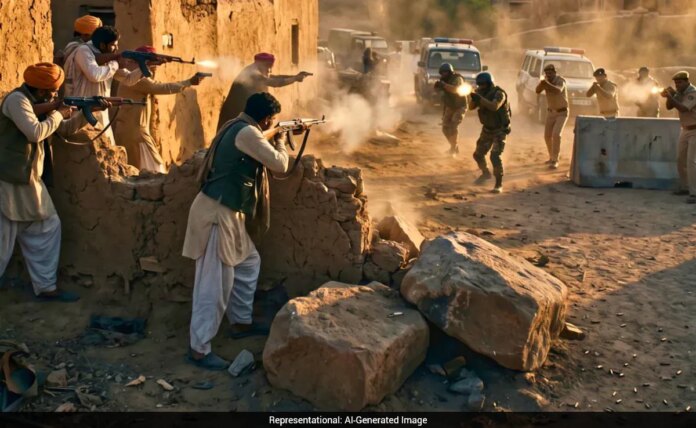
But Hapu Ram, along with Arjun, who was in charge of security, had taken position on the roof. From there, they opened fire on the police. It was pitch dark. Meanwhile, four others on the ground attempted to flee. The police repeatedly warned the men on the roof, “Put your pistol down and come down slowly or you will be shot. If you surrender, you will have another chance at life.”
But Hapu Ram and Arjun refused to give in. What followed was an exchange of nearly 15 rounds of fire. In a desperate attempt to escape, both men jumped from the roof. Arjun was quickly overpowered, and his weapon, a replica foreign-made pistol with a high-capacity magazine, was seized.
Hapu Ram tried to flee under the cover of darkness, but was caught after injuring his leg during the jump. Both sustained injuries while attempting to escape. Inside the under-construction building, the police found large quantities of MD drugs in the process of being manufactured. A total of 176 kg was recovered and laid out to dry before being processed further for supply.
The estimated value: nearly Rs 90 crore, with each kilogram selling for around Rs 30 lakh.
The Anti-Narcotics Task Force had Hapu Ram and his associates under surveillance. However, the gang communicated only through encrypted social media apps, making it difficult to trace their exact location. So investigators shifted focus to the supply chain. A key component in the manufacture of MD drugs is ice.
The breakthrough came when police identified unusually large consignments of ice being delivered to a remote location in Balesar. That was the clue they needed. Once confirmed, the police moved in, launching the raid that led to the arrest of six smugglers caught red-handed, and the seizure of drugs in the middle of production.
Hapu Ram was the kingpin, the one who recruited the others. Naresh served as the chief chemist. Arjun, a local from Balesar, handled security and was the one who opened fire during the raid. The others, Shrawan and Budhram, assisted the chemist and managed deliveries. Narendra was in charge of production. He had previously served time in a Hyderabad jail and was an experienced member of the syndicate.
A common link among many of them was Dhorimanna in Barmer, a region where several members either belonged or had family connections. Interestingly, investigators found that all the accused used iPhones to evade surveillance. These devices allowed them to communicate via encrypted apps that are difficult to track through conventional mobile tower data.
The under-construction building located in an isolated agricultural field belonged to Jiya Ram, Arjun’s uncle. It had been leased to the syndicate for Rs 2.5 lakh, far above its actual value of around Rs 5,000.
Jiya Ram was not present during the raid and reportedly fled after hearing the gunfire. The Anti-Narcotics Task Force believes it has dismantled a crucial segment of the MD drug network in Rajasthan.
In this network, chemicals are sourced from Gujarat and Maharashtra, processed in isolated locations across districts such as Jodhpur, Sanchore, Barmer, and Jalore, and then trafficked outward.
Once manufactured, the drugs are routed through Gujarat to Maharashtra and other states. From Bikaner in the north, they are further distributed to Punjab and other northern regions.
In the past year alone, 33 MD drug factories have been busted in Rajasthan, 31 of them in this belt covering Jodhpur, Jalore, Sanchore, and Barmer.